

Collaborative Financial Planning: 10 Powerful Benefits 2025
Why Collaborative Financial Planning Is Changing Client Relationships
Collaborative financial planning is a partnership approach where advisors and clients work together throughout the planning process, using interactive tools and ongoing dialogue to create, test, and refine financial strategies in real-time.
Key Elements of Collaborative Financial Planning:
– Active client participation in goal-setting and scenario analysis
– Live plan modeling during meetings using interactive software
– Transparent assumption review and recommendation refinement
– Ongoing plan updates rather than static annual reports
– Shared decision-making through client portals and regular touchpoints
This approach differs dramatically from traditional planning where advisors create comprehensive reports behind closed doors and present finished plans to clients. Instead, collaborative planning treats financial planning as an ongoing conversation rather than a one-time deliverable.
The results speak for themselves. Research shows that 78% of consumers want active involvement in their financial planning process. When clients feel truly engaged, their trust in their advisor strengthens by 85% and they become 74% more likely to refer others to the practice.
Why does this matter for independent advisors? Collaborative planning creates deeper client relationships, drives organic growth through referrals, and positions you as a trusted partner rather than just a service provider. It’s also what today’s clients increasingly expect from their financial relationships.
I’m Ray Gettins, Director at United Advisor Group, where we’ve helped hundreds of advisors transition to more collaborative, client-centered practices that prioritize flexibility and true fiduciary service. Through our work with elite advisors, I’ve seen how collaborative financial planning transforms both client outcomes and practice growth.
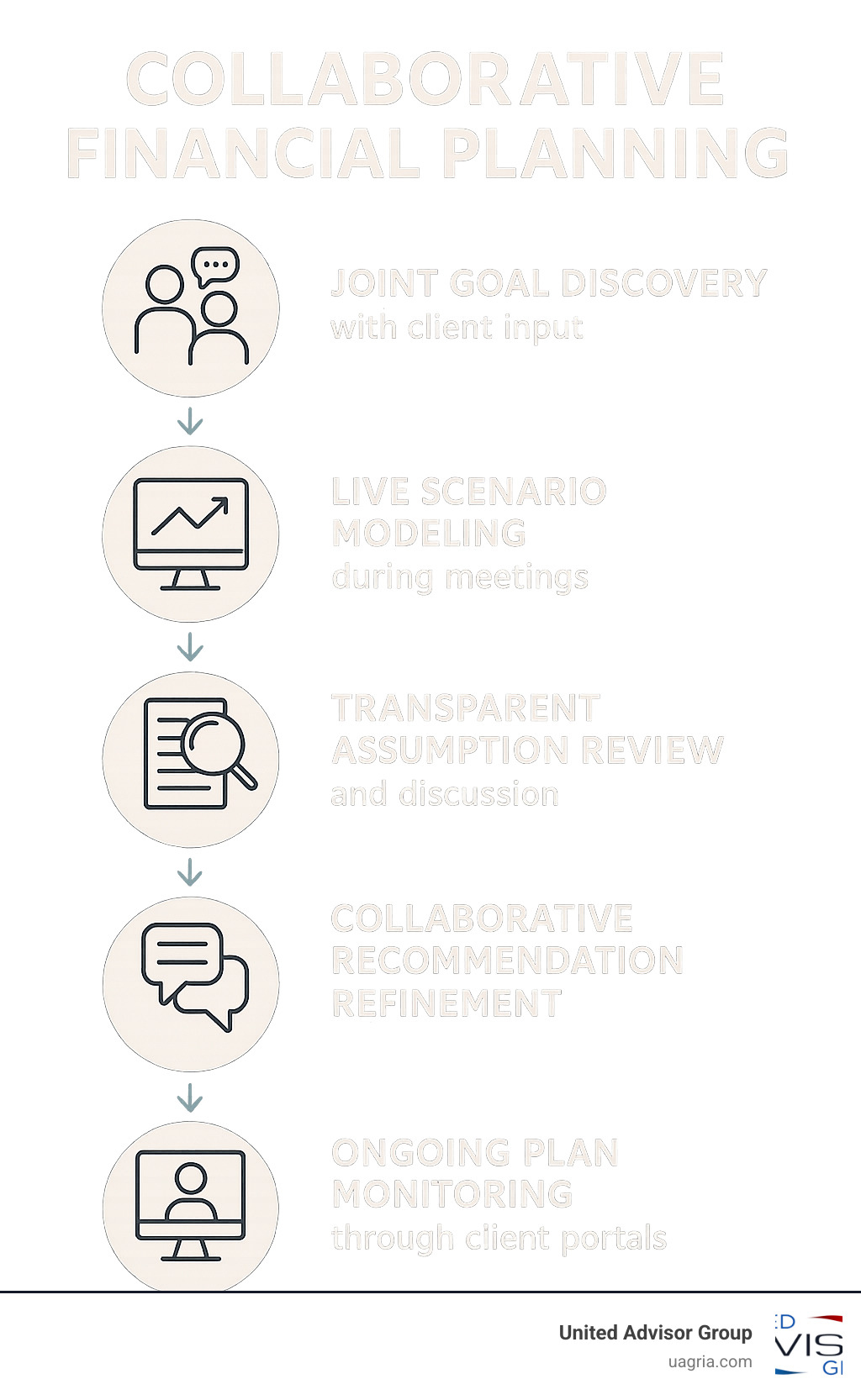
Collaborative Financial Planning Explained: Definition, Principles & Benefits
Picture this: You’re sitting across from your financial advisor, watching your retirement projections change in real-time as you discuss working an extra year versus taking that dream trip to Italy. Instead of waiting weeks for a revised report, you’re seeing the numbers adjust instantly on the screen between you.
This is collaborative financial planning in action – and it’s changing everything about how advisors and clients work together. If you’d like a refresher on the broader discipline, the Wikipedia entry on financial planning offers a concise overview.
At its heart, collaborative financial planning transforms you from a passive recipient of financial advice into an active partner in creating your financial future. Think of it like cooking a meal together instead of just being served the final dish.
The magic happens through five core principles: Client empowerment through active participation means your voice shapes every major decision. Transparency in every assumption and recommendation ensures nothing happens behind closed doors. Real-time plan adjustments based on your feedback keep everything current. Continuous dialogue replaces dreaded annual meetings. Finally, shared accountability means we’re both invested in making your plan work.
The results speak for themselves. Recent research shows that 61% of clients working with highly collaborative advisors experience genuine peace of mind compared to just 41% using traditional planning approaches. Even better, advisors who accept collaborative activities see 33% more annual referrals than their less collaborative peers.
How Collaborative Financial Planning Differs From Traditional Planning
Traditional financial planning treats you like a patient receiving a diagnosis rather than a partner in creating solutions. You hand over documents, answer a questionnaire, then wait weeks for a comprehensive report you’ve never seen before.
Collaborative financial planning flips this approach upside down. Instead of working in isolation, your advisor brings you into the process from day one. Rather than assuming you’ll retire at 65, you explore multiple scenarios together during meetings, seeing immediately how each choice affects your ability to travel, help your kids, or pursue hobbies.
The real-time modeling during meetings means you can ask “what if” questions and get instant answers. This active involvement creates something traditional planning rarely achieves: genuine excitement about your financial future.
Key Touchpoints in Collaborative Financial Planning
- Goal finding and prioritization goes far deeper than typical retirement conversations. We explore what truly matters through interactive exercises that help you articulate not just what you want, but why it matters.
- Live scenario testing transforms theoretical discussions into visual, immediate experiences. During meetings, we model different scenarios in real-time so you can see exactly how various decisions play out.
- Assumption review and validation ensures every foundation of your plan makes sense personally. We review assumptions about inflation, investment returns, and spending patterns together, adjusting them based on your actual experience.
- Recommendation refinement happens collaboratively. If a strategy doesn’t feel right, we explore alternatives together until we find approaches that align with your personality and circumstances.
- Ongoing plan monitoring through secure client portals keeps you connected between meetings. You can track progress toward goals and communicate whenever questions arise.
These touchpoints create what researchers call “improved client engagement.” Clients using collaborative approaches show a 92% increase in commitment to maintaining their advisory relationship and experience a 35-point increase in trust when working with interactive planning tools.
Step-By-Step Implementation Guide
Making the switch to collaborative financial planning is straightforward when broken into manageable phases. Think of it like learning to dance with a partner – with practice, you find your rhythm and start moving together beautifully.
Getting started means rethinking your onboarding process. Instead of clients disappearing for weeks after providing documents, collaborative planning keeps them engaged from day one. You’re involving clients in validating their information and confirming that the picture you’re building matches their reality.
Goal creation becomes a true partnership. Instead of assuming what clients want based on demographics, you’re facilitating interactive sessions that help them find and articulate their own priorities. That conservative 55-year-old might dream of starting a nonprofit. That young professional might prioritize caring for aging parents over maximizing retirement savings.
Live scenario analysis transforms planning meetings from presentations into collaborative workshops. You’re modeling different possibilities together in real-time. Clients can see the impact immediately and help shape the solutions.
Implementation becomes shared accountability. Instead of handing over a to-do list, you’re working together to prioritize next steps and create realistic timelines. This collaborative approach leads to much higher completion rates on recommended actions.
For more guidance on finding advisors who truly understand collaborative approaches, our key considerations for selecting a financial advisor can help you identify the right partnership.
Preparing Your Firm & Clients
Setting clear expectations upfront prevents confusion later. Your clients need to understand that collaborative planning requires more involvement initially but creates much better long-term outcomes. Be honest about the time commitment while explaining how this investment pays off in plans that actually fit their lives.
Communication becomes the heartbeat of collaboration. Research shows that collaborative planners update client plans for 42% of clients annually, compared to just 32% for traditional approaches. This means you need clear protocols: monthly progress updates through secure portals, quarterly reviews with live scenario modeling, and annual comprehensive updates.
Technology serves the relationship. When clients actively use portals for collaboration, their trust in advisors increases by 35 points. The best portals make it easy to share documents, track goal progress, and access educational resources.
Collaborative Financial Planning Workflow
The most effective collaborative financial planning follows a five-step framework that balances client engagement with professional efficiency.
Interactive findy replaces traditional fact-finding. You’re using collaborative tools to facilitate genuine conversations about values and priorities through visual exercises and structured dialogues.
Live plan building happens during client meetings. Using screen-sharing and interactive planning software, you’re constructing the initial plan framework together. Clients can see every assumption and provide input that shapes recommendations.
Scenario stress-testing becomes collaborative exploration. Together, you’re testing the plan’s resilience by modeling various possibilities. This builds confidence by showing how the plan adapts to different circumstances.
Refinement happens through partnership. Based on scenario results, you’re working together to adjust recommendations rather than presenting predetermined solutions.
Implementation becomes shared accountability with realistic timelines and tracking systems created together.
Best Practices & Cultural Foundations
The fiduciary mindset becomes more important. Collaborative financial planning embodies the highest fiduciary standards by ensuring clients are truly informed partners in their financial decisions.
Active listening transforms from nice-to-have to essential. You’re asking open-ended questions, reflecting back what you hear, and acknowledging emotions alongside facts and figures.
Transparency becomes your competitive advantage. Every recommendation comes with clear explanations. Plan projections include discussions of underlying assumptions. You’re addressing potential conflicts of interest openly.
Continuous education strengthens the partnership. You’re providing resources that help clients understand planning concepts while building their financial confidence.
Research reveals that highly collaborative advisors represent just 19% of the industry but see dramatically higher referral rates and client satisfaction scores.
Technology, Tools & Budgeting Applications
Choosing the right technology can make or break your collaborative financial planning efforts. The good news? There are excellent platforms that have proven themselves in real collaborative environments.
eMoney leads the pack with 42.7% adoption among collaborative planners, largely thanks to its Decision Center feature that lets you model scenarios live during client meetings. MoneyGuidePro comes in second at 31.9% adoption, with their Play Zone feature making financial planning feel more like exploration than homework. RightCapital, used by 23.9% of collaborative planners, offers visual planning experiences through their Blueprint feature.
For tax planning specifically, Holistiplan dominates with 80.8% adoption. This platform shines in collaborative tax strategy sessions where you can model different scenarios and show clients exactly how various moves affect their tax bill.
The technology landscape keeps evolving. ViziWealth is designed specifically for family collaboration with privacy controls. Cloud-based FP&A tools enable bottom-up budgeting where multiple stakeholders contribute input. AI-powered dashboards provide real-time insights that make scenario modeling faster and more accurate.
According to recent financial planning technology research, while forecasting speed has improved significantly, with many organizations now producing forecasts in under two business days, 51% still take five days or more. This highlights why choosing platforms built for real-time collaboration matters.
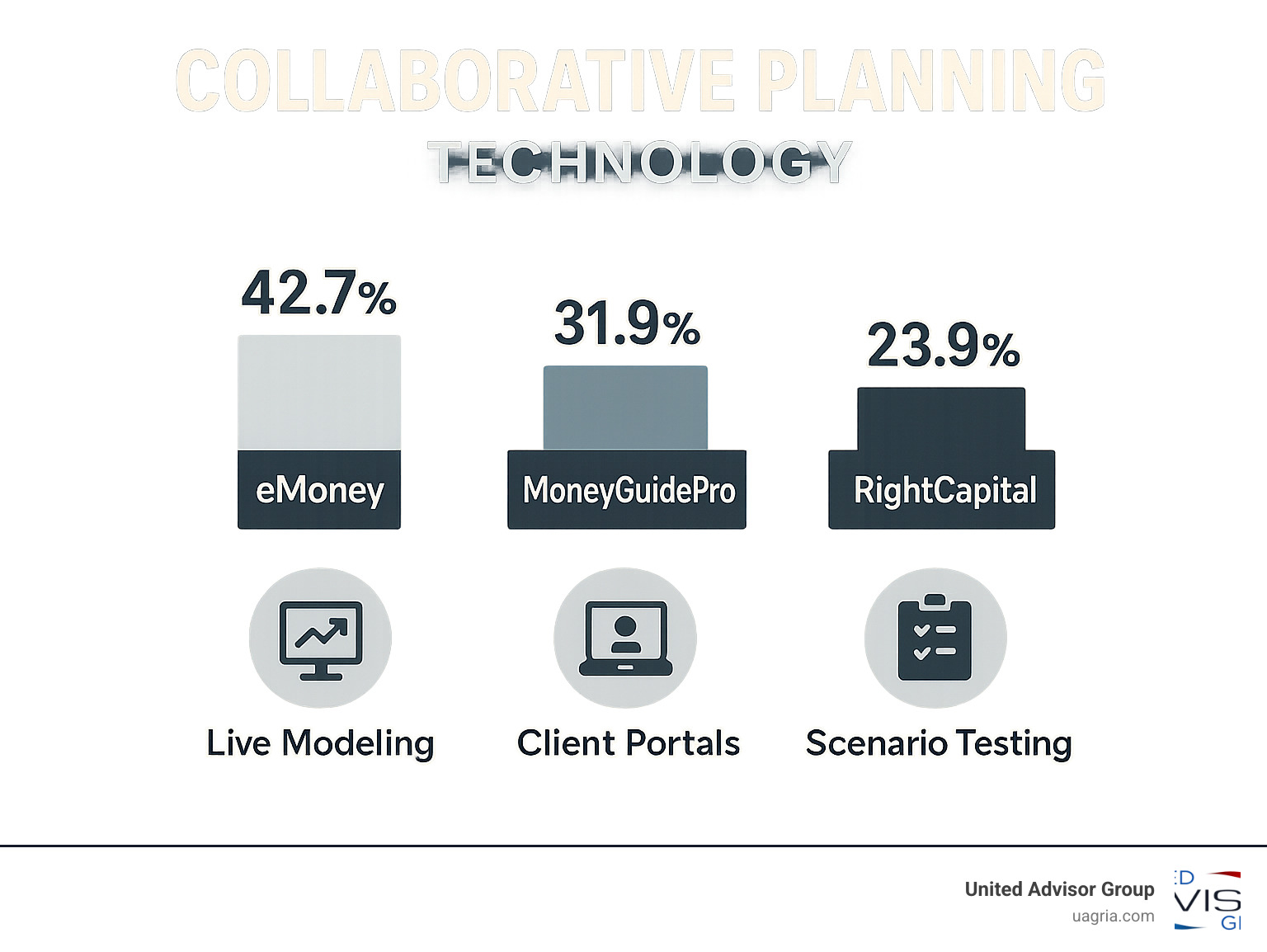
Choosing the Right Collaborative Tech Stack
Integration capabilities should be your first consideration. Your planning software needs to work with your CRM, portfolio management system, and custodial platforms. Disconnected systems create awkward moments during client meetings.
Ease of use matters enormously for both you and your clients. The best collaborative tools feel intuitive from the first login. If clients need a manual just to access their portal, you’ve lost half the battle.
Role-based access controls become crucial when sharing sensitive information. Your technology should let you control exactly what different users can see and modify.
Data security standards aren’t negotiable. Any collaborative platform must meet SOC 2 compliance standards and use bank-level encryption.
Real-time collaboration tools separate truly collaborative platforms from traditional planning software. Essential features include screen sharing capabilities, live scenario modeling, and the ability to save and share different planning scenarios.
Collaborative FP&A in Action
Collaborative financial planning principles work beautifully beyond individual client relationships. Many organizations are changing their internal budgeting and financial planning & analysis (FP&A) processes using these same approaches.
Bottom-up budgeting brings department leaders directly into the planning process, creating financial plans that reflect operational realities. Departmental input leads to dramatically improved accuracy because people closest to the work understand what things really cost. Stakeholder buy-in increases significantly when people help create the budgets they’ll be measured against.
The technology impact on accuracy is remarkable. Research shows that organizations with high technology acceptance see a 75% reduction in financial errors. This improvement comes from automated data consolidation, real-time collaboration, and eliminating endless spreadsheet shuffling.
The most successful collaborative FP&A implementations treat budgeting as an ongoing conversation rather than an annual ordeal. They establish clear roles, use cloud-based platforms for real-time collaboration, implement standardized processes, and set realistic timelines.
Challenges, Research Insights & FAQs
Collaborative financial planning isn’t always smooth sailing. While the benefits are substantial, there are real challenges that both advisors and clients face during implementation.
The most common problems include getting clients comfortable with new technology, maintaining professional standards while increasing client involvement, and addressing compliance concerns. Technology adoption presents the biggest initial challenge, as not every client accepts digital tools with the same enthusiasm.
Compliance concerns also worry some advisors. The answer is clear: involving clients more in the planning process doesn’t create regulatory issues as long as you maintain clear professional boundaries.
Here’s what makes these challenges worth tackling: 93% of highly collaborative advisors receive referrals from existing clients, compared to just 60% of their less collaborative peers. That’s a 33-percentage-point difference that translates directly to business growth.
Overcoming Common Pitfalls
Poor communication kills collaborative planning faster than anything else. The solution starts with setting clear expectations upfront about communication frequency, channels, and response times. Create standardized communication templates for common situations.
Commitment gaps happen when clients initially accept collaborative planning but fail to follow through. Combat this by starting small with achievable action items that build momentum. Use project management tools within your client portal to make progress visible.
Change fatigue affects both advisors and clients during transition. Don’t implement everything at once. Roll out collaborative planning in phases, starting with simple tools before moving to sophisticated workflows.
Research Highlights & Statistics
The data supporting collaborative financial planning gets stronger every year. Trust metrics show dramatic improvements – when clients use collaborative portals, their trust in their advisor increases by 35 points.
The business impact is equally impressive. Highly collaborative advisors achieve nearly double the assets under management compared to traditional counterparts. Complex plans developed collaboratively generate 21% more revenue, and these advisors see 33% more annual referrals each year.
Client satisfaction reaches new levels with collaborative planning. 61% of clients working with highly collaborative advisors report genuine peace of mind, compared to just 41% with traditional approaches.
Collaborative planning is actually more operationally efficient. These advisors spend a median of 15 hours per client in the first year, compared to 19 hours for traditional custom plans.
FAQ #1 – Is collaborative financial planning more time-consuming?
This might surprise you: collaborative planning actually saves time when implemented correctly. Collaborative planners spend a median of 15 hours per client in the first year, while traditional custom plans require 19 hours.
Why? When clients help create planning assumptions, there’s less rework needed. Shared preparation makes meetings more productive. Live scenario modeling eliminates multiple presentation meetings. The efficiency gains continue long after the initial plan because collaborative clients need less hand-holding during implementation.
FAQ #2 – How does technology keep my data secure?
Bank-level encryption (256-bit SSL) secures all data transmission and storage. Role-based access controls give you granular control over information sharing. SOC 2 Type II certification represents the gold standard for financial services technology. Multi-factor authentication requires multiple forms of verification before allowing access.
Professional monitoring gives cloud-based platforms advantages over local systems with 24/7 security teams and multiple backup copies across geographic locations.
FAQ #3 – Can collaborative planning work virtually?
Virtual meetings have actually improved collaborative financial planning. Screen-sharing capabilities let clients watch scenario modeling in real-time. Digital whiteboards enable collaborative brainstorming. Secure client portals create continuous engagement rather than episodic interactions.
Hybrid approaches work particularly well – virtual meetings for routine updates and scenario modeling, in-person meetings for major planning milestones. This provides flexibility while maintaining personal connection.

Conclusion
Collaborative financial planning represents the future of our industry – one where clients are true partners in creating their financial success rather than passive recipients of advice. The research is clear: this approach creates stronger client relationships, better outcomes, and more sustainable advisory practices.
At United Advisor Group, we’ve built our platform specifically to support advisors who want to accept collaborative approaches without the constraints of proprietary products or broker-dealer compliance burdens. Our independent model gives you the freedom to choose the collaborative tools and processes that work best for your clients.
The evidence supporting collaborative financial planning is overwhelming. 78% of consumers want active involvement in their financial planning, and when they get it, their trust in their advisor increases by 85%. These engaged clients become 74% more likely to refer others and show a 92% increase in commitment to maintaining their advisory relationships.
Think about what this means for your practice. Instead of constantly prospecting for new clients, you could be building a referral-based business where satisfied clients become your best marketing team. Instead of struggling with client retention, you could be creating relationships so strong that clients wouldn’t dream of working with anyone else.
The transition to collaborative financial planning doesn’t happen overnight, but the advisors who make this shift are building more resilient, profitable, and fulfilling practices. They’re also delivering the kind of personalized, transparent service that today’s clients increasingly expect.
Your next steps are straightforward: Assess your current technology stack – do your planning tools support real-time collaboration? Evaluate your client communication processes – are you creating ongoing dialogue or just annual check-ins? Most importantly, consider your firm’s culture – does your approach truly prioritize client empowerment and transparency?
If you’re ready to explore how collaborative financial planning can transform your practice, we’re here to help. Our team understands the challenges of implementing new approaches while maintaining the high standards your clients deserve.
For more information about how our Registered Investment Advisor platform supports collaborative planning approaches, visit our guide to enhancing client relationships.
The future of financial planning is collaborative. The question isn’t whether this shift will happen – it’s whether you’ll lead it or follow it. We believe independent advisors who accept collaborative approaches today will build the strongest, most successful practices of tomorrow.

