

No Proprietary Products: 5 Powerful Benefits to Know 2025
Why the Shift to No Proprietary Products Matters for Today’s Advisory Landscape
No proprietary products are becoming the gold standard for advisors who want to put clients first. Here’s what you need to know:
Quick Definition:
– Non-proprietary products = Investment solutions available from multiple vendors without exclusive ownership restrictions
– Key benefit = Complete freedom to choose what’s truly best for each client
– Main difference = No conflicts of interest from selling in-house products
Why This Shift Is Happening:
1. Regulatory pressure – SEC Regulation Best Interest demands clearer conflict disclosure
2. Client awareness – Investors increasingly question advisor motivations
3. Better outcomes – Access to 600+ model portfolios vs. limited in-house options
4. Cost savings – Competition drives down fees when you’re not locked into one provider
The financial advisory world is experiencing a fundamental change. When Genetec surveyed organizations in 2023, 67% preferred non-proprietary systems specifically to avoid vendor lock-in and increase flexibility. The same principle applies to financial services – advisors want the freedom to recommend truly optimal solutions.
I’m Ray Gettins, Director at United Advisor Group, where we’ve built our entire platform around the no proprietary products philosophy because we believe advisors should never face pressure to sell anything other than what’s genuinely best for their clients.
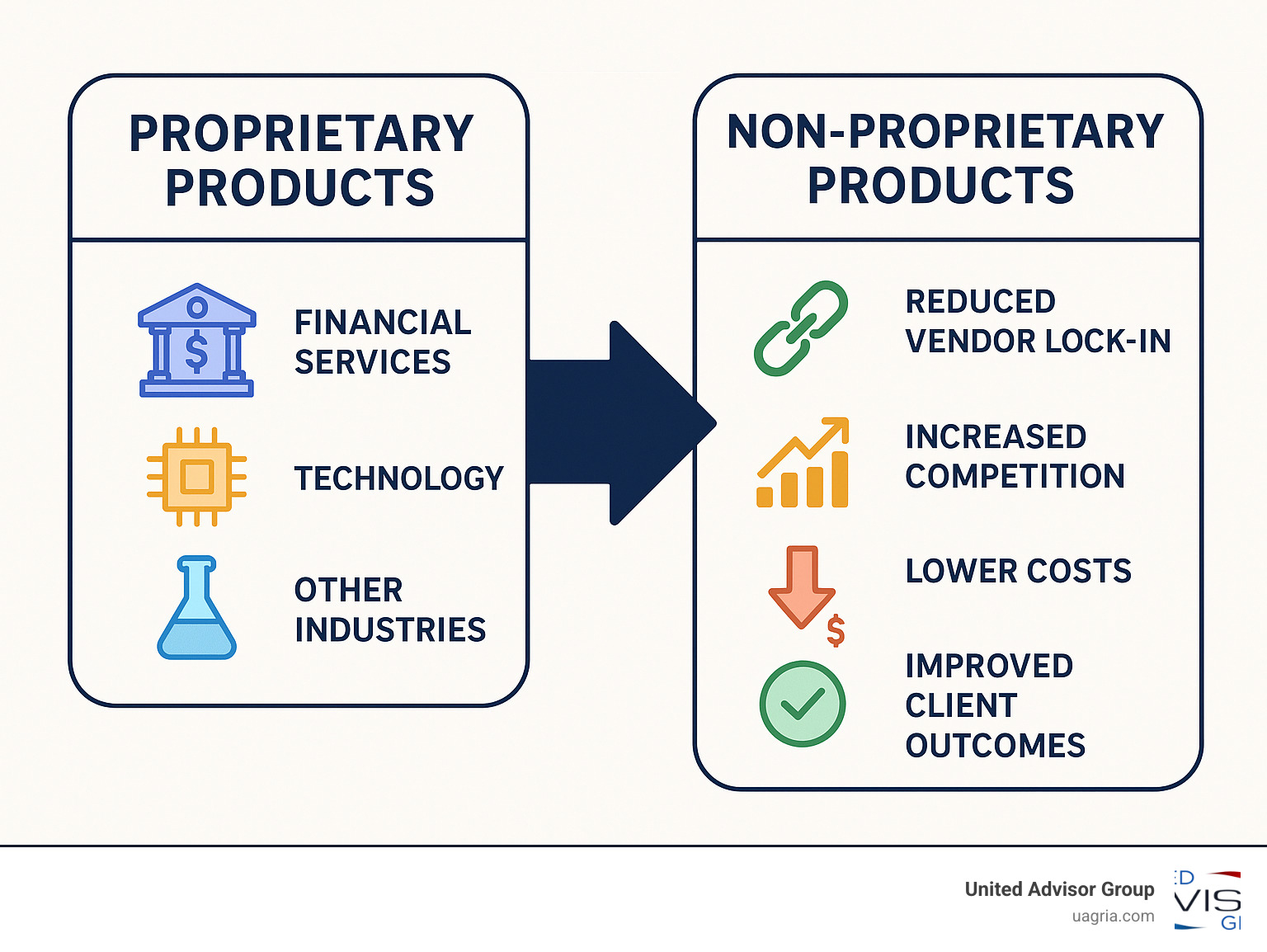
The Rise of No Proprietary Products: Definitions and Key Differences

Picture walking into a grocery store where you can only buy one brand of cereal – the store’s own brand. That’s essentially what proprietary products do to your choices. Now imagine a store with dozens of cereal options from different manufacturers, all competing on price and quality. That’s the beauty of no proprietary products.
What Exactly Are “No Proprietary Products”?
No proprietary products are solutions that aren’t owned or controlled by just one company. Think of them as the “generic” option in the business world – widely available, competitively priced, and not tied to a single provider’s agenda.
A proprietary investment platform is like having a phone that only works with one specific carrier’s network. A non-proprietary platform is like an open uped phone – you can choose any carrier based on coverage, cost, and customer service.
In financial services, this means access to the entire marketplace of investment options. Instead of being limited to one company’s mutual funds, advisors can tap into hundreds of investment managers and multiple custodial platforms.
How They Differ From Proprietary Counterparts
The difference goes beyond availability – it’s about freedom versus restrictions, choice versus limitation.
Closed systems create vendor lock-in. Once you’re in, switching becomes expensive and complicated. Imagine buying a coffee maker that only works with one brand of coffee pods – you’re committed to that brand’s pricing whether you like it or not.
Proprietary products often come with exclusivity requirements. In financial services, this might mean advisors can only recommend their firm’s investment products, even when better options exist elsewhere.
Non-proprietary solutions accept interoperability – they play well with other systems and providers. This means you can mix and match components based on what works best, not what one vendor wants to sell you.
For financial advisors, this translates to genuine independence. No pressure to meet sales quotas for in-house products. No conflicts between what’s profitable for the firm and what’s best for the client.
Benefits and Drawbacks of Going Non-Proprietary
Choosing no proprietary products isn’t just about philosophy – it’s about real dollars, flexibility, and outcomes for your clients. Like any business decision, it comes with both advantages and challenges.
Advantages for Consumers & Businesses
Competition drives down costs in surprising ways. When only one company can sell a product, they set the price. When five companies can offer the same solution, they compete for your business.
Flexibility becomes your superpower when you’re not locked into one vendor’s vision. If a custodian changes their fee structure or a technology provider shifts focus, you’re not trapped. You can adapt, switch, or find better alternatives without starting from scratch.
Innovation accelerates when products are built on open standards rather than proprietary systems. For advisors, this translates to access to cutting-edge portfolio management tools and investment strategies as soon as they’re developed, not when one company decides to include them.
Trust builds naturally when conflicts of interest disappear. Firms offering no proprietary products can credibly eliminate the inherent conflicts that arise when advisors are incentivized to recommend in-house solutions.
Freedom from vendor lock-in might be the most valuable benefit. You can negotiate better terms, demand better service, and switch providers if performance deteriorates – all without facing substantial switching costs.
Potential Limitations to Consider
Support can get more complex when working with multiple vendors instead of one integrated system. With proprietary solutions, there’s usually one phone number to call when things go wrong. Non-proprietary environments might involve coordinating between different providers.
The good news? This challenge often resolves itself as competitive support ecosystems develop around popular non-proprietary standards.
Integration requires more upfront effort than plug-and-play proprietary systems. Those seamless proprietary platforms do have an advantage in initial setup simplicity. Non-proprietary solutions may need additional configuration to achieve smooth operation.
Certification and compliance can be trickier when mixing and matching solutions rather than using pre-certified proprietary packages. Some regulatory requirements are easier to meet with established, all-in-one systems.
However, mature non-proprietary standards typically address these requirements through industry collaboration and standardization bodies.
More info about advisor independence
Industry Snapshots & Real-World Examples of No Proprietary Products
Sometimes the best way to understand no proprietary products is to see them in action. Across industries, forward-thinking companies are finding that open, non-proprietary solutions often deliver better results than their locked-down alternatives.
Technology & Manufacturing
RISC-V processors are revolutionizing the chip industry. This open instruction set architecture has attracted over 3,100 members worldwide. Unlike traditional processor designs that require hefty licensing fees, RISC-V is completely free and open.
Automotive companies developing self-driving cars can now customize processors for their exact needs instead of hoping a big chip company will prioritize their requirements. The same goes for AI startups and medical device manufacturers.
OpenEVSE electric vehicle chargers prove the DIY repair culture isn’t dead. They’ve shipped thousands of open-source charging units globally, and users love the freedom to customize, repair, and upgrade their stations without calling service technicians.
The security industry tells a similar story. Genetec’s 2023 survey found that 67% of organizations prefer non-proprietary security systems specifically to avoid vendor lock-in.
Financial Services & Advisory
This is where no proprietary products really shine. At United Advisor Group, we’ve built our platform around this philosophy because we’ve seen how it transforms the advisor-client relationship.
Conflict-free investment platforms give advisors access to hundreds of model portfolios from dozens of managers. Instead of being pressured to sell whatever their firm manufactures, advisors can choose investments based purely on what’s best for each client.
Fee transparency becomes automatic when you’re not trying to hide markup on proprietary products. Clients can see exactly what they’re paying for investment management, platform services, and advisory fees.
Custodial choice means advisors can select the custodian that best serves each client’s specific needs rather than forcing everyone into the same system.
Food, Health & Sustainability
Generic pharmaceuticals created the template for how no proprietary products can serve the public good. Same active ingredients, same therapeutic benefits, dramatically lower costs. Multiple manufacturers ensure supply chain resilience.
Natural hydrocarbon refrigerants demonstrate environmental benefits with Global Warming Potential of 3 or less and zero Ozone Depletion Potential. Unlike proprietary chemical refrigerants, these natural alternatives are widely available and don’t create supply chain vulnerabilities.
The pattern is clear: no proprietary products create more choices, better outcomes, and greater resilience.
Regulatory Landscape, Standards & How to Choose Wisely
The regulatory world is shifting toward transparency, competition, and putting clients first. This makes no proprietary products not just smart business, but often the easiest path to compliance.
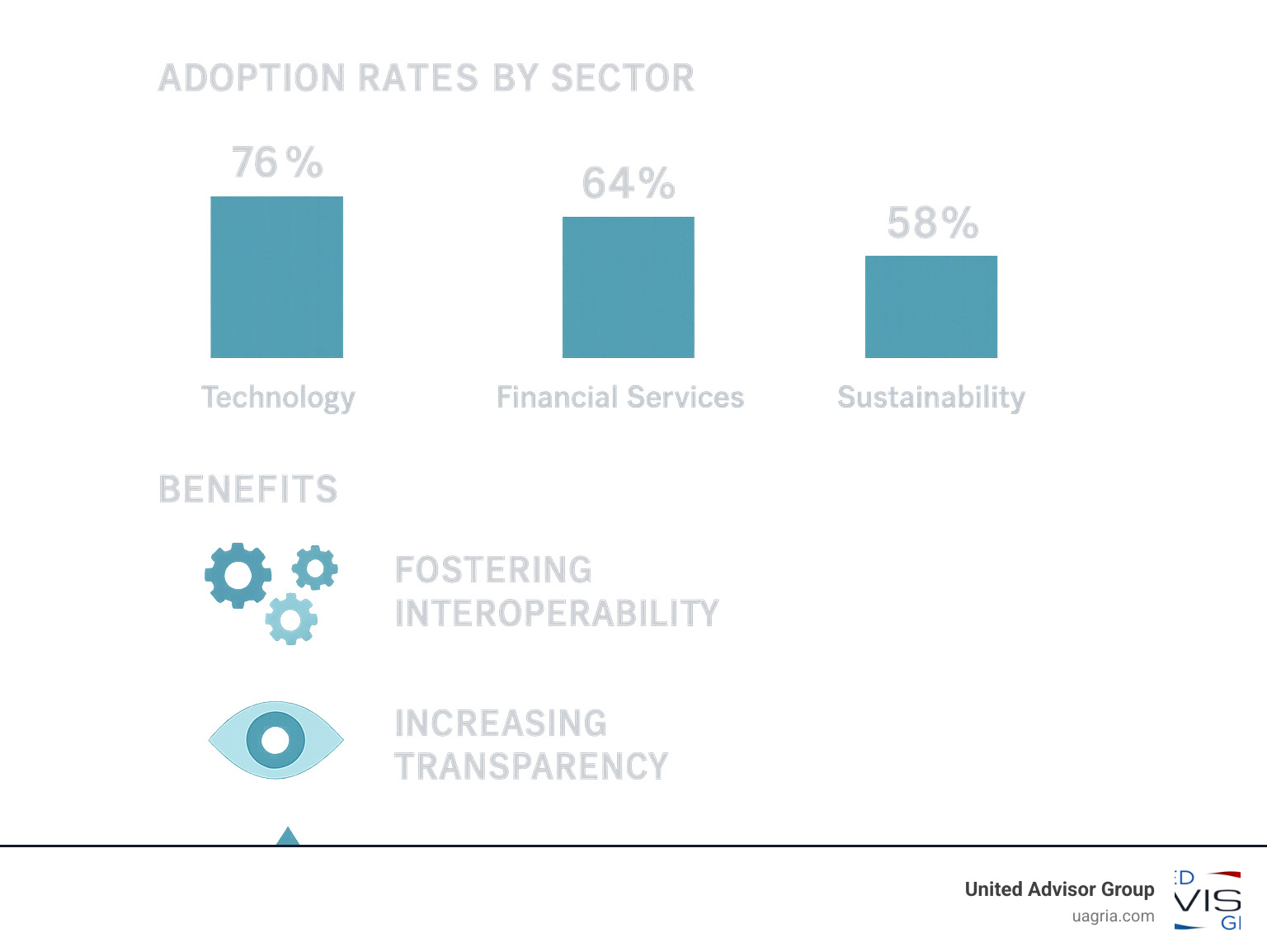
How Non-Proprietary Products Promote Competition & Innovation
The SEC Made Things Crystal Clear
When Regulation Best Interest took effect in June 2020, it required advisors to prove their recommendations actually serve client interests, not just company profits.
Here’s the beautiful thing about no proprietary products: they eliminate this headache entirely. When you have no financial incentive to push one investment over another, compliance becomes straightforward.
Competition Gets Government Support
The Federal Trade Commission has been quietly supporting the non-proprietary movement for years. Their mission revolves around protecting consumers through competition – exactly what happens when vendors can’t lock you into their ecosystem.
Standards That Actually Make Sense
International standards bodies like ISO/IEC have figured out something important: interoperability beats exclusivity almost every time. These organizations develop frameworks that help you evaluate systems based on performance rather than vendor relationships.
The legal framework around open-source licensing has matured beautifully too. Today’s licenses provide clear protection for both developers and users while ensuring improvements benefit everyone.
Practical Checklist for Selecting Non-Proprietary vs Proprietary Solutions
Start With What You Actually Need
Before getting impressed by features, define your real requirements. What problems are you trying to solve? What capabilities are absolutely essential versus merely nice to have?
Do Your Market Homework
Research available non-proprietary alternatives with the same rigor you’d apply to proprietary solutions. Compare feature sets, pricing, and support options across multiple providers.
Calculate the Real Costs
Total cost of ownership extends far beyond initial purchase prices. Factor in ongoing licensing fees, support costs, and maintenance expenses over your expected usage period.
Test Before You Commit
Implement small-scale pilots whenever possible. Test compatibility with existing systems and evaluate performance under realistic conditions.
Assess the Risks Honestly
Consider vendor stability and long-term viability for both proprietary and non-proprietary options. Evaluate support availability and quality from multiple angles.
The goal isn’t to choose non-proprietary products for ideological reasons. It’s to select solutions that serve your interests rather than vendor interests.
More info about selecting a financial advisor
Frequently Asked Questions about No Proprietary Products
Let’s tackle the most common questions about no proprietary products. These concerns are completely understandable – you want to make sure you’re making the right choice for your business and clients.
What impact do no proprietary products have on vendor lock-in?
No proprietary products are like having the keys to every door instead of being trapped in one room.
When you’re stuck with proprietary systems, switching vendors can feel like escaping from a maze designed to keep you inside. The vendor controls your data formats, requires specialized training that doesn’t transfer, and often makes moving your information so complicated that you just… don’t.
No proprietary products flip this dynamic completely. Since these systems use open standards and common data formats, your information stays portable. Your team’s skills transfer between vendors. Most importantly, vendors know you can leave – which keeps them honest about pricing and service quality.
How can an organization verify if a product is truly non-proprietary?
Here’s my practical test: ask about your exit strategy during the sales process. A truly non-proprietary provider will happily explain exactly how you can export your data, what standard formats they use, and how easy it would be to move to a different vendor.
Proprietary vendors tend to get uncomfortable with these questions. They’ll change the subject or give vague answers about “working with you” if you ever need to move your data.
Look for multiple independent providers offering the same service. If only one company can provide what you need, that’s a red flag. True non-proprietary solutions have thriving ecosystems with multiple vendors and support options.
Check the technical standards too. Non-proprietary products typically comply with industry standards like ISO specifications. They use common file formats rather than requiring special proprietary software to access your own data.
Do non-proprietary systems improve long-term sustainability?
Absolutely – and in more ways than you might expect.
Financially, non-proprietary systems protect you from vendor price manipulation. When you’re not locked in, vendors can’t suddenly double their fees just because they can. Competition keeps pricing reasonable and predictable.
Operationally, these systems make your business more resilient. What happens if your proprietary vendor gets acquired or goes out of business? With non-proprietary systems, you’re not dependent on any single company’s business decisions or survival.
The innovation benefits are huge too. Instead of waiting for one company to develop new features, you benefit from an entire ecosystem of providers competing to offer better solutions.
Skills and knowledge stay relevant across vendors with non-proprietary systems. Your team’s expertise doesn’t become obsolete when you change providers.
At United Advisor Group, we’ve built our entire platform around this sustainability principle. Our advisors aren’t trapped by proprietary products or forced upgrade cycles. They have the freedom to evolve their practices using the best available tools.
Conclusion
The movement toward no proprietary products isn’t just changing how we do business – it’s changing how we think about what’s truly best for clients. When you strip away conflicts of interest and vendor pressures, better outcomes become the natural result.
We’ve seen this change across industries. RISC-V processors are revolutionizing technology by letting companies innovate without paying tribute to chip giants. Generic medications deliver the same therapeutic benefits at a fraction of the cost. And in financial services, advisors finally have the freedom to recommend what actually works best.
The regulatory winds are blowing in this direction too. Regulation Best Interest isn’t going away – it’s getting stronger. Clients are asking tougher questions about conflicts of interest. The old model of pushing proprietary products while claiming to act in clients’ best interests is becoming harder to defend.
At United Advisor Group, we made this choice years ago because it just makes sense. Why would we want our advisors torn between what’s best for clients and what’s best for our bottom line? When you have access to hundreds of investment managers and multiple custodians, you can focus on the only question that matters: what’s truly right for this specific client?
Organizations using no proprietary products approaches report better client satisfaction, lower costs, and more flexibility. They don’t get trapped by vendor lock-in or forced into expensive upgrades. They can negotiate better terms because they’re not dependent on a single provider.
But here’s what really matters: trust. In an industry built on relationships, trust is everything. When clients know you have no hidden agenda – no proprietary products to push, no internal quotas to meet – they relax. They refer friends. They stick with you through market ups and downs.
The future is clear. Technology will keep getting more open. Regulations will keep demanding more transparency. Clients will keep getting smarter about conflicts of interest. The question isn’t whether this trend will continue – it’s whether you’ll be ahead of it or playing catch-up.
If you’re an advisor who’s tired of explaining away conflicts or defending recommendations you’re not completely sure about, there’s a better way. No proprietary products means no more internal pressure, no more compliance headaches, and no more wondering if you’re truly putting clients first.
Ready to see what genuine independence looks like? We’d love to show you how freeing it can be when your only job is helping clients succeed.

