

Why Financial Advisor Jobs Are Your Gateway to Independence
Financial advisor jobs are experiencing unprecedented growth, with strong demand across all experience levels. The market shows robust opportunities ranging from entry-level positions to senior advisor roles, with major financial institutions and independent firms actively recruiting.
Current Market Snapshot:
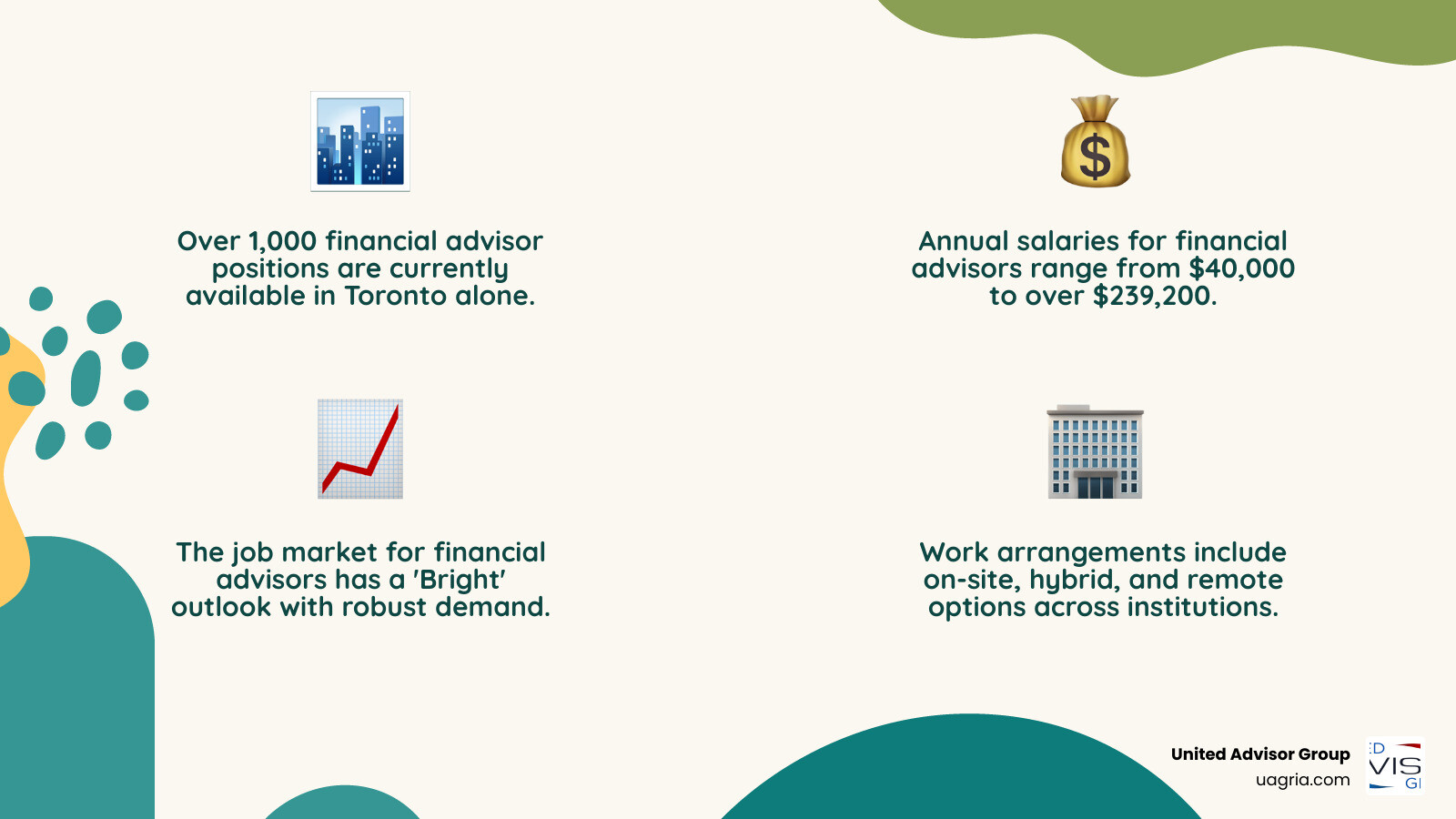
- 1,000+ financial advisor positions in Toronto
- 500+ mid-senior level opportunities
- Major employers: Large banks, insurance companies, and independent firms
- Salary ranges: $40,000 to $239,200+ annually
- Work arrangements: On-site, hybrid, and remote options
- Growth outlook: “Bright” with very likely new opportunities
The financial advisory landscape is evolving. Traditional broker-dealer models are giving way to independent platforms that prioritize advisor autonomy and client-focused service. As one industry expert notes, “Our structure is designed to help already exceptional advisors become even better… the strength is the collaboration within the group.”
Modern advisors want a true partnership that eliminates proprietary product pressures and maximizes earning potential. The shift toward independence reflects a desire to build their own practices while maintaining comprehensive support.
I’m Ray Gettins, Director at United Advisor Group, where we’ve created a structure designed by advisors for advisors. Having worked extensively with financial advisor jobs and career transitions, I understand the challenges advisors face when seeking greater independence and better compensation.
Quick Financial advisor jobs definitions:
What to Expect: The Modern Financial Advisor Role
Picture this: you walk into your office, and instead of dreading another day of pushing products that don’t quite fit your clients’ needs, you’re genuinely excited about the conversations ahead. That’s what financial advisor jobs should feel like – and increasingly, that’s what they’re becoming.
The modern financial advisor role has evolved far beyond the old-school “sell first, advise second” approach. Today’s advisors are true partners in their clients’ financial journeys. Your days will be filled with meaningful client relationship management, crafting personalized financial strategies that build lasting trust. The beauty of modern advisory work lies in its variety. One morning you might be analyzing market trends, while the afternoon finds you walking a young family through their first comprehensive financial plan. You’ll leverage cutting-edge technology, but the heart of what you do remains deeply human – helping people achieve their dreams.

Core Responsibilities Beyond the Job Description
An advisor’s day-to-day is more complex and rewarding than most job descriptions suggest. Your expertise transforms financial stress into confidence and clarity.
- Client goal setting: You’ll help clients define what they want from life and translate those dreams into actionable financial strategies.
- Portfolio management: You’ll research investment options, monitor performance, and make strategic adjustments based on market conditions and client needs, with the freedom to recommend what’s truly best.
- Risk assessment: You’ll identify potential threats to clients’ financial security, from inadequate insurance to market volatility, and create protection strategies.
- Estate planning: You’ll guide clients through ensuring their wealth transfers smoothly to the next generation, often working with legal professionals.
- Tax strategies: You’ll stay sharp on tax laws to help clients keep more of what they’ve earned, showing how smart planning can lead to significant savings.
- Regulatory compliance: While not the most exciting part, it’s what keeps you and your clients protected. A good firm makes compliance a support system, not a burden.
Key Qualifications and Skills That Set You Apart
Advancing in financial advisor jobs requires a mix of formal credentials and personal skills. The industry rewards professional development, but combining technical knowledge with people skills creates truly successful advisors.
- Professional certifications: These open doors and build credibility. The Certified Financial Planner (CFP®) designation is the gold standard. The Chartered Financial Analyst (CFA) demonstrates deep investment analysis skills, while the Chartered Financial Consultant (ChFC) focuses on advanced planning. They represent real expertise that clients value.
- Licensing requirements: Series 7 and Series 66 licenses are often essential for securities-related advice. State insurance licenses may also be needed. This is your ticket to providing comprehensive guidance.
- Communication skills: You must explain complex concepts simply and listen carefully. Sometimes what a client doesn’t say is most revealing.
- Analytical abilities: You’ll analyze market trends, evaluate investments, and create financial projections. Your job is to help clients understand what the data means for their lives.
- Sales experience: Building a practice requires business development. When you believe in the value you provide, client acquisition becomes about sharing solutions, not just making sales.
- Technology proficiency: From financial planning software to CRM systems, the right tools help you serve clients more effectively. Modern platforms are designed to improve your expertise, not replace it.
The most successful advisors combine these qualifications with genuine care for their clients. When you find a firm that supports your growth and gives you autonomy, these skills become the foundation for a rewarding career.
Exploring the Landscape of Financial Advisor Jobs
The world of financial advisor jobs is buzzing with opportunity. If you’re looking to make a move or start fresh, you’re entering at an exciting time. Toronto alone has over 1,000 financial advisor positions available, with hundreds more across provinces like Ontario, Alberta, and British Columbia. What’s particularly encouraging is the variety of experience levels being sought, from over 140 entry-level roles to more than 500 mid-senior level positions in Toronto. The work arrangement landscape is also shifting, with hybrid and contract opportunities becoming more common alongside traditional full-time roles.

Different Types of Financial Advisor Positions
“Financial advisor” isn’t a single job but a family of related roles, each with a unique focus:
- Financial Planners focus on the big picture, mapping out comprehensive plans for retirement, education, and more.
- Investment Advisors and Wealth Managers live and breathe the markets, helping clients grow their assets. Wealth managers often provide holistic services to high-net-worth clients.
- Retirement Counselors specialize in helping people steer their golden years, understanding the nuances of pensions and healthcare costs.
- Banking and Mortgage Advisors work within financial institutions, providing traditional banking services, financial guidance, and specialized advice on home financing.
- Financial Analysts provide the essential research and analytical support that drives better investment decisions.
Each path offers unique rewards, so it’s worth considering where your strengths and interests align.
Where to Find Financial Advisor Jobs: Captive vs. Independent Models
This is where your career choice gets interesting, impacting your daily experience and long-term success.
Traditional institutional roles at major banks and insurance companies offer structure and security. They provide excellent training, a steady lead flow, and the comfort of a well-known brand. The trade-off? You’ll work within strict corporate guidelines, often limited to proprietary products, and build someone else’s business, not your own.
Broker-dealer environments open up more product options but often operate with a strong sales culture. Commissions can be lucrative, but the pressure to sell can conflict with clients’ best interests.
Now, let’s talk about the independent model. Independent firms are attracting experienced advisors for good reason. The advisor autonomy is real—you choose your own custodians, technology, and investment products. This allows for truly unbiased advice. The financial benefits are also compelling, with higher payout rates since you’re essentially running your own business with comprehensive support.
The best independent platforms provide robust back-office assistance for compliance, marketing, and technology, giving you freedom without the administrative burden. The shift toward independence reflects what many advisors want: the ability to build a legacy while serving clients’ best interests. At United Advisor Group, we’ve seen how this model transforms both advisor satisfaction and client outcomes.
Charting Your Career Path and Compensation
Starting a career in financial advisor jobs means stepping onto a path with clear progression and significant earning potential. Your journey can evolve from an entry-level position to a senior leadership role, with compensation designed to reward expertise and client success.

The beauty of this profession is its predictable growth trajectory. Unlike careers where advancement feels uncertain, financial advising offers a clear roadmap. As you develop deeper client relationships and expand your knowledge, your earning potential increases dramatically. It’s about building a sustainable practice that serves both your clients’ needs and your professional ambitions.
Typical Career Progression: From Associate to Senior Advisor
Your journey typically follows a well-established progression:
- Associate Advisor/Trainee: This entry-level stage is about learning the fundamentals. You’ll support senior advisors, help with client onboarding, and prepare reports while benefiting from training and mentorship.
- Financial Advisor: Here, you manage your own clients, build relationships, and develop financial plans. You’ll focus on growing your book of business and start seeing the real impact of your advice.
- Senior Financial Advisor: With years of experience and advanced certifications, you’ll handle more complex situations, like high-net-worth clients or business owners with sophisticated needs. Many senior advisors also mentor newcomers.
- Partner/Practice Owner: The pinnacle for many is a leadership role. For those seeking ultimate autonomy, establishing an independent practice offers the freedom to serve clients exactly as you envision.
Specialization paths also open up, allowing you to become a go-to expert in areas like retirement planning or investment management.
Understanding Compensation Structures
The earning potential in financial advisor jobs varies based on your experience, client base, and compensation model. Understanding these structures is crucial as they impact your income and how you serve clients.
- Salary-based: Common in entry-level roles, this offers stability but often limits earning potential.
- Commission-based: This ties income to sales, offering high earning potential but creating potential conflicts of interest and income volatility.
- Fee-only: Gaining popularity among independent advisors, this model aligns your interests with your clients’. You’re paid directly for advice, typically as a percentage of assets under management (AUM), hourly fees, or flat retainers.
- Hybrid models: These combine elements, such as a base salary plus performance bonuses, offering both stability and growth potential.
Bonus potential and AUM fees are particularly attractive for experienced advisors. The average Financial Advisor earns around $89,884 nationally, but the range spans from $40,000 to over $239,200 annually, reflecting the significant potential in performance-based and independent models.
If you’re considering a transition to a more client-focused, independent model, access the UAG calculator to see how much more you can earn. The financial benefits of moving away from proprietary product pressures can be substantial.
Making Your Next Move: Tips for Landing the Right Role
Landing the right financial advisor jobs is about strategic presentation and finding the perfect match for your career goals. Today’s most effective strategies combine traditional networking with digital platforms like LinkedIn and other job boards. The key is using them smartly with targeted alerts and looking for firms that are actively hiring.
Your resume is your first impression, so tailor it to each application. Highlight the specific skills and experiences that match the employer’s needs. Quantify your achievements, such as “maintained a 95% client retention rate over three years.” Interview preparation goes beyond rehearsing an elevator pitch. Research the firm’s culture and be ready to discuss how you’ve handled real-world scenarios. Networking remains a powerful tool, as many of the best opportunities are filled through professional connections.
We understand that transitioning to a new firm can feel overwhelming. The right guidance can make this move smooth and profitable.
Advice for Aspiring and Transitioning Advisors
Making a career move requires both courage and strategy. Here’s how to approach it:
- Tailor your application: Study the job description and mirror its language to show you understand the firm’s needs.
- Highlight achievements: Think like a business owner. Instead of “managed client portfolios,” try “grew client AUM by 25% while maintaining 98% client satisfaction.” Numbers tell a powerful story.
- Ask the right questions: During interviews, inquire about technology, support systems, and professional development. For experienced advisors, ask about compensation, succession planning, and client acquisition strategies. This shows you’re thinking long-term.
- Evaluate firm culture: Look beyond marketing materials. Observe employee interactions. Do they seem collaborative? Does the firm truly put clients first, or does it push proprietary products?
The rise of independent and virtual advisory roles has created exciting possibilities. These models provide comprehensive support (compliance, tech, marketing) while giving you the freedom to act in your clients’ best interests. For transitioning advisors, understanding independent models can be a game-changer, offering control, better technology, higher payouts, and the satisfaction of building your own practice. The goal is finding an opportunity that supports your growth and allows you to deliver exceptional service.
Conclusion: Find a Firm That Truly Supports Your Ambition
The landscape of financial advisor jobs offers incredible opportunities for those ready to control their careers. We’ve seen a thriving market, diverse compensation models, and clear paths toward true independence.
What sets successful advisors apart is finding the right partner to support their ambitions. The traditional captive model, with its proprietary product pressures, is giving way to a more empowering alternative: true advisor autonomy.
This shift toward independence allows exceptional advisors to become extraordinary. When you’re free from sales pressure and compliance is a support system, your success directly translates to better client outcomes. The value of a supportive partner firm is the difference between building someone else’s business and creating your own legacy.
At United Advisor Group, we’ve built a structure designed by advisors, for advisors. We know a client-first focus is the foundation of sustainable success. Our advisors see improved client satisfaction, stronger retention, and significantly higher compensation. But more importantly, they gain the satisfaction of operating at their highest potential.

Your next career move can be a calculated decision based on real data. If you’re ready to see how independence can transform your practice and income, we’ve made it simple to explore your options.
Ready to take control of your financial advisory career and see the tangible benefits of true independence? Access the UAG calculator to see how much more you can earn than you are currently earning.