

Why the RIA Business Model is Changing Financial Advisory
The RIA business model represents a significant shift in financial services. As more advisors seek independence from restrictive broker-dealer environments, understanding this model has become crucial for career planning.
What is the RIA Business Model?
- Structure: Independent firms registered with the SEC or state regulators.
- Standard: Fiduciary duty to act in clients’ best interests.
- Compensation: Fee-based (typically 0.5%-2% of AUM), not commission-based.
- Ownership: Advisors own their practice and build enterprise value.
- Products: Open architecture with no proprietary product requirements.
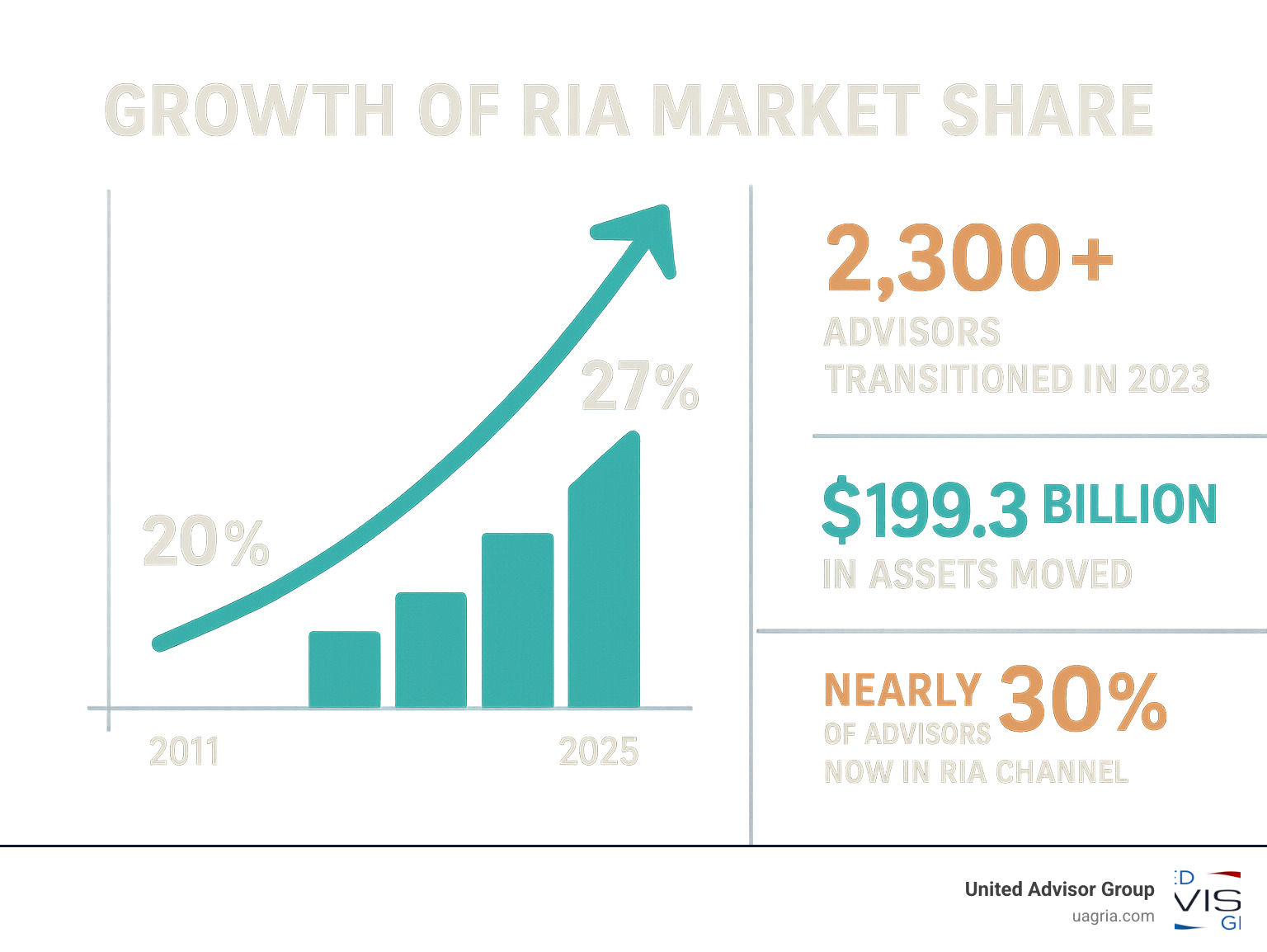
- Growth: The RIA channel now holds 27% of advisor-managed assets, up from 20% in 2011.
The financial services industry is in a massive paradigm shift as traditional wirehouses face pressure from advisors choosing the freedom and client-centric approach of RIA independence. This shift is about your ability to serve clients without conflicts of interest, build wealth through business ownership, and create your ideal practice.
The numbers tell the story: Nearly 30% of financial advisors now operate within the RIA channel. In 2023 alone, over 2,300 advisors transitioned, bringing approximately $199.3 billion in client assets with them.
I’m Ray Gettins, Director at United Advisor Group. We help elite advisors steer the RIA business model transition successfully, leveraging the independence and flexibility of the RIA structure while maintaining the support systems needed for growth.
What is a Registered Investment Advisor (RIA)?
When advisors ask about the RIA business model, the fundamentals are the best place to start. A Registered Investment Advisor (RIA) is a firm that provides investment advice and must register with either the U.S. Securities and Exchange Commission (SEC) or state securities regulators.

What truly matters for your practice is that RIAs operate under a fiduciary standard. This is a legal obligation to always act in your client’s best interest, a higher standard than the “suitability” rule common in the broker-dealer world. This distinction eliminates the conflicts of interest that can arise from commissions and puts client welfare first.
The regulatory framework for RIAs stems from the Investment Advisors Act of 1940-2). A key requirement is filing Form ADV, which publicly discloses business practices, fees, and potential conflicts, creating a level of transparency that builds deep client trust.
The Fiduciary Duty: The Cornerstone of Trust
The fiduciary standard is the foundation of the RIA model. It consists of a duty of care, requiring prudent and well-researched advice custom to client goals, and a duty of loyalty, which demands full disclosure of any potential conflicts. This commitment to transparency and putting clients first is what builds stronger, trust-based relationships. As we discuss in our guide on Independent Financial Advice, this standard transforms you from a salesperson into a trusted partner.
Key Differences from the Broker-Dealer Model
The differences between the RIA and broker-dealer models are fundamental to your practice. This table highlights why so many advisors are making the switch.
| Feature | RIA Model | Broker-Dealer Model |
|---|---|---|
| Fiduciary vs. Suitability | Fiduciary standard: Legally required to act in client’s best interest | Suitability standard: Must recommend “suitable” products, but conflicts allowed if disclosed |
| Compensation | Fee-based: Typically percentage of AUM or fixed fees, aligned with client success | Commission-based: Earnings from product sales, creating potential conflicts |
| Product Shelf | Open architecture: Access to broad universe of investments chosen for client needs | Proprietary focus: Often pressured to sell in-house products, limiting client options |
| Business Ownership | Full ownership of practice, control over branding, technology, and service delivery | Employee or contractor status, subject to firm’s rules and limited ownership rights |
The business ownership aspect is especially compelling. As an RIA, you’re building enterprise value that you own and control. This autonomy allows you to create a practice that reflects your vision, rather than conforming to corporate mandates.
The Core Advantages of the RIA Model for Financial Advisors
Choosing the RIA business model is about fundamentally changing how you serve clients and build your career. This model empowers advisors to achieve genuine independence, cultivate deeper client relationships, and improve both their earning potential and long-term business value.

Advisors who make the transition often describe it as finally being able to build a practice that truly reflects their values, free from sales quotas and proprietary product pressure. This shift is about reclaiming your professional identity, as you can see in these RIA Transition Success Stories That Motivate Lasting Change.
Opening up True Advisor Autonomy
True advisor autonomy means every decision about your business is yours. You gain complete freedom of choice to build your practice your way. This includes building your own brand, selecting your own technology stack, and customizing client workflows without corporate mandates. Most importantly, you escape proprietary product sales pressure. Your recommendations are driven solely by your client’s best interests, giving you access to an open universe of investment solutions. The relief of having No Proprietary Products to push is a key part of the Advisor Autonomy Benefits.
Enhancing Client Relationships and Service
The fiduciary standard transforms client relationships. When clients know your advice is objective and unconflicted, it creates deeper, trust-based relationships. The RIA business model positions you to offer customized solutions for complex needs, evolving your role into a true financial quarterback. Modern RIAs offer a wide range of services: 91% provide retirement income planning, 52% offer comprehensive financial planning, and 50% provide advanced services like tax and estate planning. This comprehensive model, detailed in Registered Investment Advisor: Enhancing Client Relationships, helps clarify the distinction between a Wealth Manager vs Financial Advisor: A Comprehensive Comparison.
Maximizing Your Earning Potential and Building Equity
The financial opportunities in the RIA business model far exceed traditional arrangements. You gain higher payout potential by controlling your expenses and capturing a much larger share of revenue. Instead of a 40-60% payout, RIAs often retain 80-90% or more.
The real game-changer is building tangible enterprise value. Your RIA firm is a privately owned, sellable asset that appreciates over time. This creates a path to substantial wealth at retirement, eligible for favorable long-term capital gains treatment upon sale. The market for RIA acquisitions is robust, and the model also allows for legacy planning by bringing in partners or family members. The financial implications are significant, which is why we encourage you to use the UAG calculator to see how much more you could be earning. It’s an eye-opening exercise that reveals the true financial benefit of independence.
Exploring the Different Types of the RIA Business Model
The beauty of the RIA business model is its flexibility. It’s not a one-size-fits-all solution; it’s a spectrum of options that allow you to align your practice with your personal goals and entrepreneurial spirit. Choosing the right structure is a critical decision for your firm’s future.

Whether you want to build from scratch or prefer a supported path, there’s an RIA model that fits. Let’s explore the primary types:
The Stand-Alone RIA: The Entrepreneur’s Path
For the true entrepreneur, the stand-alone RIA offers maximum control and flexibility. You own your brand, processes, and technology. However, this path means you are responsible for all business functions, including compliance, operations, and marketing. It requires a significant upfront investment and a willingness to manage every aspect of the business, as detailed in our Insights on Costs Involved in Becoming an RIA.
The Hybrid RIA Business Model: Blending Services
The hybrid RIA business model, or dually registered platform, is a compelling middle ground. It allows you to offer fee-based advisory services as an RIA while also conducting commission-based business through a broker-dealer. This flexibility is ideal for serving a wider range of client needs and retaining commission-based accounts. While it involves navigating dual registration and compliance, it’s a powerful and rapidly expanding option for advisors seeking to maximize their offerings.
The Supported RIA Model: Independence with a Safety Net
The supported RIA business model has become a popular choice for independent advisors. This model lets you maintain independence and client ownership while leveraging the established infrastructure of a larger supporting firm. These firms provide turn-key solutions for critical functions like compliance, technology, and back-office support. This allows you to focus on serving clients and growing your business, not administrative burdens. This model, often called “Supported Independence,” combines your entrepreneurial spirit with the scale and expertise of a partner. The supported independence model bridges the gap for many advisors.
Navigating the Transition: Key Considerations for Advisors
Moving to the RIA business model requires thoughtful planning and execution. While the freedom on the other side is worth it, the transition itself can be complex. There are Key Problems When Moving to RIA from Broker-Dealer, but with proper preparation, you can steer them successfully.
The transition typically takes several months, during which you’ll build the foundation for your new practice while managing current responsibilities.
Operational and Compliance Problems
Building your independent practice involves several key steps:
- Choosing a custodian: This is a critical decision. Your custodian safeguards client assets and provides your core technology platform.
- Setting up your legal entity: You’ll need to establish an LLC or Corporation to house your RIA firm and provide legal protection.
- Registering the firm: You will register with the SEC (over $100M AUM) or state regulators by filing Form ADV. The Electronic Filing for Investment Advisers on IARD system streamlines this.
- Establishing a compliance program: This includes creating a Code of Ethics, policies, and procedures. You may need a Chief Compliance Officer or a consultant.
- Selecting your technology stack: The RIA model allows you to choose best-in-class solutions for CRM, financial planning, and portfolio management that fit your practice.
Client Communication and Retention
Communicating the move to clients is easier than many advisors expect. Your clients chose to work with you. When you explain the benefits, most are supportive.
Focus your explanation on what matters to them:
- Truly unconflicted advice: Explain that you’ll no longer face pressure to sell proprietary products.
- Broader access to investment solutions: Highlight how open architecture allows for more customized portfolios.
- Improved technology and expanded services: Mention any new capabilities, like more comprehensive financial planning.
The account transfer process is handled by your new custodian, but clear communication is key. Most advisors are pleasantly surprised by high retention rates when clients understand the move is designed to serve them better.
The Future is Independent: RIA Industry Trends and Outlook
The RIA business model isn’t a passing trend; it’s reshaping the wealth management landscape. The momentum is driven by advisors seeking independence, clients demanding transparency, and a market that rewards fiduciary relationships. This shift is creating unprecedented opportunities for advisors ready to control their future.

Growth and Demand
The numbers show a clear story of change. Nearly 30% of all financial advisors now operate in the RIA channel. In 2023 alone, over 2,300 advisors went independent, bringing approximately $199.3 billion in client assets with them. This growth is fueled by an expanding demand for fiduciary relationships. Today’s informed clients understand the difference between suitability and fiduciary standards and actively seek advisors legally obligated to put their interests first. The RIA model’s transparency and elimination of conflicts directly address client concerns about commissions and sales incentives.
The Evolution of Services
The RIA business model has evolved beyond investment management. Successful RIAs are now comprehensive wealth partners, acting as “financial quarterbacks” for their clients. The scope of services is impressive: 91% of RIAs offer retirement income planning, 52% provide comprehensive financial planning (expected to be 55% by 2026), and 50% offer advanced tax, estate, and charitable planning. This shift toward holistic advice allows RIAs to provide greater value and capture more lucrative accounts. Some are even creating integrated service models like Understanding Independent Fiduciary Virtual Family Office Roles. The future is independent, and the RIA model is leading the charge.
Frequently Asked Questions about the RIA Business Model
As advisors consider the RIA business model, several common questions arise. Here are answers to the most frequent ones.
How does the RIA fee structure create alignment?
The RIA fee structure puts you and your clients on the same side. Most RIAs use a fee based on a percentage of assets under management (AUM), typically 0.5% to 2% annually. When your clients’ portfolios grow, your revenue grows too. This eliminates the conflicts of commission-based models and builds trust because your success is directly tied to theirs. The model is also flexible, allowing for fixed fees, hourly rates, or subscriptions.
What is the difference between an RIA and an Investment Advisor Representative (IAR)?
This distinction is simple: the RIA (Registered Investment Advisor) is the firm registered with regulators to provide investment advice. The IAR (Investment Advisor Representative) is the individual advisor who works for the RIA and provides advice to clients. In short, the firm is the RIA, and you are the IAR.
What are the primary clients that RIAs serve?
The RIA business model is highly versatile, allowing you to serve a wide range of clients. While many RIAs work with high-net-worth individuals and families, they also serve institutional investors (endowments, pension plans), business owners, and those needing multi-generational family planning. The model’s flexibility allows you to build a practice focused on any client niche that aligns with your expertise, from tech entrepreneurs to retirees. This is why so many advisors are making the switch. When you’re ready, access the UAG calculator to see the financial benefit for yourself.
Conclusion: Is the RIA Model Your Path to a Better Practice?
Is the RIA business model the right path for you? The answer depends on what you value most. This model is about fundamentally changing how you serve clients and build your career by embracing the fiduciary standard, where every decision is in your client’s best interest.
The autonomy is life-changing. You can build your practice exactly as you envision it, with the technology, services, and brand that reflect your values, free from proprietary product lists. The financial benefits are equally compelling. Beyond higher take-home pay, you are building a tangible asset—a legacy you can sell or pass down.
The RIA model isn’t for everyone. It requires an interest in the business side of advisory work. But if you feel constrained by your current environment and are excited by the idea of building your own enterprise, the RIA business model deserves serious consideration. The industry momentum is clear.
United Advisor Group understands this is a major decision. That’s why we’ve developed tools to help you see the real numbers. The financial impact of transitioning is unique to every advisor. Find your potential and see how much more you could be earning by making the switch. Our calculator can show you what independence could mean for your bottom line.
The future of financial advice is independent and built on trust. If that aligns with your ambitions, the RIA business model is the path to the practice you’ve always wanted.