

Advisor Autonomy Benefits: 7 Powerful Positive Gains 2025
Why Advisor Autonomy is the Secret to Happier Advisors and Better Client Outcomes
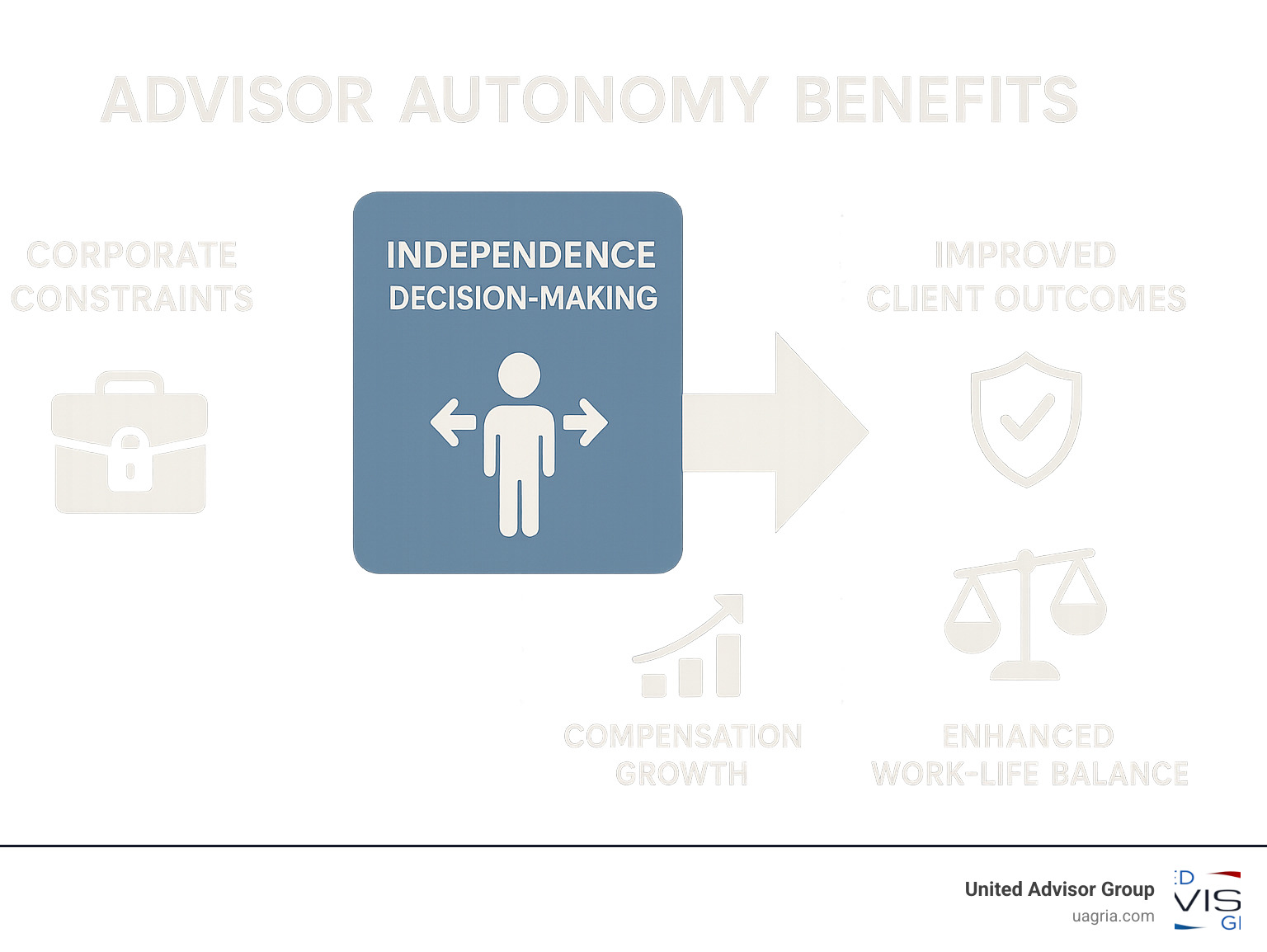
Advisor autonomy benefits include higher payouts, stronger client relationships, better work-life balance, and the freedom to truly put clients first. Independent advisors report 86% client retention rates during transitions and experience significantly higher job satisfaction compared to those constrained by corporate mandates.
Here are the key benefits at a glance:
- Higher Compensation: Independent advisors enjoy significantly higher payout rates without corporate revenue sharing
- Client-First Advice: Freedom from proprietary product pressure allows truly unbiased recommendations
- Technology Choice: Access to best-in-class tools rather than outdated legacy systems
- Work-Life Balance: Advisors with high autonomy take 29 vacation days yearly vs. 15 for those with low autonomy
- Business Control: Full authority over client selection, team structure, and succession planning
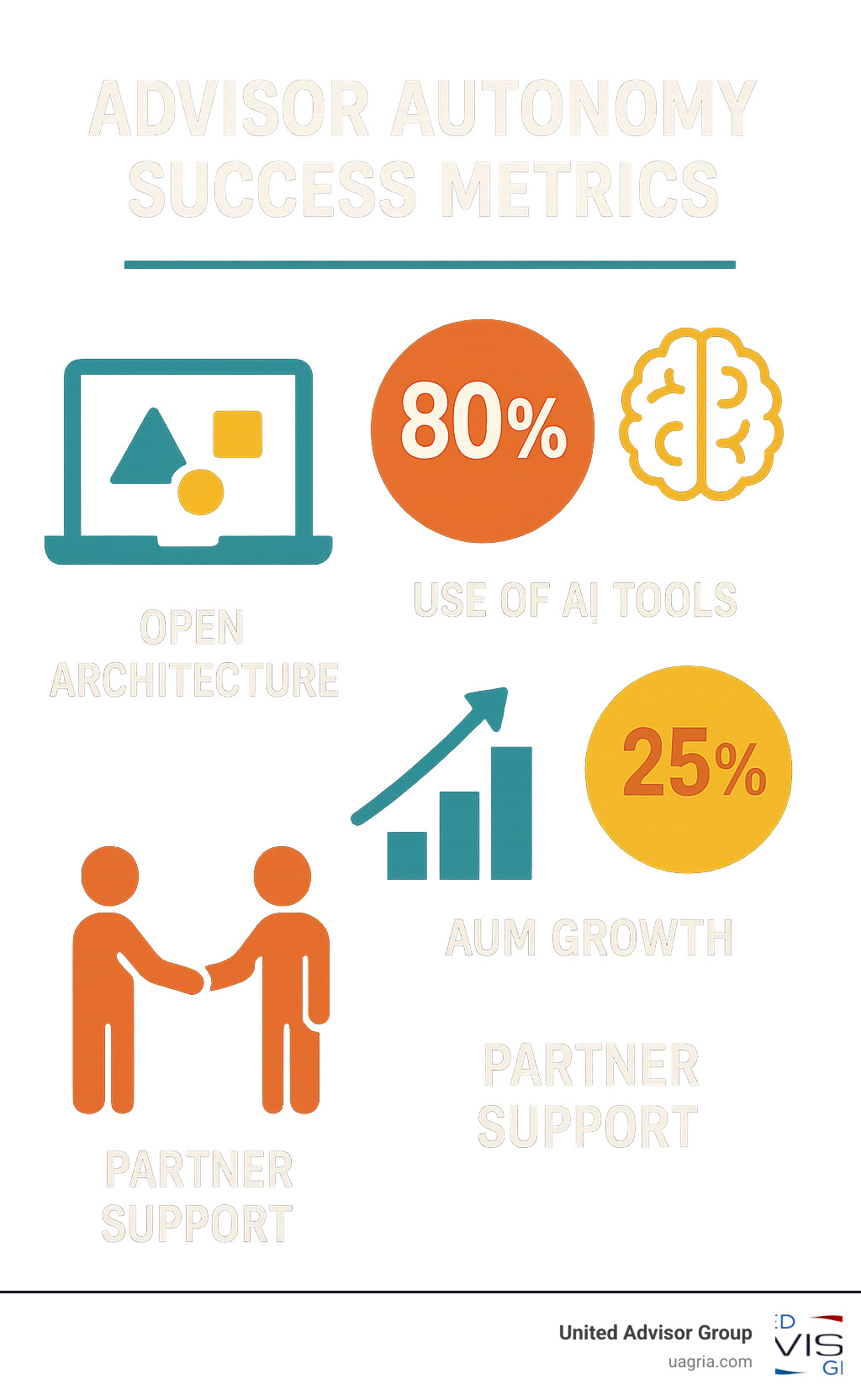
- Growth Potential: 36% of independent advisors saw 25%+ AUM growth in recent studies
The desire for greater control has become the single most powerful driver of advisor movement in today’s market. Research shows that advisor autonomy support is the strongest predictor of global advising satisfaction – even more important than knowledge or availability.
Yet many advisors worry about losing enterprise-level support or creating inconsistent client experiences. The good news? Modern technology and partnership models now make it possible to have both autonomy and institutional backing.
I’m Ray Gettins, Director at United Advisor Group, where we’ve spent years helping exceptional advisors achieve greater independence while maintaining collaborative support. Through our work with hundreds of advisors, I’ve seen how advisor autonomy benefits extend far beyond just higher payouts to create more fulfilling careers and better client outcomes.
What Is Advisor Autonomy and Why It Matters
Advisor autonomy is the freedom to run your practice the way you believe it should be run. It’s having control over the decisions that matter most – how you serve clients, structure your business, and build your career.
This goes deeper than just “being your own boss.” Scientists who study human motivation have found that autonomy is one of three basic needs we all have for happiness and success at work. When we feel in control of our choices, we naturally perform better, feel more satisfied, and avoid burnout.
For financial advisors, this control shows up in areas that really matter. You get to choose clients based on whether they’re a good fit, not just their account size. You can recommend investments you truly believe in rather than whatever products your firm is pushing. You pick technology that actually helps your practice instead of fighting with outdated systems.
The compensation piece is significant too. Advisor autonomy benefits include keeping more of what you earn and structuring fees that make sense for the value you provide. You also get to hire your own team and plan your succession on your timeline.
Research shows this kind of autonomous motivation leads to better outcomes across the board. When advisors feel autonomous, they don’t just feel better about their work – they actually become more effective at helping clients reach their financial goals.
Advisor Autonomy Benefits For Satisfaction
Studies have found that autonomy actually reduces cortisol – the stress hormone that makes you feel burned out and affects your health. When advisors have real control over their work environment, the changes are dramatic.
Lower stress levels are just the beginning. Advisors with autonomy report higher energy throughout the day and genuine satisfaction with their careers. They can align their daily work with what they actually believe is right for clients, which creates a sense of purpose that’s hard to find in more restrictive environments.
One advisor recently told me: “I went from dreading Monday mornings to actually looking forward to client meetings. When you can truly put clients first without worrying about product quotas, the work becomes fulfilling again.”
The numbers back this up. Advisors with high autonomy work fewer hours per week – about 38 compared to 43 for those with less control. But here’s the kicker: they also take nearly twice as many vacation days. They’re not grinding harder; they’re working smarter and more sustainably.
This career longevity benefit is massive. When you reduce burnout, advisors stay in the profession longer and serve clients better over time. It’s a win-win that creates lasting value for everyone involved.
Advisor Autonomy Benefits At a Glance
When I talk to advisors considering greater independence, they want to know: What’s actually different? The advisor autonomy benefits aren’t just theoretical – they show up in your daily work life, your bank account, and your client relationships in very real ways.
Let’s start with compensation. Independent advisors typically see payout rates of 80-95% compared to 40-60% at traditional firms. That’s not just a nice bump – we’re talking about potentially doubling your take-home pay on the same revenue.
But the money, while important, often isn’t what makes them happiest. It’s the freedom to actually serve clients the way they know they should. When was the last time you recommended a product because it was truly the best fit for your client, not because it met some internal quota?
The technology freedom is another game-changer. Instead of being stuck with whatever legacy system corporate decided to implement, you get to choose tools that actually help your practice run smoothly.
Client relationships transform too. When you have control over your client base, you can focus on the people you’re genuinely excited to help. This isn’t about being picky – it’s about finding that sweet spot where your expertise meets their needs.
The business benefits extend to succession planning and equity building. Every client you serve and every process you improve builds value in your business, not someone else’s.
Since around 2017, independent advisors have controlled more wealth than traditional firms. This isn’t just a trend – it’s a fundamental shift happening because both advisors and clients prefer the personalized service and transparency that comes with autonomy.
As the wealth management landscape continues evolving, preserving autonomy has become crucial even as the industry consolidates.

Advisor Autonomy Benefits & Client Outcomes
Here’s where the advisor autonomy benefits get really exciting – they create a ripple effect that dramatically improves what your clients actually experience and achieve.
Research shows that clients see human advisors as delivering 16% closer progress toward their financial goals compared to robo-advisors. But autonomous advisors do even better because they’re not handcuffed by corporate restrictions.
When you have the freedom to truly customize your approach, behavioral coaching becomes your superpower. You can spend time on what research identifies as the highest-value activity – helping clients make better financial decisions.
Holistic planning becomes possible when you’re not limited to proprietary products. Your clients get access to the entire market of solutions, not just what your corporate parent wants to sell.
The relationship depth changes too. When you can choose clients you’re passionate about serving, something magical happens. One advisor told me, “Every client is someone I chose to work with – that makes a huge difference in how invested I am in their success.”
Service customization means you can adapt to how each client actually wants to work with you. Some need frequent check-ins during market volatility, others prefer quarterly deep dives.
Advisor Autonomy Benefits & Compensation
Let’s get specific about the money side of advisor autonomy benefits – because while compensation isn’t everything, it certainly matters for building the practice and life you want.
The payout structure difference is often the first thing that gets advisors’ attention. We’re talking about payout rates of 80-95% versus 40-60% at traditional firms. Do the math on your current revenue – that difference is often life-changing.
But the real power comes from fee flexibility. Want to charge hourly for comprehensive financial planning? Go ahead. Prefer asset-based fees with performance components? Your choice.
Equity building is the long-term wealth creator that employed advisors miss entirely. Every client relationship you build, every process you refine – it all builds value in your business.
Revenue diversification opens doors that corporate compliance often keeps locked. Many autonomous advisors expand into specialized consulting or niche services that weren’t possible under corporate constraints.
The results speak for themselves. Recent studies show 36% of independent advisors experienced 25% or more AUM growth, with 14% seeing growth of 50% or more.
Balancing Independence with Consistent Client Experience
Here’s the question that keeps many advisors up at night: “If I go independent, will my clients get the same level of service they’re used to?” It’s a fair concern, and honestly, it used to be a real problem. But technology has completely flipped the script.
The dirty little secret? Modern centralized rebalancing technology can actually deliver better tax management and more customization options than most advisors managing portfolios manually. You’re not choosing between autonomy and quality anymore – you can have both.
When you were at a big firm, did you personally execute every trade? Handle all the compliance paperwork? Manage the technology infrastructure? Of course not. The difference now is that you get to choose your support partners instead of being stuck with whatever corporate decided was “good enough.”
Here’s how smart advisors are solving this puzzle:
The most successful independent advisors I work with use what I call “guided autonomy.” They set the investment philosophy and client service standards, then partner with specialized teams to handle the heavy lifting. You maintain control over what happens while benefiting from economies of scale in how it happens.
Take rebalancing, for example. You decide the target allocations and tax-loss harvesting parameters based on each client’s unique situation. The technology handles the execution across hundreds of accounts simultaneously, often achieving better tax outcomes than manual management ever could.
Brand consistency doesn’t require corporate ownership. Modern platforms let you maintain consistent client experiences while preserving your ability to customize.
The research backs this up. Cost pressures from low-cost ETFs and robo-advisors have actually improved the technology available to independent advisors. What used to require massive corporate infrastructure is now available to practices of any size.
One advisor recently told me, “My clients are getting better service now than they ever did at the wirehouse. The difference is that every decision I make is based on what’s best for them, not what’s best for corporate revenue.”
The key insight? Advisor autonomy benefits don’t mean you have to do everything yourself. They mean you get to choose who you work with and how you serve your clients.
Trade-Offs to Monitor
Let’s be honest about the challenges. Independence isn’t all sunshine and higher payouts. There are real trade-offs you need to manage thoughtfully.
Compliance becomes your responsibility. Without a corporate compliance department, you need robust support or you’re asking for trouble. The good news is that modern compliance technology makes this much more manageable than it used to be.
Platform costs are real. Enterprise-level technology and support cost money. However, these costs are typically a fraction of what you’re giving up in reduced payout rates at traditional firms.
You lose some oversight safety nets. Corporate firms have layers of oversight that catch mistakes and provide guidance. As an independent advisor, you need to be more disciplined about business management and risk controls.
Some clients expect big firm brands. A few clients will always prefer the perceived stability of household name firms. This requires clear communication about why independent advice is actually more stable for their long-term interests.
Pathways to Greater Autonomy Without Going It Alone
Here’s the good news: you don’t have to choose between going completely solo and staying trapped in corporate constraints. The modern advisory landscape offers multiple pathways to achieve greater autonomy while keeping the institutional support that makes your life easier.
Turnkey Asset Management Platforms (TAMPs) have revolutionized how advisors can access institutional-quality investment management without giving up control. These platforms handle the heavy lifting of portfolio construction, rebalancing, and risk management while you maintain your own branding and client relationships.
RIA affiliation models offer another compelling path. You join an established RIA that provides compliance oversight, technology infrastructure, and operational support – but you keep your own brand and direct client relationships.
Modern custodial platforms have stepped up their game dramatically. Many now offer comprehensive support including streamlined onboarding, automated billing, sophisticated portfolio management tools, and detailed reporting.
Virtual ensemble models let you outsource specific functions – compliance, technology, or portfolio management – while maintaining complete control over client relationships and business strategy.
The rise of open architecture platforms means you can access best-in-class tools and investments without being forced into proprietary products. You get choice without sacrificing quality or capabilities.
Research shows that 80% of independent advisors are already leveraging AI tools to improve their practices. Those who effectively use technology partnerships experienced above 25% AUM growth. The secret isn’t avoiding partnerships – it’s choosing partners who amplify your capabilities rather than limit your choices.
For deeper insights on how strategic teaming can improve your practice while preserving independence, explore our guide on registered investment advisor enhancing client relationships.
Practical Steps & Partnership Models
Ready to take concrete steps toward greater autonomy? Here’s your practical roadmap, based on what we’ve learned from hundreds of successful transitions.
Start by assessing your current situation honestly. Can you choose your clients and set appropriate goals for them? Do you control your compensation structure? Can you hire the talent your practice needs? Do you have real choice in technology options?
Next, identify your priorities. What aspects of autonomy matter most to your vision of success? Maybe it’s higher compensation and equity building. Perhaps it’s technology choice. Or it could be client selection freedom and succession planning control.
Research partnership models by talking to advisors who’ve made the leap. 60% of advisors considering independence consult peers who have already made the transition. Their real-world experiences are invaluable.
When you’re ready to plan your transition, know that 83% of advisors complete their move within 12 months once they make the decision. Recently independent advisors retain an impressive 86% of their client base on average.
Finally, build your support network before you need it. Whether through formal partnerships or peer relationships, ensure you have access to expertise in compliance, technology, and business management.
Modern platforms offer comprehensive transition support, from asset transfer assistance to client communication templates. The breakaway transition process has evolved to be advisor-friendly, with many platforms providing dedicated transition teams.
The key is choosing partners who improve your autonomy rather than constraining it. You want allies who help you serve clients better, not new masters telling you how to run your practice.
For detailed guidance and real examples of successful transitions, check out our RIA transition success stories to see how other advisors have steerd this journey.
Frequently Asked Questions about Advisor Autonomy Benefits
How does autonomy impact client satisfaction?
The connection between advisor freedom and client happiness is stronger than most people realize. When advisors can make decisions based purely on what’s best for their clients, trust deepens and outcomes improve.
Clients can sense when their advisor is genuinely focused on their needs versus when they’re being pushed toward certain products. Advisor autonomy benefits create this authentic relationship because autonomous advisors aren’t constrained by corporate quotas or proprietary product requirements.
The research backs this up. Clients working with autonomous advisors report higher trust levels because they know their advisor’s recommendations aren’t influenced by corporate pressure. These advisors can focus on what studies show matters most – behavioral coaching and truly holistic planning.
Autonomous advisors can customize everything about their service. Some clients need weekly check-ins during market volatility, others prefer quarterly reviews. When you have autonomy, you can adapt to each client’s unique communication style and service needs.
Research shows clients attribute significantly more value to human advisors than digital alternatives – 16% closer progress toward goals versus only 5% for robo-advisors. This gap becomes even larger when advisors have the freedom to fully customize their approach.
What risks come with more autonomy, and how can I mitigate them?
More freedom does come with more responsibility. But every risk has a practical solution, and you don’t have to figure it out alone.
Compliance challenges are probably the biggest worry. Modern platforms now offer compliance-as-a-service specifically designed for independent advisors. You get expert support without the corporate bureaucracy.
Technology and cybersecurity concerns are real too. The solution is partnering with firms that have strong security protocols and business continuity plans. Look for partners who handle data backup, disaster recovery, and security monitoring.
Business management can feel overwhelming when you’re used to corporate support. The key is building systems gradually. Start with good financial tracking and performance benchmarking. Many platforms now provide business consulting and peer benchmarking.
Professional isolation might be the most underestimated risk. Running your own practice can feel lonely. The solution is intentionally building peer networks through industry groups, advisor communities, or formal partnership models.
The secret is acknowledging these challenges upfront and building support systems before you need them. Most successful autonomous advisors say the key was finding the right partners who provided expertise without trying to control their business decisions.
Can I stay autonomous and still leverage enterprise-level tech?
You absolutely can have both autonomy and institutional-quality technology – in fact, you can often get better technology as an independent advisor than you’d have at a traditional firm.
Modern API integrations mean you can connect the best tools from different providers without being locked into one vendor’s ecosystem. Want the CRM from one company, financial planning software from another, and portfolio management tools from a third? No problem.
Cloud-based platforms have democratized access to enterprise-level capabilities. Automated rebalancing, client portals, comprehensive reporting, and institutional-quality research are all available without massive infrastructure investments.
80% of independent advisors are already using artificial intelligence tools in their practices. Those who effectively use technology aren’t just working more efficiently – they’re growing faster, with many experiencing above 25% AUM growth.
Automation handles the routine stuff so you can focus on high-value client work. Modern platforms automate everything from client onboarding to billing and portfolio rebalancing, while still allowing you to customize and oversee the process.
The key is choosing open-architecture platforms that improve your capabilities rather than limiting your choices. Look for partners who provide powerful tools and support while respecting your autonomy to make business decisions.
Conclusion
The journey toward greater advisor autonomy benefits isn’t just about making more money or having a flexible schedule. It’s about refinding why you became a financial advisor in the first place – to truly help people achieve their financial goals.
When we look at the numbers – advisors taking 29 vacation days instead of 15, keeping 86% of their clients during transitions, experiencing 36% AUM growth rates – we’re seeing the results of advisors who can finally focus on what matters most. They’re building relationships and delivering real value.
The shift we’re witnessing isn’t temporary. Since 2017, independent advisors have controlled more wealth than traditional firms, and this trend keeps accelerating. Clients are voting with their wallets for advisors who can offer unbiased advice and personalized service.
Here’s what excites me most about today’s landscape: you don’t have to choose between freedom and support anymore. The old “go it completely alone or stay trapped in corporate” dilemma is over. Modern technology and partnership models let you have advisor autonomy benefits with institutional backing.
At United Advisor Group, we’ve seen hundreds of advisors make this transition successfully. What strikes me every time is how their energy changes. One advisor recently told me, “I didn’t realize how much I was holding back until I didn’t have to anymore.” When advisors can truly put clients first without corporate interference, the work becomes fulfilling again.
The path forward isn’t the same for everyone. Some advisors need maximum independence, others want more support. The key is finding partners who improve your capabilities without micromanaging your decisions.
Your clients deserve an advisor who can focus entirely on their needs. You deserve a career that energizes rather than drains you. Both are possible when you accept the advisor autonomy benefits that modern partnership models provide.
Ready to explore what autonomy could mean for your practice? Start by learning more about building stronger advisor-client relationships through improved independence. Because at the end of the day, advisor autonomy isn’t just about freedom – it’s about creating the practice, the client relationships, and the life you actually want.

