

Why RIA Platform Comparison Matters More Than Ever
RIA platform comparison is critical for advisors seeking independence from restrictive broker-dealers. Here’s what you need to evaluate when comparing RIA platforms:
Key Comparison Factors:
- Technology Integration – CRM compatibility, API capabilities, reporting flexibility
- Service Models – Dedicated support teams vs. tiered service structures
- Pricing Transparency – Asset-based fees, ticket charges, cash sweep rates
- Custodian Choice – Multiple options vs. single-custodian dependency
- Growth Support – Business development resources, M&A assistance
The choice of your custodial and technology partner is easily one of the most important business decisions for your advisory firm. As one industry expert noted, “the advisory firm is the front end of the client relationship, but it entrusts client assets, and key aspects of their service, to a custodian that safeguards the money and provides the underlying platform.”
Industry consolidation is forcing advisors to re-evaluate their partnerships. A recent major merger in the custodial space eliminated a major option, while many advisors report feeling like “small fish in a big pond” at large custodians. This has created an opportunity to explore platforms that prioritize advisor needs over retail competition.
The largest RIA custodians control the vast majority of custodied assets, but that doesn’t mean they’re the right fit for every advisor. Smaller, advisor-focused platforms are gaining traction by offering personalized service, transparent pricing, and conflict-free relationships.
For advisors leaving broker-dealers, the stakes are even higher. You’re not just choosing technology – you’re selecting a partner that will support your independence and help you build a practice focused entirely on client outcomes rather than proprietary product sales.
I’m Ray Gettins, Director at United Advisor Group, where we help advisors steer the complexities of RIA platform comparison to find solutions that truly support their independence. Having worked extensively with advisors transitioning from restrictive environments, I understand the importance of choosing partners who prioritize advisor success over their own retail competition.
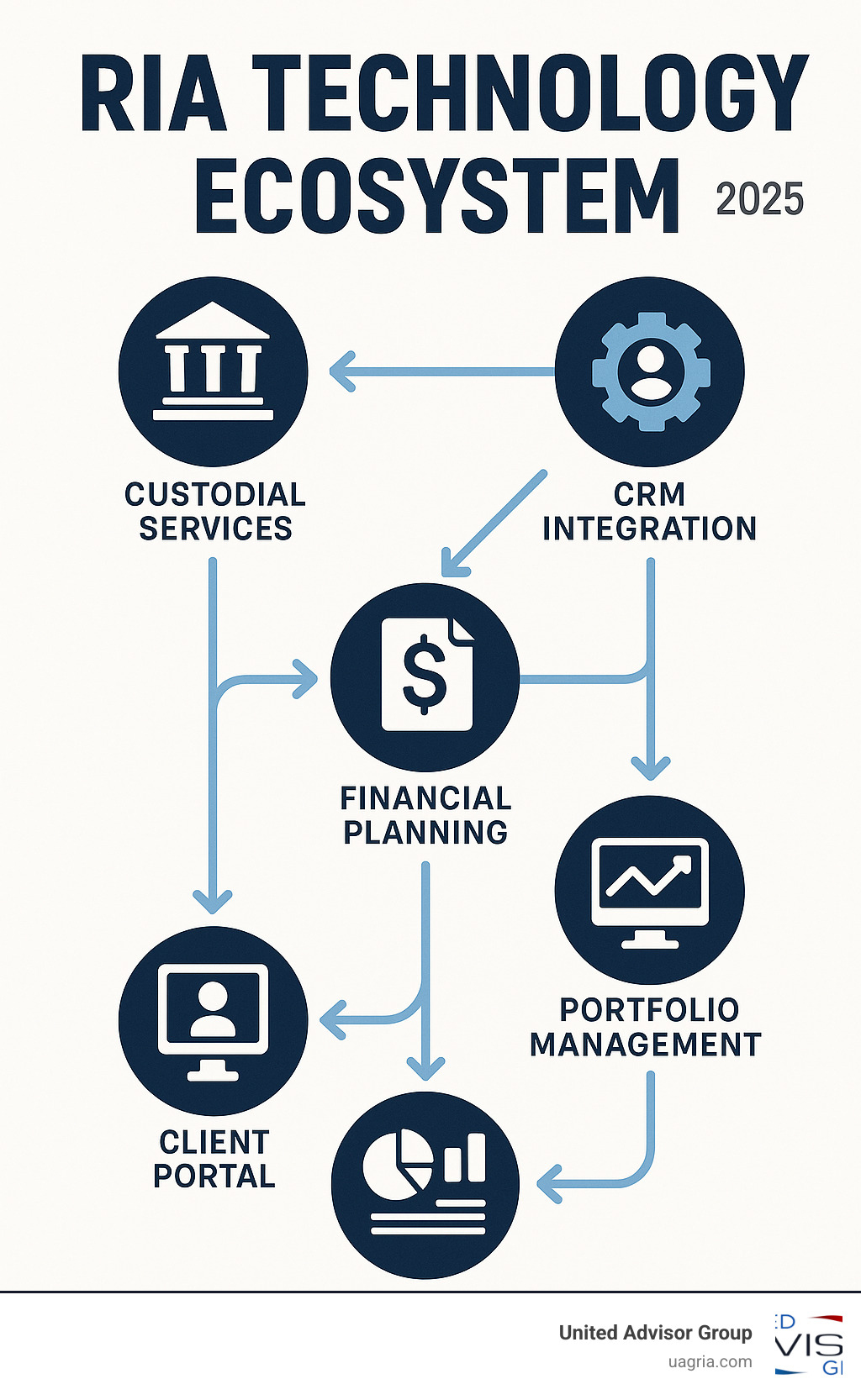
RIA platform comparison vocabulary:
Key Factors for Evaluating RIA Custodial and Technology Platforms
When you’re evaluating potential partners for your RIA platform comparison, it’s tempting to focus on brand recognition alone. But here’s the thing – the biggest name doesn’t always mean the best fit for your practice.
Let’s dig into what really matters when choosing a custodial and technology partner that will support your independence and help you serve clients better.
Technology, Integration, and Reporting
Your technology stack is the backbone of your practice. Think of it as the nervous system that connects every aspect of your business – from client onboarding to portfolio reporting. When evaluating platforms, ask yourself: Does this feel modern and responsive, or am I looking at something that belongs in a museum?
The real game-changer is finding platforms with open API architecture and robust integration capabilities. Here’s why this matters: without seamless connections between your CRM, financial planning software, and reporting tools, you’ll spend countless hours manually transferring data between systems. It’s like having a sports car with square wheels – technically functional, but painfully inefficient.
Data aggregation capabilities should give you a complete picture of all client holdings, regardless of where they’re housed. You want reporting flexibility that lets you create customized reports that reflect your unique approach to client communication, not generic statements that look like everyone else’s.
Your client portal experience is often the most visible part of your technology to clients. It should be intuitive enough that your least tech-savvy client can steer it without calling you for help. This portal represents your firm’s professionalism.
Cybersecurity isn’t negotiable in today’s environment. Your chosen platform must have enterprise-grade security measures, including end-to-end encryption and role-based access controls. The SEC has made it clear that cybersecurity failures can have serious consequences for advisory firms.
For exploring integration options, the AdvisorTech Directory offers comprehensive insights into how different platforms work together.
Services, Support, and Growth

Technology is just half the equation. The other half is finding a partner that treats you like a valued client, not a number in their system.
Dedicated service teams and relationship managers make all the difference. Many advisors at larger custodians report feeling like they’re stuck in a tiered service model where they get shuffled to whoever happens to answer the phone. That’s not a partnership – that’s a transaction.
Look for partners that offer genuine business development support. This might include marketing resources, practice management consulting, or referral opportunities. The best custodial partners understand that your growth benefits everyone involved.
Planning for the future means considering M&A and succession planning support. Whether you’re looking to acquire another practice or planning your own exit strategy, having a custodian that understands these complexities can be invaluable.
If you’re considering the move from a broker-dealer environment, understanding the key problems when moving to RIA from broker-dealer can help you choose a partner that smooths the transition.
Pricing Models and Firm Stability
Let’s talk about the elephant in the room – how much this is going to cost you and how your custodian makes their money.
Most custodians use a combination of asset-based fees (typically 0.10% to 0.15% of assets), ticket-based fees for transactions, and various platform fees for technology access. Understanding these structures upfront helps you budget accurately and avoid surprises.
Cash sweep revenue is where things get interesting. Even custodians offering “zero-commission” trading generate significant income from the interest earned on client cash balances. They often sweep client funds into accounts paying below-market rates, keeping the difference. As a fiduciary, you need to understand these arrangements and how they might affect your clients.
Long-term viability matters more than ever in our consolidating industry. You need a partner with a strong balance sheet and a proven commitment to the RIA market. The last thing you want is to go through another forced transition because your custodian got acquired or decided to exit the RIA business.
For more insights on the financial aspects of RIA independence, check out our analysis of costs involved in becoming an RIA.
The right RIA platform comparison considers all these factors together, not in isolation. Your ideal partner should excel in technology, provide exceptional service, offer transparent pricing, and demonstrate long-term stability. Most importantly, they should share your commitment to putting clients first.
The Evolving RIA Custodial and Technology Landscape
The RIA platform comparison landscape feels like it’s changing every day. As an advisor looking for a new home, you’re facing more choices than ever before – but also more complexity. Understanding how different platform models work can help you find the perfect fit for your practice.
The good news? This evolution means you have real options. Whether you’re drawn to the resources of established giants or the personalized touch of advisor-focused solutions, there’s likely a platform that aligns with your vision for serving clients.
Comprehensive, Resource-Rich Platforms: Strengths and Considerations
Let’s start with the elephants in the room – the largest, most established RIA custodians. These platforms control an impressive share of custodied assets in the RIA market, with some individual firms holding trillions of dollars in assets.

Their Market Presence is undeniable, and for good reason. These platforms offer Extensive Resources that can feel almost limitless – think comprehensive research departments, vast technology budgets, and Broad Investment Options that cover virtually every asset class imaginable. The Brand Recognition alone can open doors and lend instant credibility to your practice.
But here’s where it gets tricky. That massive scale can create a Potential for Tiered Service that leaves smaller advisors feeling overlooked. If you’ve ever spent 20 minutes navigating phone menus just to ask a simple question, you know what we mean. Many advisors report feeling like they’re just another account number rather than a valued partner.
The challenge isn’t that these platforms don’t care – it’s that their sheer size makes personalized attention difficult to scale. When you’re managing trillions in assets, it’s easy for a $50 million practice to get lost in the shuffle. For insights on how advisors are navigating these industry changes, check out Insights on Advisors Navigating Change.
Advisor-Focused, Innovative Solutions
Now, let’s talk about the platforms that are shaking things up. A new wave of advisor-focused custodians and technology providers may not have trillion-dollar AUM, but they’re winning hearts and minds with a different approach entirely.
The magic word here is Personalized Service. When you call these platforms, you’re likely to reach someone who knows your name, understands your business, and can actually make decisions. It’s the difference between talking to a call center representative reading from a script and having a conversation with someone who genuinely wants to help your practice succeed.
Many of these innovative solutions operate with Conflict-Free Models – and this is huge. They don’t have retail divisions competing directly with you for clients. Every strategic decision they make is focused on supporting advisors, not balancing advisor needs against their own consumer business. This aligns perfectly with our belief in No Proprietary Products for truly independent advice.
Innovative Pricing is another game-changer. Some platforms, for example, have introduced disruptive pricing models, such as low per-account fees and commission-free trading for common securities. For cost-conscious practices, these models can significantly impact your bottom line.
These platforms also accept Modern Technology with impressive Agility. Because they’re not weighed down by legacy systems, they can adapt quickly to new integrations and features. Their entire Focus on RIAs means every tool and service is designed specifically for independent advisors – not retrofitted from retail banking platforms.
Key differentiators that make these advisor-focused platforms compelling include personalized service with dedicated relationship managers, business models that avoid competing with advisors, transparent and often more cost-effective pricing, emphasis on modern technology and seamless integrations, culture deeply aligned with advisor independence, flexibility in responding to feedback, and specialized support for the unique challenges of independent practices including business development and succession planning.
The beauty of today’s landscape is that you have genuine choices. Whether you value the extensive resources of larger platforms or the personalized attention of advisor-focused solutions, the key is finding a partner whose values and service model align with your vision for client service.
A Comprehensive RIA Platform Comparison
Making a direct RIA platform comparison requires a clear understanding of your firm’s unique needs and how different technology and service models can meet them.
The truth is, there’s no one-size-fits-all solution in the RIA world. What works brilliantly for a $50 million boutique practice might feel overwhelming for a solo advisor, while a billion-dollar firm needs capabilities that would be overkill for most smaller practices.
All-in-One vs. Best-of-Breed: Choosing Your Tech Model
One of the most important decisions you’ll face is choosing between an All-in-One Platform or a Best-of-Breed Approach. Think of it like choosing between a Swiss Army knife or a specialized toolbox.
All-in-One Platforms promise to handle everything under one roof – trading, rebalancing, reporting, client portals, the works. The appeal is obvious: you get an Integrated Experience with Streamlined Workflows, and you only need to manage one vendor relationship instead of juggling multiple contracts. Many of these solutions are Custodial-dependent, meaning the technology is tightly woven into your custodian’s services.
The downside? You might find yourself settling for “good enough” in some areas rather than getting the best-in-class functionality you really need. It’s like living in a studio apartment – everything’s there, but you might wish the kitchen was bigger.
The Best-of-Breed Approach takes the opposite route. You handpick the absolute best software for each specific function – maybe one CRM system, a different financial planning tool, and yet another platform for portfolio reporting. This strategy relies heavily on Open APIs to create a customized tech stack that fits your firm like a glove, offering maximum Customization.
The trade-off here is complexity. You’ll need to manage multiple vendor relationships and ensure all these systems talk to each other smoothly. When it works well, it’s like having a perfectly orchestrated symphony. When it doesn’t, you might feel like you’re conducting a group of musicians who can’t hear each other.
Your choice significantly impacts your Operational Efficiency and how effectively you serve clients. The goal is always to improve Registered Investment Advisor: Enhancing Client Relationships through smart technology choices.
How to Approach Your RIA Platform Comparison
So how do you cut through all the marketing noise and make the right choice? It starts with taking a hard, honest look at your own practice.
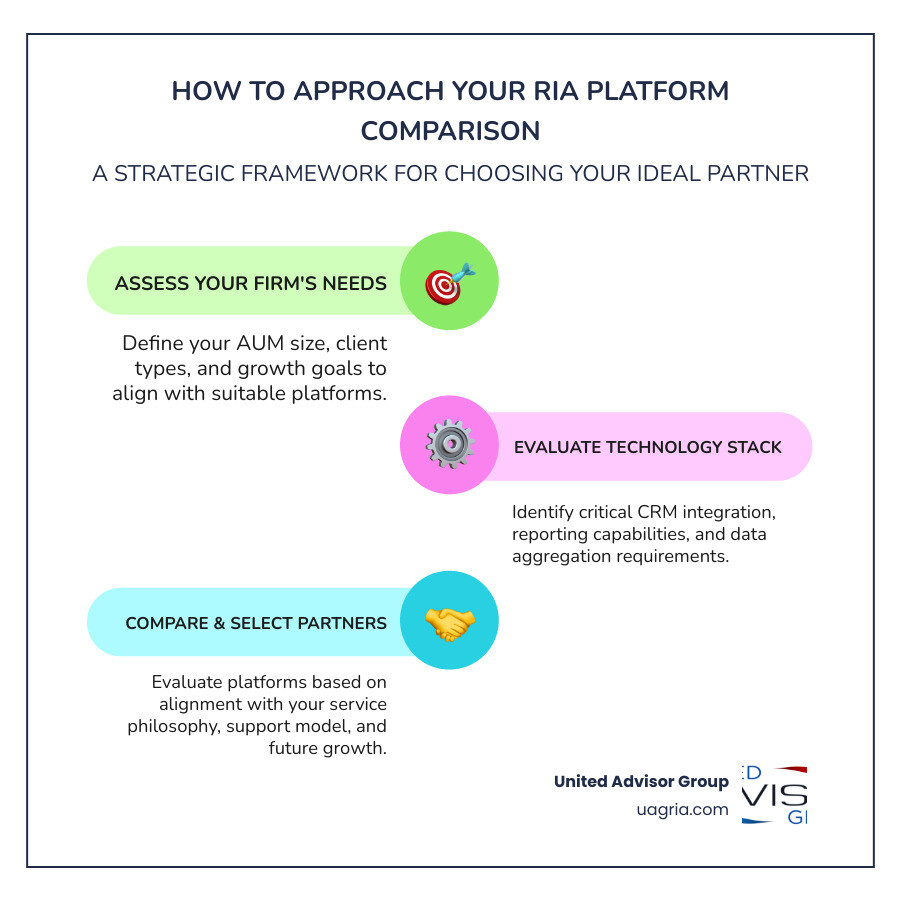
Assess your firm’s needs first and foremost. Your AUM size matters more than you might think – remember, 73% of all RIAs manage less than $250 million. This isn’t just a statistic; it’s a reality check. Some platforms are built for the big players and might make you feel like you’re paying for features you’ll never use. Others are designed specifically for emerging firms and growing practices.
Consider your typical Client type and what they expect from you. Are you working with tech-savvy millennials who want mobile access to everything, or are you serving retirees who prefer phone calls and paper statements? Your clients’ preferences should influence your technology choices.
Think seriously about your Growth goals. Are you planning to double your AUM in the next three years, or are you happy maintaining a smaller, boutique practice? Your growth trajectory should inform whether you need a platform that can scale with you or one that’s optimized for where you are right now.
Next, Evaluate your technology stack requirements with brutal honesty. What kind of CRM integration do you absolutely need? Can you live with basic contact management, or do you need sophisticated workflow automation? What about your Reporting needs – both for clients and your own internal analysis? Some advisors need advanced performance attribution and risk analytics, while others just need clean, professional statements.
This self-assessment is the foundation of any successful RIA platform comparison. Without it, you’re just shopping for features you might never use. For inspiration on how other advisors have made successful transitions, check out these RIA Transition Success Stories That Motivate Lasting Change.
The Impact of Industry Consolidation on Your RIA Platform Comparison
The financial advisory landscape has been fundamentally reshaped by Industry Consolidation, with a recent high-profile merger between two major custodians being the most visible example. While the integration went relatively smoothly for most advisors, it served as a wake-up call for the entire industry.
This type of consolidation inevitably leads to Reduced Choice in the marketplace. When major players merge, advisors have fewer options, and the remaining giants have less competitive pressure to innovate or maintain service levels. It also raises legitimate Service Level Concerns – will a merged entity of this size be able to maintain the personalized attention that smaller firms once provided?
Many advisors chose not to switch immediately after the merger, largely due to the cost and hassle of repapering accounts. But the event definitely served as a catalyst for re-evaluation. It got advisors thinking: “What if this happens again? What if my custodian’s priorities shift in a direction that doesn’t align with mine?”
The lesson here is clear: Industry Consolidation makes it more important than ever to choose partners whose long-term strategic direction aligns with yours. You want to work with firms that see RIAs as their primary focus, not just one segment among many. For deeper insights on how advisors are navigating these changes, read our Insights on Industry Consolidation.
Frequently Asked Questions about RIA Platforms
When you’re considering an RIA platform comparison, certain questions come up time and again. Let me address the most common concerns I hear from advisors who are exploring their options.
Do RIA custodians have a minimum AUM requirement?
The short answer? It depends entirely on which custodian you’re considering. Some large custodians have made headlines by eliminating minimum asset requirements altogether, opening their doors to advisors at any stage of their career. This accessibility can be a lifeline for new RIAs just starting to build their practice.
However, here’s where it gets interesting: having no minimum doesn’t guarantee equal treatment. Many custodians operate on tiered service models, where your AUM determines the level of support you receive. You might qualify to open accounts, but accessing premium services, dedicated relationship managers, or priority support often requires crossing higher asset thresholds.
Advisor-focused custodians tell a different story. These platforms are specifically designed with growing RIAs in mind, often offering robust support and personalized service regardless of your current AUM. They understand that today’s $50 million firm could be tomorrow’s $500 million success story.
When you’re evaluating options, don’t just ask about minimums – ask about service levels at your current AUM and what changes as you grow.
How do custodians make money if they offer “zero-commission” trading?
This is one of my favorite questions because it gets to the heart of understanding your custodial relationship. “Zero-commission” definitely doesn’t mean “free” – custodians are businesses, and they’ve simply shifted how they generate revenue.
The biggest revenue driver is often cash sweep programs. When your clients hold cash in their accounts, custodians typically sweep these funds into money market accounts or bank deposit programs. The custodian earns interest on these balances, usually paying clients a lower rate than what they’re earning themselves. In today’s interest rate environment, this can be quite lucrative.
Payment for order flow is another significant revenue source. Market makers pay custodians for the right to execute client trades, which helps offset the “free” trading costs. While this practice is regulated and disclosed, it’s worth understanding as part of the custodial business model.
Custodians also generate income through platform fees and administrative charges. These might be asset-based fees, flat monthly charges, or fees for specific services like wire transfers or account maintenance.
The key is transparency. As fiduciaries, we need custodians who are upfront about their revenue sources and ensure these don’t create conflicts with our clients’ best interests.
What is the difference between a custodian and a technology platform?
This distinction is crucial for any RIA platform comparison, yet it’s often misunderstood. Think of them as two different layers of your advisory infrastructure.
A custodian is essentially the vault where client assets live. They’re the financial institution – regulated and insured – that holds your clients’ cash, stocks, bonds, and other investments. Custodians handle the heavy lifting of trade execution, settlement, recordkeeping, and regulatory reporting. They’re legally required to keep client assets separate from their own, providing that critical layer of protection and oversight.
A technology platform, on the other hand, is your control center. This software sits on top of the custodial relationship, providing the tools you need to manage client portfolios, generate reports, aggregate data from multiple sources, and deliver client services. Think portfolio management systems, performance reporting tools, client portals, and financial planning software.
Here’s where it gets interesting: some custodians offer integrated technology platforms, creating an all-in-one solution where custody and technology are tightly woven together. Others focus primarily on custodial services and rely on third-party technology integrations.
Many successful RIAs choose a “best-of-breed” approach, selecting their custodian based on asset safety, service, and cost, then building their technology stack with specialized software providers. Modern APIs make these integrations seamless, giving you the flexibility to create a custom solution that perfectly fits your practice.
The beauty of this separation is choice. You’re not locked into using a custodian’s proprietary technology just because that’s where client assets are held. You can mix and match to create the perfect combination for your specific needs and client service model.
Conclusion: Finding the Right Partner for Your Independent Firm
Choosing an RIA platform isn’t just about picking software or finding the cheapest custodian. It’s about finding a true partner who understands your vision for independence and will support you every step of the way.
Throughout this guide, we’ve explored the vast landscape of options available to you. From the resource-rich platforms of the industry giants to the personalized, conflict-free approach of advisor-focused solutions, each model offers distinct advantages. The key is understanding which one aligns with your firm’s DNA.
Your perfect RIA platform comparison starts with honest self-reflection. What matters most to your practice? Is it having access to every possible investment option, or is it getting a dedicated relationship manager who knows your name and your business goals? Do you need the perceived safety of a massive custodian, or would you thrive with the agility and innovation of a smaller, advisor-focused partner?
The right choice empowers you to deliver Independent Financial Advice without the constraints and conflicts that plague traditional broker-dealers. No more proprietary product quotas. No more compliance headaches that serve the firm’s interests over your clients’. No more wondering if your recommendations are truly in your clients’ best interests.
At United Advisor Group, we’ve seen countless advisors transform their practices by making the leap to true independence. We understand that advisors seeking a new home aren’t just looking for a place to park assets – they’re looking for a partner who champions advisor autonomy and puts client outcomes first.
The financial benefits of independence are often surprising. Many advisors find they can earn significantly more while providing better service to their clients. It’s a win-win that seems too good to be true, but it’s the reality of breaking free from the constraints of traditional financial institutions.
We help advisors steer these critical decisions to build more profitable and autonomous practices. Our model eliminates proprietary product pressures and broker-dealer compliance burdens, giving you the freedom to focus entirely on what matters most – serving your clients’ best interests.
Ready to see what true independence could mean for your bottom line? Access the UAG calculator to see how much more you can earn than you are currently earning. We’re confident the numbers will open your eyes to possibilities you may not have realized existed.