

Why Financial Advisors Are Making the Move to Switch RIA Firm
The decision to switch RIA firm has become a defining moment for thousands of financial advisors seeking greater independence and control over their practice. If you’re considering this transition, here’s what you need to know:
Key Steps to Switch RIA Firm:
- Plan ahead – Allow 6-12 months for proper due diligence and transition planning
- Review legal obligations – Understand non-compete and non-solicit clauses in your current contract
- Choose your model – Decide between starting solo, joining an established RIA, or a hybrid approach
- Prepare financially – Expect initial income fluctuation and potential asset loss (typically 18-22%)
- Build your support team – Secure compliance, technology, and operational partners
- Execute client transition – Develop a communication strategy to retain your client relationships
The numbers are compelling: Roughly 10% of financial advisors are expected to transition their practices in 2025, and 9,615 experienced advisors switched last year alone. This movement is driven by a desire for freedom from restrictive corporate cultures, sales quotas, and proprietary product pressure.
The financial incentive is equally compelling. While wirehouse advisors typically receive 45% to 47% of the revenue they generate, independent RIAs can achieve earnings closer to the 60% to 70% range after covering overhead. As one advisor noted after making the switch: “I have a fraction of the clients I had, I’m able to do great planning for them, stress level is way down, I’ve tripled my income and I have a practice that is worth millions when I decide to retire.”
The “push and pull” dynamics are clear. Wirehouses experienced a net loss of 605 advisors in 2024, while independent firms added 689 advisors to their ranks. Over the past five years, wirehouses lost 8,303 reps, while retail-facing RIAs gained 8,739 reps.
I’m Ray Gettings, Director at United Advisor Group, where I help already exceptional advisors steer the decision to switch RIA firm and find greater success through our collaborative model. Having worked with advisors throughout this transition process, I understand both the challenges and tremendous opportunities that come with making this important career move.
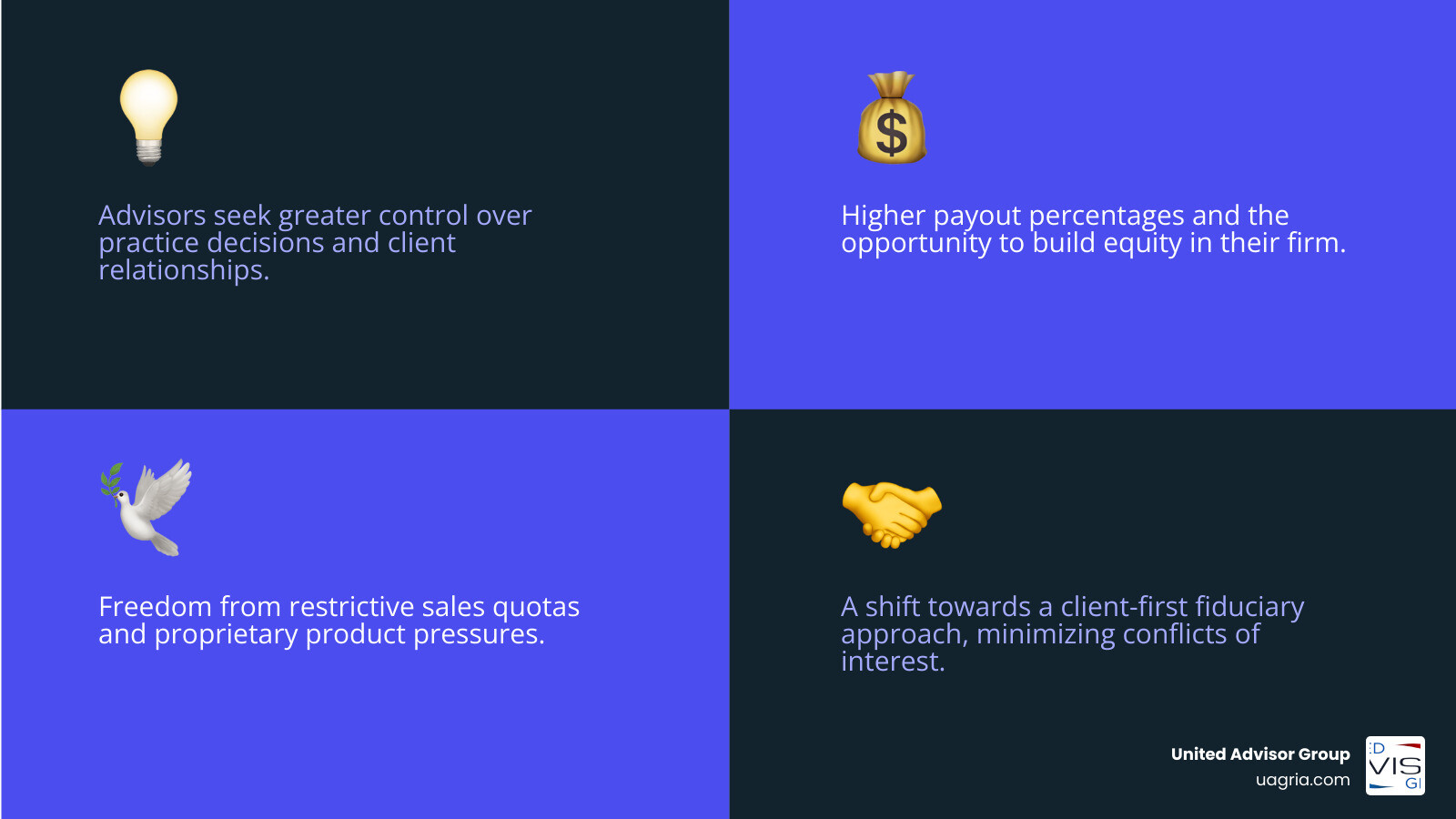
The Great Migration: Why Top Advisors Are Seeking New Opportunities
Something remarkable is happening in our industry. Financial advisors are leaving traditional firms in record numbers to switch RIA firm and accept independence. It’s a fundamental shift in how successful advisors want to build their careers.
The numbers tell the story: in 2022, wirehouses saw a net loss of 612 advisors while RIAs gained 856. Over the last five years, wirehouses lost over 8,000 reps as independent firms gained thousands. By 2028, experts project one-third of all advisors will operate in the RIA space.
What’s driving this exodus? Advisors are seeking the freedom to truly serve clients without corporate interference. Key drivers include:
- Fiduciary Duty: The legal obligation to act in clients’ best interests aligns with why many advisors joined the profession.
- Higher Compensation: Independent RIAs often achieve payouts of 60-70% after overhead, compared to 45-47% at wirehouses.
- Equity Building: Advisors build a valuable asset they can sell, creating a legacy beyond their job.
- Technology: Over half of financial advisors consider switching due to tech limitations at their current firms.
Studies show freedom is the main driver for advisors seeking independence. At United Advisor Group, our Advisor Autonomy Benefits model addresses exactly what these successful advisors are seeking.
The Allure of Independence: Key Benefits of the RIA Model
The RIA model offers true ownership of your professional destiny. The primary “pull” factors include:
- Greater control and flexibility: Choose your own technology, select investments based purely on client needs, and design your own culture.
- Building equity and enterprise value: Your practice becomes a sellable asset, creating wealth that extends far beyond your working years.
- Improved client relationships: Without pressure to sell proprietary products, you can focus entirely on what’s best for each client. This No Proprietary Products approach is key to Enhancing Client Relationships.
- Higher earning potential: Freedom to access the entire marketplace for solutions often leads to better client outcomes and stronger retention.
The “Push” Factors: What’s Driving Advisors to Seek Change?
While independence offers a tremendous pull, many advisors are also being pushed out by frustrating corporate environments. These include:
- Rigid corporate culture that stifles creativity and personalized service.
- Sales quotas that create tension between client needs and management expectations.
- A “hero to zero” mentality where past performance is constantly discounted.
- M&A consolidation that creates instability and declining service levels from corporate.
The combination of these push factors with the compelling benefits of independence explains why so many top advisors are making the move. They’re reclaiming their professional lives and building something that truly belongs to them.
Your Strategic Blueprint to Switch RIA Firm
Making the decision to switch RIA firm requires careful preparation, realistic timelines, and a clear understanding of both opportunities and risks. With the right approach, this can be the most rewarding move of your career.

The due diligence process should begin 6-12 months before your move. This allows time to research partners, understand legal obligations, and prepare financially for the transition. Financial preparedness is critical. With 82% of failing businesses citing cash flow issues, having adequate reserves to cover initial income fluctuations is essential.
When you’re ready to switch RIA firm, you’ll face an important decision about your business model. You can start solo, join an established team, or choose a hybrid approach like the one offered at United Advisor Group. Our model combines independence with comprehensive support systems, specifically designed to address the key problems when moving to RIA from broker-dealer.
Legal & Compliance: Navigating the Minefield
The legal and compliance aspects can feel overwhelming, but they are manageable with proper guidance.
- Employment Contract Review: Your first step is to have an employment attorney review your non-solicit and non-compete clauses. This is a crucial investment.
- The Protocol for Broker Recruiting: This can simplify client transitions, but many firms have left it. Your strategy will depend on whether your firm is a signatory.
- Registration and Form ADV: You’ll need to determine SEC vs. State registration and file a detailed Form ADV, which is a public document.
Partnering with compliance specialists at United Advisor Group is invaluable. We become your ongoing compliance partner, helping you file correctly and stay updated on regulatory changes.
Assembling Your Toolkit: Technology and Partners
Building your independent practice requires the right tools and partners.
- Custodian: This choice is foundational, as your custodian holds client assets and integrates with your technology.
- Tech Stack: Getting your technology right is crucial. Key components include a CRM to manage client interactions, financial planning software for presentations, and professional reporting tools.
- Outsourcing: Consider options like TAMPs for portfolio management and back-office support to improve work-life balance. 95% of advisors who outsource report better work-life balance.
United Advisor Group’s integrated technology and support solutions eliminate the guesswork. We provide a proven technology stack from day one, so you can focus on growing your practice.
Want to see the financial impact of making this move? Access the UAG calculator to see how much more you can earn than you are currently earning. The numbers might surprise you.
The Transition Playbook: A Step-by-Step Guide
With your strategic blueprint in place, it’s time for execution. A well-orchestrated approach is the key to a smooth transition, turning months of planning into action.

Resignation day is a critical, choreographed event. Handle your departure with professionalism, even if your firm doesn’t. Before you resign, understand what you can and cannot take; client lists and notes may legally belong to your firm. Having employment counsel on standby is essential to protect yourself.
Next, focus on business and operational setup. This involves formalizing your RIA structure, obtaining licenses, and completing regulatory filings like your Form ADV. Your office, technology, and back-office systems must be fully functional from day one. Thorough preparation is the common thread in all RIA transition success stories that motivate lasting change. At United Advisor Group, we help streamline this entire process.
Managing the Most Critical Asset: Your Clients
Your clients are your most critical asset, and their successful transition is paramount.
- Communication Plan: Develop a plan that frames the move positively. Focus on the benefits for them, such as access to a wider range of solutions and a true fiduciary approach. Instead of saying “I’m leaving because of restrictions,” try “My new firm gives me access to the entire marketplace to find the best solutions for you.”
- Paperwork and ACATS: Make the client consent and paperwork process as simple as possible. Explain each document and be available for questions. The ACATS process will handle the electronic transfer of assets, which typically takes one to three weeks.
- Minimize Disruption: Be transparent about potential costs, like surrender charges on proprietary products, and work with your new firm to explore reimbursement options.
Advisors who switch RIA firm typically experience about 18% asset loss, less than the 22% for all switching advisors. This difference often comes down to communication and demonstrating the benefits of independent financial advice. United Advisor Group provides dedicated client transition support to ensure your clients feel valued and informed.
Launch and Growth: Beyond the Initial Switch RIA Firm
Completing the transition is just the starting line.
- Onboard and Reaffirm: Schedule meetings with transitioned clients to reintroduce your services, demonstrate new technology, and reaffirm your commitment. They took a leap of faith; show them it was the right decision.
- Develop a Marketing Plan: For the first time, you have full control over your brand. Target your ideal clients with messaging that reflects your unique value. Explore digital marketing, community outreach, and referral programs to achieve organic business growth effectively.
United Advisor Group’s growth resources extend far beyond the transition. We provide ongoing marketing and business development support to help your practice thrive long-term.
Frequently Asked Questions about Switching RIA Firms
Making the decision to switch RIA firm raises many questions. Based on our experience helping hundreds of advisors transition, here are answers to the most common concerns.
How long does it take to switch to a new RIA firm?
Plan for 6-12 months from initial consideration to having clients fully onboarded. This timeline allows for a solid foundation. Factors that influence the timeline include:
- Practice Complexity: Larger practices with intricate investment structures require more time.
- Legal Complications: Disputes over non-compete clauses can add months to the process, highlighting the need for early legal counsel.
- Chosen Model: Joining an established RIA like United Advisor Group is typically faster than starting from scratch, as our infrastructure, compliance, and technology are already in place.
What are the biggest risks when you switch RIA firm?
Understanding the risks is the first step to managing them.
- Legal Risk: Your former firm may claim violations of non-compete or non-solicit agreements. An experienced attorney should review your contract before you make any moves.
- Financial Risk: Expect setup costs and a potential initial income dip. Advisors switching to an independent model typically lose around 18% of assets, a temporary dip that is often offset by higher long-term earnings and equity.
- Client Attrition: Some clients may not follow you. The key is clear communication about how the move benefits them and demonstrating the value of your new independent practice.
Can I take my clients with me?
This answer depends on your employment contract and legal framework.
- The Protocol for Broker Recruiting: If both your current and new firms are signatories, you can generally take basic client contact information (names, addresses, phone numbers, emails) to solicit them.
- Non-Protocol Transitions: If your firm is not in the Protocol, you generally cannot take any client information. Direct solicitation becomes legally risky.
- Legal Counsel is Critical: An attorney specializing in advisor transitions is essential to steer your specific obligations and state laws.
In non-protocol situations, you can typically make a public announcement of your new affiliation. The focus shifts from “taking” clients to allowing them the “choice” to follow you once they learn of your move. At United Advisor Group, we connect you with the right resources to manage this process smoothly. Want to see how much this move could benefit you financially? Access our calculator to see how much more you could earn with our independent model compared to your current situation.
Conclusion: Take Control of Your Future
The opportunity to switch RIA firm is your chance to reclaim your professional destiny. As we’ve explored, thousands of advisors are moving toward independence for greater freedom, higher compensation, and the ability to serve clients without conflicts of interest.
The statistics are clear: Roughly 10% of financial advisors are expected to transition their practices in 2025. They are finding that independence is about building something that is truly yours. Moving from a 45-47% payout to a potential 60-70% while building equity has a life-changing financial impact.
The challenges—legal complexities, income fluctuation, and client attrition—are real. However, they can be managed with a 6-12 month strategic timeline and experienced partners to guide you.
At United Advisor Group, I’ve witnessed how the right support structure can turn what seems like an overwhelming transition into an empowering journey. Our collaborative model addresses the common pain points advisors face when going independent—from compliance headaches to technology frustrations—while preserving the autonomy and control you’re seeking.
Your clients deserve the best version of you as their advisor. You deserve a practice that rewards your expertise and dedication appropriately. The path to independence may require courage, but it’s a path that thousands of successful advisors have walked before you.
Ready to see the financial impact of making this move? See how much more you could earn. Use our calculator to model your future. The numbers might surprise you—and they could be the catalyst that transforms your vision of independence into reality.