

Why Financial Advisors Consider Career Changes
A career change from financial advisor is more common than you might think. Whether you’re feeling burnt out by sales quotas, frustrated with proprietary product pressure, or simply seeking more meaningful work, you’re not alone in questioning your current path.
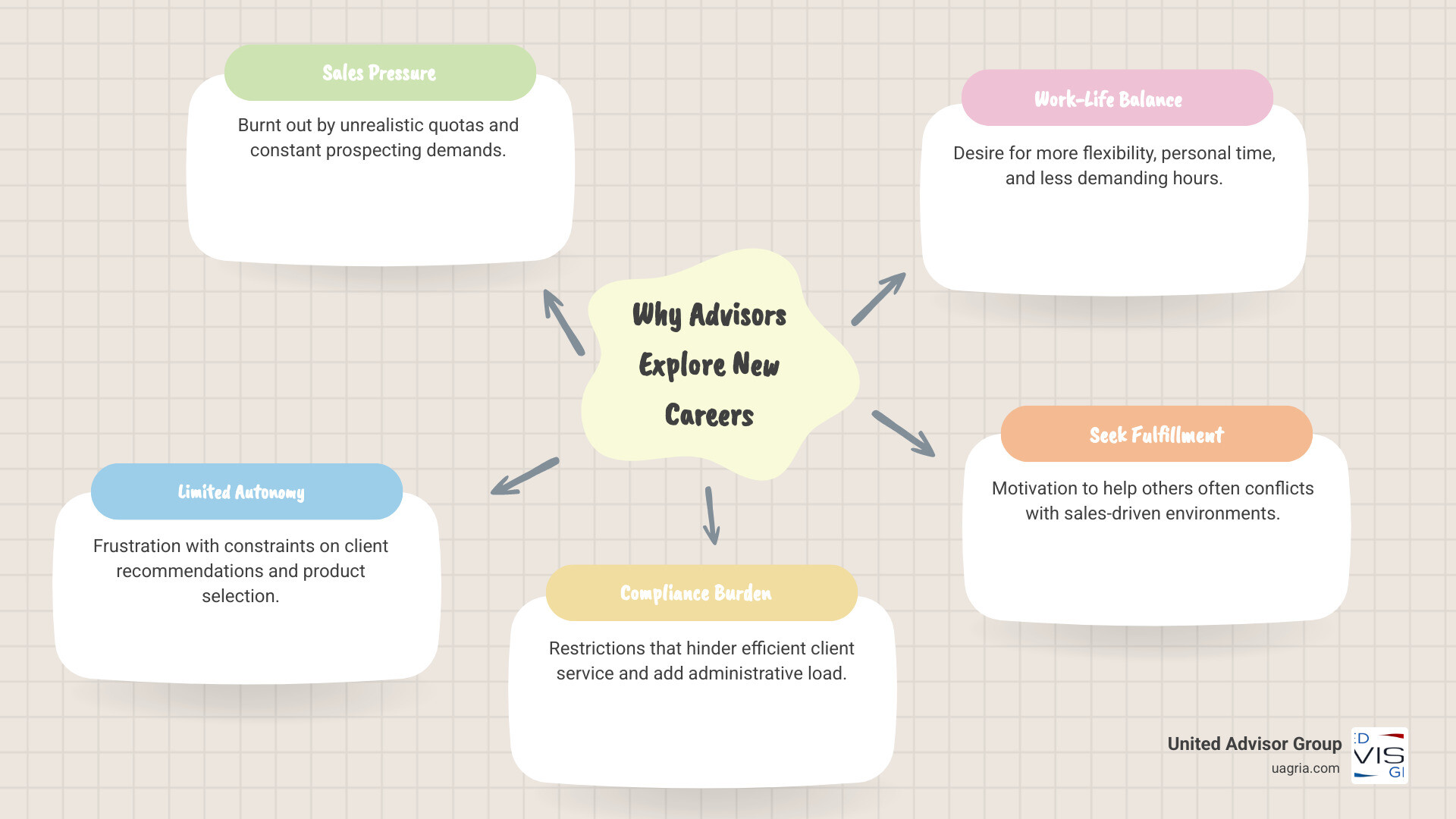
Top reasons financial advisors explore new careers:
- Sales pressure and unrealistic quotas
- Limited autonomy in client recommendations
- Compliance restrictions that hinder client service
- Burnout from constant prospecting
- Desire for better work-life balance
Research shows that most people change careers at least 3 times in their lifetime. For financial advisors specifically, the 2024 Survey of Trends in the Financial Planning Industry found that while a majority are satisfied with their careers, 28% joined the profession to help others – a motivation that sometimes conflicts with sales-driven environments.
The good news? Your advisor background has equipped you with incredibly valuable transferable skills. Client relationship management, analytical thinking, financial literacy, and problem-solving abilities are highly sought after across many industries and career paths.
As Ray Gettins, Director of United Advisor Group, I’ve helped numerous advisors steer the career change from financial advisor journey, whether that means gaining true independence or exploring entirely new fields. My experience shows that advisors often find their most fulfilling path when they can serve clients without corporate constraints or product sales pressure.
Why Your Advisor Skills Are Your Greatest Asset in a Career Change
If you’re considering a career change from financial advisor, you might feel like your skills are too specialized to transfer elsewhere. That couldn’t be further from the truth! Your years as a financial advisor have given you a treasure trove of abilities that employers across industries are actively seeking.

Think about what you do every day. You build trust with anxious clients facing major life decisions. You analyze complex data to create strategies that will impact someone’s future for decades. You explain complicated concepts in ways that make sense to regular people. These aren’t just “advisor skills” – they’re leadership skills, analytical skills, and communication skills that translate beautifully to countless other careers.
The confidence you’ve built through years of helping others steer uncertainty? That’s pure gold in any professional setting. Your ability to stay calm under pressure while managing multiple client relationships simultaneously shows an emotional intelligence that many professionals never develop.
What are the most valuable transferable skills from financial advising?
Your client relationship management expertise is perhaps your most powerful asset. You’ve mastered the art of building trust, often with people who are stressed about money – one of life’s most sensitive topics. This ability to connect with people and manage their expectations is crucial for building stronger client relationships in any future role, whether you’re leading a team or serving customers in an entirely new industry.
Your analytical and strategic thinking capabilities run deep. Every day, you dissect market data, spot trends, and develop long-term plans that account for countless variables. This sharp analytical mind, paired with your ability to think strategically about the future, makes you incredibly valuable in business planning, market analysis, or risk management roles.
Don’t underestimate your financial literacy either. While it might seem obvious to you, your deep understanding of markets, investments, and economic principles is actually quite rare. This knowledge becomes a superpower when you’re managing budgets, making strategic business decisions, or even starting your own venture.
Your communication and empathy skills set you apart from many professionals. You’ve learned to translate complex financial concepts into plain English while genuinely caring about your clients’ fears and dreams. This combination of clear communication and emotional intelligence is invaluable in leadership positions, education, human resources, or any role where you need to connect with people.
Every client scenario you’ve handled has been a problem-solving exercise. From retirement planning puzzles to estate management challenges, you’ve developed a systematic approach to identifying issues, weighing options, and implementing solutions. This methodical problem-solving ability transfers perfectly to project management, consulting, and operational roles.
Your sales and business development experience – even if you’re tired of the sales pressure – has taught you fundamental business skills. Prospecting, presenting ideas persuasively, negotiating win-win outcomes, and closing deals are the building blocks of business growth. These talents become incredibly valuable if you decide to start your own business or move into business development.
Working in the heavily regulated financial industry has given you regulatory knowledge and compliance expertise that many other professionals lack. Your attention to detail and understanding of compliance frameworks makes you attractive for risk management, audit, or legal roles across various industries.
Finally, your market analysis abilities extend far beyond financial markets. The skills you use to interpret market dynamics can be applied to competitive analysis, economic forecasting, or product development in completely different sectors.
The beautiful thing about considering a career change from financial advisor is that you’re not starting from scratch – you’re bringing a sophisticated skill set that took years to develop. Whether you’re exploring new opportunities within finance or venturing into entirely different fields, your advisor background has prepared you to succeed in ways you might not even realize yet.
The Ultimate Career Change from Financial Advisor: Gaining True Independence
Here’s something that might surprise you: the most rewarding career change from financial advisor doesn’t always mean leaving the financial world behind. For many advisors, it’s about changing how they practice within it.
Think of it this way – you became an advisor to help people, right? But somewhere along the line, sales quotas, proprietary products, and corporate red tape started getting in the way of that mission. The independent model offers a path back to your original purpose.

Picture this: no more pressure to sell products that aren’t quite right for your clients. No more explaining why you can’t recommend that perfect solution because it’s not on your firm’s approved list. As an independent advisor, you get to put your clients first – always.
The fiduciary-first approach that comes with independence aligns perfectly with why most of us entered this profession. Statistic about 28% of advisors joining to help others? Independence lets you live that mission every single day.
Building your own brand becomes more than just a business strategy – it’s about creating something that truly reflects who you are as an advisor. Whether you’re passionate about helping young families, guiding business owners through transitions, or specializing in retirement planning, independence gives you the freedom to serve the clients who energize you most.
The escape from traditional constraints is often the biggest relief for advisors making this transition. Those broker/dealer compliance headaches? Gone. The pressure to push specific products regardless of fit? History. True Advisor Autonomy Benefits mean you can focus on what you do best – advising.
At United Advisor Group, we’ve built our entire approach around this philosophy. We believe advisors should serve clients without proprietary product pressures or unnecessary compliance burdens. It’s not just our business model – it’s our mission to help you reclaim your practice.
Now, let’s be honest – this transition isn’t without its challenges. Understanding the Key Problems When Moving to RIA from Broker-Dealer is crucial for a smooth transition. You’ll need to steer new regulatory requirements and build different systems. But here’s the thing: thousands of advisors have successfully made this move, and with the right support, you can too.
The Financial and Professional Rewards of the Independent Model
Let’s talk numbers – because while money isn’t everything, it certainly matters when you’re considering a major career move.
Uncapped earning potential is often the first thing advisors notice after going independent. While the median income for established financial advisors sits around $192,000, independent advisors who build their own practices often see significantly higher earnings. Compare that to the median U.S. household income of $68,700, and you can see the financial opportunity.
But it’s not just about immediate income. You’re building equity in your own business – creating something valuable that you own. This isn’t just a job anymore; it’s an asset you can sell, transfer, or pass down. That’s generational wealth thinking.
The flexible schedule and location benefits go beyond just working from home (though that’s nice too). One advisor we know was tired of the same office, same routine, same constraints every day. Independence gave them the freedom to work with clients in a way that felt natural and energizing.
Serving a niche you’re passionate about changes everything about how you approach your work. Maybe you’re drawn to helping women in tech steer their stock options, or you love working with medical professionals on their unique financial challenges. Independence lets you dive deep into what excites you most.
Perhaps most importantly, no proprietary product sales pressure means every recommendation you make is genuinely in your client’s best interest. The relief and renewed sense of purpose this brings can’t be overstated.
Many advisors find this path after reading RIA Transition Success Stories That Motivate Lasting Change.
If you’re curious about the financial impact of this transition, United Advisor Group offers a calculator to see how much more you can earn than you are currently earning. It’s an eye-opening tool that shows the real financial benefit of leaving your current situation in favor of a model that prioritizes your success and autonomy.
Pivoting Within Finance: Alternative Roles for Your Expertise
Not every career change from financial advisor requires leaving the financial world entirely. Sometimes, the perfect solution is finding a role that lets you use your expertise without the relentless pressure of hitting sales targets or constantly prospecting for new clients.
Think about it – you’ve spent years mastering the intricacies of financial markets, building relationships, and solving complex problems. Why throw all that knowledge away when you can apply it in fresh, exciting ways? Many advisors find their ideal career sweet spot by transitioning into specialized finance roles that feel more like using their superpowers than starting from scratch.
Top 5 Non-Sales Roles in Finance for Former Advisors:
- Corporate Finance Analyst – Dive deep into company financials and strategic planning
- Compliance Officer – Use your regulatory knowledge to keep firms on the right track
- FinTech Product Manager – Bridge the gap between technology and financial services
- Financial Educator/Trainer – Share your wisdom without the sales pressure
- Portfolio Manager – Focus purely on investment strategy and performance
Exploring a career change from financial advisor to a technical or support role
If you’re someone who lights up when analyzing market trends or crafting the perfect financial plan, these technical roles might be your calling. They’re perfect for advisors who want to stay close to the analytical heart of finance without the constant hustle of client acquisition.
Paraplanner roles are incredibly popular among former advisors. You get to do the detective work – researching investments, building comprehensive financial plans, and analyzing client situations – while someone else handles the sales conversations. It’s like being the brilliant strategist behind the scenes, and many find it deeply satisfying.
Investment Research Analyst positions let you become the market expert you’ve always been, just with more focus. Instead of juggling client relationships, you can spend your days diving into company financials, industry trends, and economic indicators. Your insights help guide investment decisions across entire firms.
Internal Wholesaling offers a nice middle ground. You’re still building relationships and sharing knowledge about financial products, but without the intense pressure of closing deals. It’s more about education and support than traditional sales.
Risk Manager roles are perfect for advisors who’ve always been the cautious, analytical type. You get to use your understanding of market volatility and client psychology to help organizations make smarter, safer decisions.
These roles leverage your deep analytical skills without the constant pressure of prospecting. The CFP® certification is particularly valuable here, demonstrating your expertise and commitment to professional excellence.
Venturing Outside of Finance: Where Your Advisor Skills Shine
Here’s where things get really interesting. Your advisor background isn’t just valuable in finance – it’s like having a Swiss Army knife of business skills that work everywhere.
Entrepreneurship might seem scary, but think about it – you’ve been running a mini-business all along. Managing clients, assessing risks, building relationships, creating growth strategies? That’s exactly what successful entrepreneurs do. Your ability to plan, manage risk, and build relationships creates a perfect blueprint for achieving organic business growth in any new venture.
Non-profit financial management combines your financial expertise with the chance to make a real difference. These organizations desperately need people who understand budgets, funding strategies, and long-term financial planning. Plus, you’ll finally feel like every decision directly helps people – no conflicts of interest in sight.
Business Operations Director roles are tailor-made for former advisors. You understand how to optimize processes, manage compliance, and think strategically about resource allocation. Companies across all industries need these skills.
The beauty of stepping outside finance is refinding why you became an advisor in the first place. Whether it was helping people, solving complex problems, or building meaningful relationships, these motivations translate perfectly to new industries where you can make an impact without the traditional constraints of the financial services world.
Frequently Asked Questions about Career Transitions for Advisors
Making a career change from financial advisor is one of those life decisions that keeps you up at night, isn’t it? You’re not alone in having questions – and frankly, some concerns too. We’ve walked alongside countless advisors through this journey, and we know exactly what’s running through your mind. Let’s tackle the big questions head-on.
What is the biggest challenge when changing careers from financial advising?
Let’s be honest here – the two biggest problems are usually money and mindset. The initial income reduction and the psychological reality of “starting over” can feel overwhelming, especially when you’ve worked so hard to build your current position.
One career changer who made the leap from law to financial advising put it perfectly: “I took an 88% pay cut… It was a good three years when I was under-compensated compared to where I had been.” But here’s the part that really hits home – she continued, “As a career changer, you’re used to the respect and prestige that goes with your level of achievement. When you start as an advisor, you start at or near the bottom. You have to be prepared for that step down, not just financially to take that (pay) cut but psychologically.”
That psychological adjustment is real. You’ve likely spent years building expertise and earning respect in your field. Starting fresh can feel like a blow to your professional identity, even when you know it’s the right move long-term.
Here’s what we’ve learned from successful career changers: preparation is everything. A solid financial plan is essential to steer this period successfully. Build that buffer, plan for potential income gaps, and give yourself permission to have a learning curve. The advisors who thrive are those who focus on the long-term rewards of fulfillment and autonomy rather than getting stuck in the temporary discomfort.
Can I start a new career in my 40s or 50s?
Absolutely, and here’s something that might surprise you – some of the most successful career changers we see are in their 40s, 50s, and beyond. The idea that career changes are only for twenty-somethings is completely outdated. Baby boomers averaged 11.7 job changes by age 54, so you’re actually in good company!
Think about what you bring to the table that younger professionals simply don’t have. Your life experience means you’ve weathered economic ups and downs, personal challenges, and professional problems. That translates into genuine empathy and practical wisdom that’s incredibly valuable in any new role.
Your network is probably extensive and well-established by now. Those professional relationships you’ve built over the years? They’re gold when it comes to finding new opportunities or building a client base in a new field.
Most importantly, you have credibility and confidence that comes from already succeeding once. As one advisor who changed careers after 40 shared with us, “Career changers have incredible opportunities in this business. They’ve already developed themselves in another career and built confidence and skills that will translate… They also have life experience to draw on so that they can credibly give advice to clients.”

Many advisors in their 40s and 50s make the change because they’re seeking greater fulfillment, flexibility, or a chance to make a different kind of impact. You’ve earned the right to prioritize what truly matters to you professionally.
How do I leverage my licenses (e.g., Series 7, CFP®) in a new career?
Your licenses and certifications aren’t just letters after your name – they’re concrete proof of your expertise, dedication, and ethical standards. The key is understanding how to position them strategically based on where you’re headed.
Your Series 7 is specifically designed for selling securities, so its direct application depends on your new path. If you’re moving into compliance, operations, or internal support roles within finance, you might not need it actively, but it absolutely demonstrates your deep understanding of market operations and regulatory environments. That knowledge has value everywhere.
The Series 65 becomes crucial if you’re considering the independent RIA route. It’s required to register as an Investment Advisor Representative, though interestingly, advanced credentials like the CFP® can sometimes waive this exam requirement – which shows you just how respected that designation is.
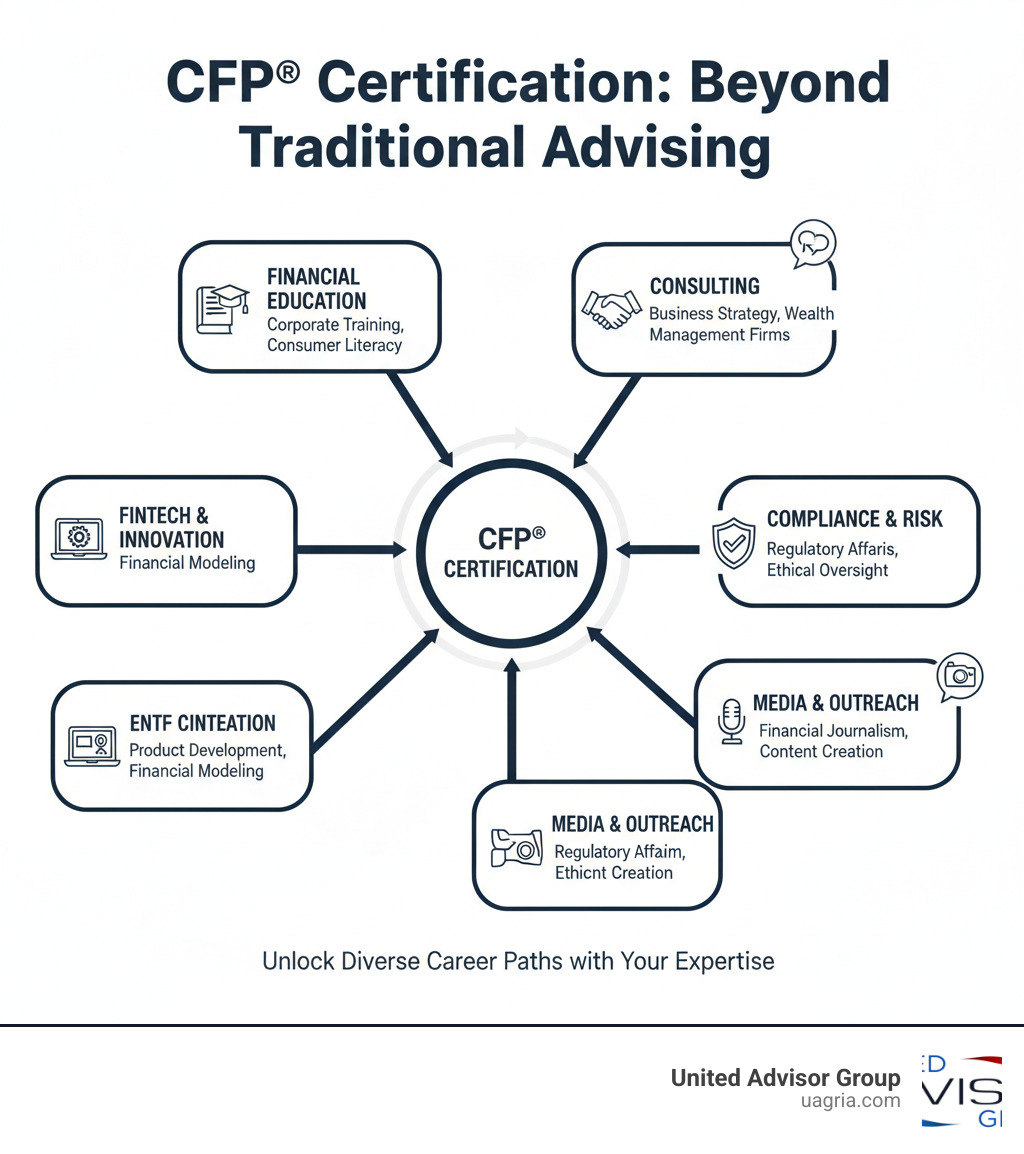
Now, your CFP® certification – that’s your golden ticket. This designation is respected far beyond traditional advisory roles and opens doors in FinTech (where your planning expertise can shape new financial solutions), financial education and training (perfect for teaching others what you’ve mastered), consulting (whether for financial firms or businesses in other sectors), and compliance or risk management roles where your ethical training and best-practice knowledge shine.
Think of these credentials as badges of honor that confirm your expertise and commitment. Even if your new role doesn’t explicitly require them, they serve as powerful differentiators on your resume and during interviews. They tell a story about your analytical rigor, professional standards, and dedication to continuous learning – qualities that are valuable in any field.
Whether you’re pivoting within finance or venturing into something completely new, these certifications represent years of hard work and specialized knowledge. Don’t underestimate their power to open doors and build credibility in your new career path.
Conclusion
Your journey as a financial advisor has been more than just a job—it’s been a masterclass in understanding people, markets, and the delicate balance between the two. Now, as you contemplate what comes next, a career change from financial advisor isn’t about leaving your expertise behind. It’s about taking everything you’ve learned and applying it in new, exciting ways.
Whether you’re drawn to the analytical challenges of a compliance role, the entrepreneurial spirit of starting your own venture, or the teaching satisfaction of financial education, your advisor background has given you a rare combination of technical knowledge and people skills. You’ve mastered the art of translating complex financial concepts into understandable terms, built trust during uncertain times, and guided people through some of their most important life decisions.
But perhaps the most transformative path isn’t leaving the advisory world at all. For many advisors we work with, the ultimate career change from financial advisor means finally practicing the way they always wanted to—with complete freedom to put clients first. At United Advisor Group, we’ve seen countless advisors refind their passion for the profession once they escape the constraints of proprietary products and rigid corporate structures.
Imagine waking up each day knowing you can recommend exactly what’s best for your clients, without worrying about sales quotas or product pushes. Picture building a practice that reflects your values, serves the clients you’re passionate about, and grows at a pace that works for your life. This isn’t just a dream—it’s the reality for independent advisors who’ve made the leap.
The transition to independence does require careful planning and the right support system. That’s where we come in. We specialize in helping advisors steer this journey, providing the infrastructure and guidance needed to build a thriving independent practice. Most importantly, we help you improve client relationships by removing the barriers that often stand between advisors and their clients’ best interests.
Ready to explore what your future could look like? United Advisor Group provides a calculator to show how much more you can earn than you are currently earning. It’s more than just numbers on a screen—it’s a glimpse into the financial freedom that comes with true professional autonomy.
Your next chapter is waiting, and we’re here to help you write it on your own terms.