

Why Financial Advisor Careers Offer Unprecedented Growth and Opportunity
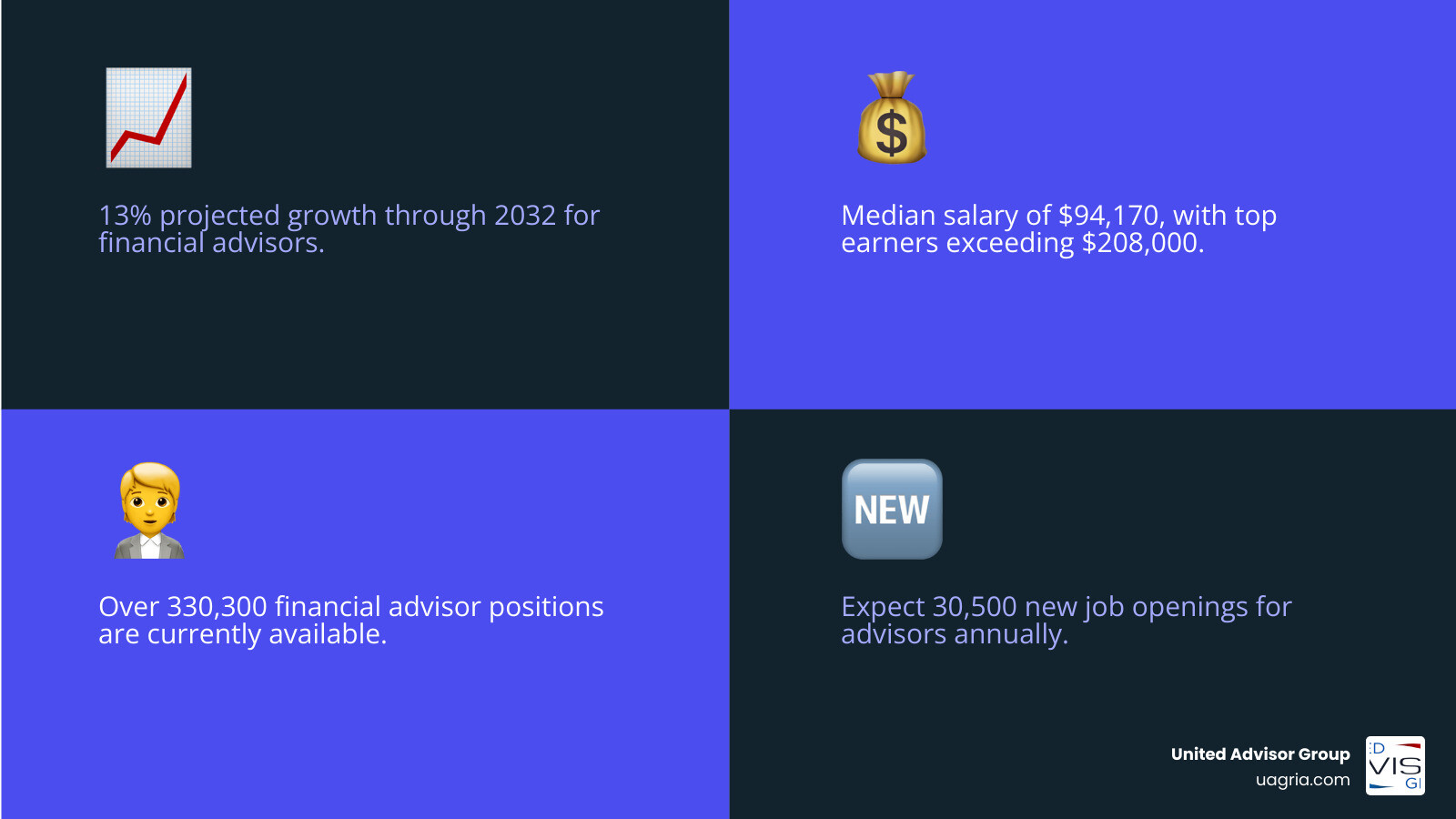
Financial advisor careers are among the fastest-growing and most rewarding professions today. With a projected 13% growth through 2032, a median salary of $94,170, and top earners exceeding $208,000, the opportunity is clear. This field offers job security, flexibility, and the chance to help clients achieve financial security while building your own wealth.
The advising sector is expanding rapidly, with the number of SEC-registered independent advisers increasing by 14% from 2019 to 2023. The workforce now serves 64.1 million clients and manages $128.4 trillion in assets.
Despite this growth, many advisors feel constrained by traditional broker/dealer structures. 71% of advisors report being stressed, and the pressure to sell proprietary products often conflicts with client interests. This raises a critical question: which practice model allows you to maximize both client outcomes and your own professional satisfaction?
The modern advisor landscape offers multiple paths, from traditional wirehouse positions to fully independent practices. Your choice of model dramatically impacts your autonomy, compensation, and ability to serve clients without conflicts of interest.
I’m Ray Gettins, and I’ve dedicated my career to helping exceptional advisors find better ways to serve their clients through United Advisor Group’s collaborative structure. My experience has shown me that financial advisor careers thrive when advisors have the freedom to focus on client needs rather than corporate sales targets.
Terms related to financial advisor careers:
The Modern Financial Advisor: A Day in the Life and Core Responsibilities
Welcome to the dynamic world of financial advisor careers, where no two days are identical. A typical day is a blend of strategic and client-facing activities:
- Client Meetings: The heartbeat of the profession, these conversations range from initial findy sessions to quarterly reviews, helping clients steer everything from college savings to retirement.
- Financial Planning: This is where you craft personalized roadmaps that account for each client’s unique situation, risk tolerance, and goals, requiring both analytical and creative problem-solving skills.
- Portfolio Management: This involves ongoing research, monitoring performance, and making strategic adjustments to stay proactive rather than reactive.
- Prospecting and Marketing: Building your practice requires dedicated time for networking, hosting seminars, or following up on referrals.
- Continuous Learning: Staying current on evolving markets, regulations, and planning strategies is essential to remain valuable to your clients.
- Administrative Tasks: Client documentation, compliance, and practice management are part of the reality, but the right practice model can minimize these burdens.

The Importance of Soft Skills
While technical knowledge is important, soft skills are what build lasting client relationships. The best advisors often act more like counselors than number crunchers.
- Empathy: Money decisions are rarely just about money. Understanding the deeper concerns behind a client’s hesitation allows you to address the real issues.
- Trustworthiness: Clients share their most private financial fears and dreams. This trust is the foundation of the advisor-client relationship and is hard to rebuild if broken.
- Communication: Great advisors translate complex financial concepts into understandable language and, more importantly, listen to what clients are saying between the lines.
- Interpersonal Skills: These skills help you steer difficult conversations with grace, whether explaining a portfolio downturn or delivering hard truths about retirement goals.
- Problem-Solving: Life throws curveballs like job loss, divorce, or illness. Your ability to devise creative financial solutions during these critical moments is invaluable.
More on the essential skills for advisors emphasizes how these qualities often matter more than technical expertise.
Rewards and Challenges of Building a Client Base
Building a client base is both the greatest reward and biggest challenge in financial advisor careers. The satisfaction of seeing clients achieve milestones you helped plan is immense. You develop meaningful relationships that often become genuine friendships built on mutual respect.
Client success stories—the thank-you note from a comfortable retiree or the referral from a family who avoided financial disaster—become your professional fuel.
However, the path has challenges. The industry’s high-stress environment is well-documented, and constant prospecting can feel overwhelming. Market volatility creates pressure from clients, and the emotional weight of managing other people’s futures can be substantial. Many advisors find relief by focusing on organic growth strategies that align with relationship-focused practices, helping build sustainable growth without sacrificing well-being. Secrets to Achieving Organic Business Growth Effectively explores these approaches.
Navigating Your Career Path: Models, Roles, and Advancement
The beauty of financial advisor careers today lies in the variety of paths available. Understanding your options is crucial to finding where you’ll truly thrive, whether you’re starting out or seeking a change.

Choosing the Right Practice Model: Finding Your Fit
The biggest decision is choosing between traditional employment and independence. Many advisors start at traditional firms for the structure and brand recognition but often face limitations. At United Advisor Group, we’ve seen countless advisors flourish after transitioning to independence. Here’s how the models compare:
| Feature | Traditional Firm Employment | United Advisor Group’s Supported Independent Model |
|---|---|---|
| Autonomy | Limited decision-making power, corporate mandates | Full control over your business and client relationships |
| Compensation | Base salary plus bonus tied to company products | Higher payout potential with transparent fee structures |
| Support | Corporate infrastructure with rigid rules | Comprehensive back-office support with flexibility |
| Compliance | Complex internal rules layered on regulations | Streamlined guidance focused on what matters |
| Product Offerings | Restricted to company-preferred options | Complete freedom to choose what’s best for clients |
Our independent model provides supportive infrastructure without the handcuffs. You get the tools you need—technology, compliance, marketing—while maintaining control. We emphasize flexible product access and streamlined compliance, so you spend more time with clients. While the transition requires planning, the Advisor Autonomy Benefits are substantial. Key Problems When Transitioning to Independence walks through common problems and how to overcome them.
Specializations and Opportunities for Career Advancement
Specializing can set you apart. Popular niches include:
- Retirement planning: Expertise in Social Security, 401(k) rollovers, and income strategies is in high demand.
- Wealth management: Serving high-net-worth clients with complex investment, tax, and estate strategies.
- Estate planning: Helping families preserve their legacy across generations.
- Niche markets: Focusing on specific professions (doctors, business owners) or life situations (divorcees) allows you to develop deep expertise.
Advancement can lead to roles like Senior Advisor, Partner, or Practice Owner. Certifications are crucial, with the CFP from the Certified Financial Planner Board of Standards being the gold standard.
Exploring Diverse Financial Advisor Careers and Roles
The advisory world is diverse. Fee-based advisors use a hybrid compensation model, while hybrid models offer flexibility in structuring compensation per client. Private client advisors provide comprehensive wealth management to wealthy families. For those interested in top-tier service, roles like an independent fiduciary or virtual family office offer institutional-level support to individual families, as detailed in Understanding Independent Fiduciary & Virtual Family Office Roles. The key is finding a model that aligns with your values and lets you put clients first.
The Economics and Realities of Financial Advisor Careers
Let’s get real about what financial advisor careers pay and what the day-to-day experience is like. Here’s the unvarnished truth about earnings, challenges, and common myths.
Earning Potential and Compensation Structures
The earning potential varies dramatically by path, but the ceiling is remarkably high. The Bureau of Labor Statistics reports a median salary of $94,170 and a mean salary around $150,000, with top performers exceeding $208,000. However, these numbers don’t capture the unlimited income potential of building your own practice.
Fee-based models, particularly those based on AUM fees, align your income with your clients’ success. As their portfolios grow, your compensation scales naturally. While traditional salary plus bonus structures offer stability, the entrepreneurial upside of independence is often far greater, as every new client directly impacts your bottom line. The BLS data on advisor pay provides a baseline, but practice models open up different earning potentials.
The Pros and Cons: A Balanced View
This career offers genuine rewards and challenges. The meaningful work of helping families secure their future is profound. The flexibility and entrepreneurial freedom, especially in independent models, allow you to design a career that fits your life.
However, the challenges are real. The high stress is significant, with a study on Work-Life Balance and Burnout in Financial Planning Profession finding that 71% of advisors feel stressed. Market volatility pressure from clients during downturns and the resilience needed to build a client base can be demanding. The regulatory burden can also feel overwhelming.
Common Misconceptions Debunked
Let’s clear up some myths about financial advisor careers:
- “It’s all sales.” The core of the job is problem-solving and relationship building. Great advisors are teachers and counselors, not salespeople.
- “You must be a math genius.” Strong analytical skills matter, but clear communication is more important than advanced calculus. Sophisticated software handles most heavy number-crunching.
- “It’s a 9-to-5 job.” The work offers flexibility, not rigid hours. You manage your own schedule, which may include evening meetings or weekend calls.
- “You have to be an extrovert.” Authenticity and deep listening skills are far more valuable than being the most talkative person in the room. Many successful advisors are thoughtful introverts.

The key to success lies in finding a practice model that aligns with your values and provides the support and freedom you need to thrive.
The Evolving Industry Landscape: Trends, Tech, and Compliance
The world of financial advisor careers is changing faster than ever. Understanding these shifts is essential for your success, whether you’re just starting out or considering a move.
The Future Outlook for Financial Advisors
The future for advisors looks incredibly bright. The U.S. Bureau of Labor Statistics projects a 13% growth rate for the industry through 2032, nearly double the average for other professions. This strong demand is driven by several factors:
- An aging advisor workforce: With the average age of financial advisors at 56, a wave of retirements is creating massive opportunities for succession planning and growth.
- Rising client demand: The number of clients working with advisors is climbing, fueled by baby boomers entering retirement, the decline of traditional pensions, and increased intergenerational wealth transfers.
The Investment Adviser Industry Snapshot 2024 confirms this positive outlook, showing steady expansion. This growth gives advisors leverage to seek out better opportunities, like independence and client-first service models.
Technology’s Impact on the Advisory Role
Technology isn’t replacing advisors; it’s making us more effective. Digital planning tools, artificial intelligence, and CRM software handle routine tasks, freeing us to focus on what robo-advisors can’t: providing empathy, navigating complex family dynamics, and offering the human touch clients need during major life decisions. Digital marketing also levels the playing field, allowing independent advisors to establish thought leadership and reach new clients.
Navigating Regulation and Compliance
Understanding regulation is crucial, especially for advisors considering independence. The fiduciary duty is the gold standard, legally requiring Registered Investment Advisors (RIAs) to act in their clients’ best interests. This contrasts with Regulation Best Interest (Reg BI), which applies to broker-dealers. The SEC regulates RIAs, while FINRA oversees broker-dealers. You can find more in the SEC’s General Information on the Regulation of Investment Advisers.
At United Advisor Group, our independent structure is designed to eliminate compliance headaches. You operate under a clear fiduciary standard without the complexity of product quotas, aligning with our commitment to No Proprietary Products and letting you focus on client needs.
Diversity and Inclusion in the Financial Sector
Our industry is recognizing that diversity is good business. Current representation of Hispanic, Asian, and Black planners remains low, representing a huge opportunity. As noted in Minority Clients Want Culturally Diverse Advisory Firms, clients increasingly seek advisors who understand their cultural backgrounds. Diverse teams bring different perspectives that lead to better client outcomes. For advisors from underrepresented backgrounds, independence can offer the freedom to build a practice that reflects your values and serves your community.

Frequently Asked Questions about Financial Advisor Careers
When considering financial advisor careers or a career change, certain questions always come up. Here are my answers to the most common ones.
How does compensation differ between an independent advisor and one at a traditional firm?
At traditional firms, you typically receive a salary plus a bonus, which is often tied to selling proprietary products. Payout grids can be frustrating, with a large portion of the revenue you generate going to the firm. In contrast, independent advisors enjoy more favorable compensation. Income often comes from AUM fees, meaning your earnings scale directly with your clients’ success. The salary and bonus structure of traditional firms caps your potential, while independence offers higher payout potential and true entrepreneurial upside.
What is the biggest challenge when transitioning to independence?
The biggest problems are often operational. Setting up compliance, integrating technology, and developing a marketing plan can feel overwhelming without a large firm’s back office. Many advisors worry about handling administrative tasks on their own.
However, these challenges are temporary, while the long-term benefits of autonomy are permanent. At United Advisor Group, our support structure is built to solve these exact problems, helping you steer the transition smoothly. Our RIA Transition Success Stories That Motivate Lasting Change show how other advisors have successfully made the leap.
Is a financial advisor career still viable with the rise of digital tools?
Absolutely. Technology is a powerful tool, not a replacement. Robo-advisors can’t provide human empathy during a market crash, steer the complex planning of a business succession, or build trust like a human can. Financial decisions are deeply personal and emotional. Technology improves our ability to provide holistic advice by handling data analysis and routine tasks, freeing us to focus on the irreplaceable human connection that improves the client experience. Digital tools make advisors more valuable, not less.
Conclusion
Financial advisor careers offer one of today’s most promising professional paths, blending meaningful client work with strategic financial management. While the career has challenges, including high stress and the need for constant prospecting, the rewards are profound: helping families achieve their dreams, building lasting relationships, and enjoying a career with high earning potential.
The industry’s projected 13% growth through 2032 and an aging advisor workforce create abundant opportunities for advancement. The key to open uping this potential is choosing the right model for your goals. The freedom that comes with true professional autonomy and a client-first service model can transform your career satisfaction and success.
At United Advisor Group, we’ve seen advisors refind their passion by breaking free from proprietary product pressures. Our supported independent model provides the freedom to serve clients without conflicts, backed by robust operational support.
If you’re ready to explore what genuine independence could mean for your career and your bottom line, we can show you the possibilities.
Ready to see what true independence could mean for your bottom line? Explore how advisors partner with us and calculate the financial benefits of making the switch. Learn more about our affiliate program. Try our financial benefit calculator.