

Why Faith-Based Investing is Reshaping Modern Portfolio Management
Faith based investing lets investors pursue competitive returns while making sure their money is not working against their convictions. Instead of viewing profit and principle as an either-or choice, the approach treats them as parallel goals.
Key elements:
- Values screening – removing companies that breach core beliefs
- Positive selection – favouring businesses that advance shared values
- Shareholder engagement – using ownership to press for change
- Impact investing – sending capital straight to projects that meet spiritual, social or environmental needs
The trend is far from fringe. Surveys show roughly 7 in 10 Americans want their values reflected in their portfolios, and asset totals measured in the trillions of dollars now follow explicit faith screens worldwide.
For financial advisors, understanding the space is an opportunity to deepen client relationships. As Ray Gettins, Director at United Advisor Group, notes, values-driven strategies dovetail perfectly with the firm’s independent model: advisors can recommend what best serves the client rather than what best serves a parent company’s product list.
What is Faith-Based Investing and Why Does It Matter?
Faith based investing adds a third filter—belief—alongside risk and return. It treats all money management as stewardship, asking not only “Will this grow?” but also “Does this honour what I value?”
The idea is old. The Quakers refused to finance slavery in the 1700s, and John Wesley warned against profiting from harm. Today the concept includes modern tools such as socially responsible investing (SRI) and environmental, social and governance (ESG) analysis, but it is anchored in unchanging religious principles rather than shifting cultural trends.
Core Motivations
- Honouring God (or one’s ultimate moral authority)
- Avoiding complicity in activities considered sinful
- Actively promoting good
- Practising financial stewardship for future generations
Faith-Based Investing vs. ESG and SRI
| Faith-Based | ESG | SRI | |
|---|---|---|---|
| Primary goal | Align with religious doctrine | Manage E,S,G risks | Advance social good |
| Screening source | Scripture / theology | Corporate data | Secular ethics |
| Stability of rules | High (doctrine seldom changes) | Medium | Medium |
Faith-based investors often operate in a narrower universe because certain industries are off-limits, yet the moral clarity can improve client confidence. Advisors looking for ways to integrate conviction and performance can explore custom investment solutions that embed these screens within diversified portfolios.
How Different Religions Approach Investment Decisions
Christianity, Islam and Judaism each supply a distinct yet overlapping framework for values-driven finance. Collectively, adherents of these faiths control trillions of investment dollars, making their guidelines highly influential.
Christian Investing Frameworks
Christians generally view themselves as stewards of God’s resources. Common practices include:
- Avoiding revenue from abortion services, pornography, gambling, alcohol, tobacco and certain entertainment.
- Preferring companies that respect life, family and creation care.
- Measuring success not only in performance but also in “Kingdom impact.”
Large faith-screened mutual funds and ETFs have operated for decades, demonstrating that such screens can coexist with broad diversification.
Islamic Finance and Shariah-Compliant Investing
Shariah law forbids:
- Riba (interest)
- Gharar (excessive uncertainty)
- Maysir (gambling)
It also excludes alcohol, pork, conventional banking and weapons. Portfolios are reviewed by Shariah scholars, and any impure income is cleansed through charitable donations (Zakat). Recent innovations such as green Sukuk bonds show how Islamic finance can address modern challenges like climate change while remaining compliant.
Jewish Values in Investing
Jewish tradition emphasises:
- Tzedakah (charitable obligation)
- Tikkun Olam (repairing the world)
- Ethical business conduct and prudent diversification inspired by Talmudic teaching
Some investors allocate a portion of their portfolio to Israel-focused companies or funds, linking financial success with support for the Jewish homeland. Overall, the objective is to create wealth that can be channelled toward community needs and social improvement.

Building a Portfolio Aligned with Your Beliefs
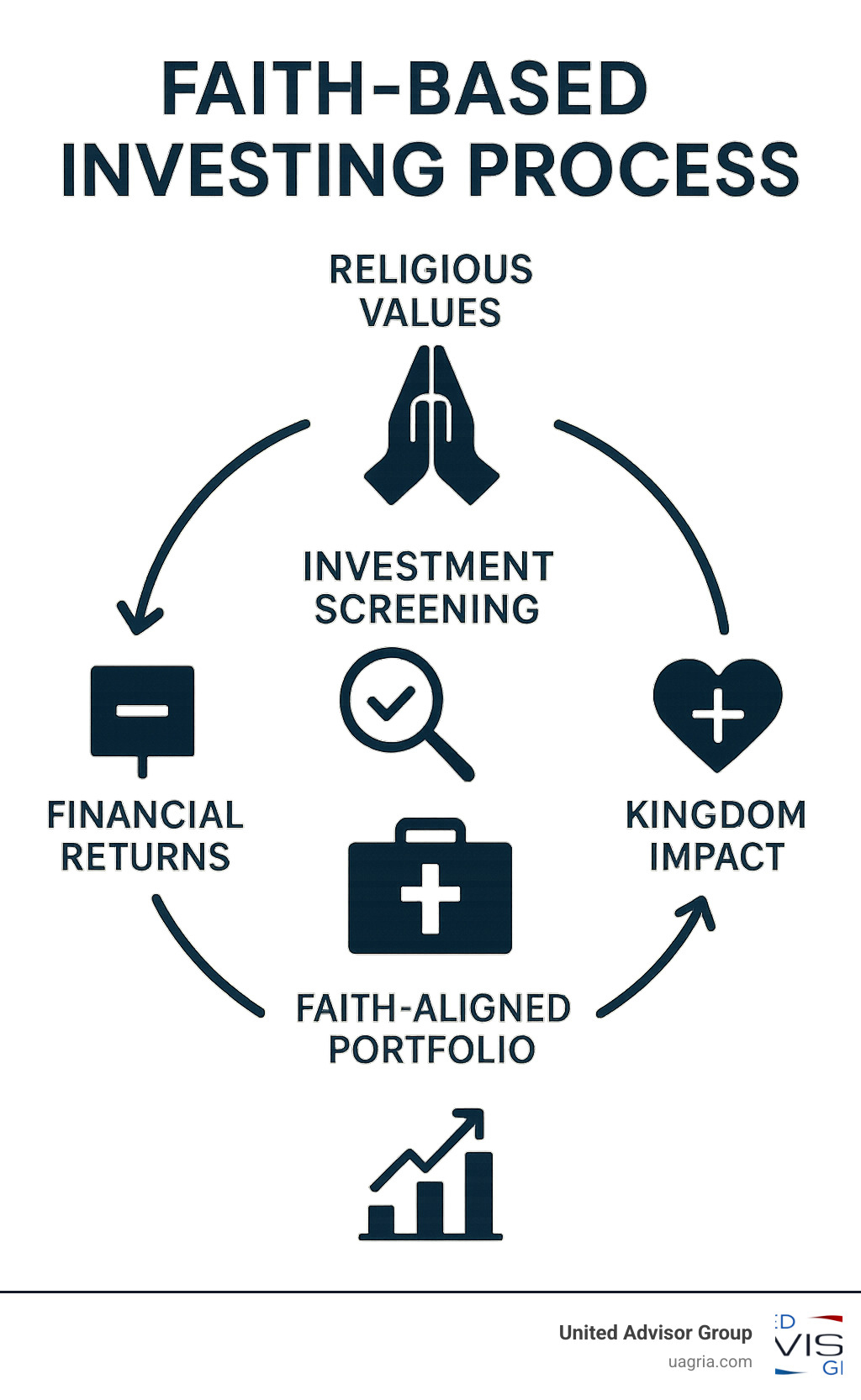
Constructing a faith-aligned portfolio involves three pillars: screening, engagement and impact. Modern data tools make it easier than ever to apply these filters without sacrificing diversification.
The Role of Biblically Responsible Investing (BRI)
BRI rests on the conviction that “God owns everything.” Typical exclusions are abortion services, pornography, gambling, alcohol, tobacco and anti-family entertainment. Providers have expanded from a single mutual fund in the 1990s to dozens of funds and ETFs across multiple asset classes, proving the model can operate at scale.
Screening and Engagement: Two Sides of the Same Coin
Negative screens remove companies that conflict with stated beliefs. Positive screens look for best-in-class operators within acceptable industries. Norms-based screens compare companies with global standards and religious teachings.
Engagement leverages ownership to advocate through proxy votes, dialogues and shareholder resolutions. Research indicates that nearly nine out of ten faith-based organizations use negative screening, and roughly eight out of ten combine it with positive selection and engagement.
Impact Investing in a Faith Context
Impact investing takes the concept further by directing capital into solutions—affordable housing, health clinics, micro-finance or renewable energy—that directly advance faith-aligned goals such as sanctity of life, human dignity or care for creation. A growing repository of case studies can be found through the Global Impact Investing Network.
Performance, Risks, and Getting Started
A common worry is that faith screens will hurt returns. Long-term analyses show little evidence of systematic underperformance; some faith-screened funds have even outpaced their conventional peers over multi-year periods.
That said, two practical issues deserve attention:
- Diversification can narrow if entire sectors are excluded. Advisors may need to use a broader mix of asset classes to compensate.
- Screening and impact research add cost, so expense ratios can be higher. Many investors consider the extra fee the price of peace of mind.
Market cycles matter, too: a portfolio that avoids certain tech or gaming stocks may lag during rallies but also sidestep related downturns. Maintaining a long-term horizon and rebalancing regularly help smooth these swings. For more on general investment risk, see the FINRA guidance.
How to Start Your Faith-Based Investing Journey

- Clarify your convictions: Which industries or practices are unacceptable? Where do you want to make a positive impact?
- Audit your current holdings against those standards.
- Select managers or funds with transparent, well-documented screening processes.
- Work with an independent advisor—such as United Advisor Group—who is free from proprietary product pressures and can customise a strategy around your beliefs.
Seeking independent financial advice ensures your plan balances faith, risk and return.
Frequently Asked Questions about Faith-Based Investing
What types of companies are typically excluded from faith-based portfolios?
When people first explore faith based investing, they’re often curious about which companies get filtered out. The answer depends on your specific faith tradition and the fund’s particular guidelines, but there are some common patterns across different religious approaches.
Christian-based funds typically exclude companies that profit from activities considered sinful according to biblical teachings. This usually means avoiding businesses involved in abortion services and abortifacient drugs, pornography and adult entertainment, gambling and casinos, tobacco products, alcohol production and distribution, and weapons manufacturing. Many Christian funds also screen out companies involved in abortion activism, LGBT activism that conflicts with traditional biblical views, embryonic stem cell research, and in vitro fertilization services.
Islamic funds follow Shariah law and have their own set of exclusions. They avoid conventional banking (due to interest prohibition), alcohol, pork products, gambling, and businesses with excessive uncertainty (gharar). They also steer clear of companies with high debt-to-equity ratios since excessive leverage is considered problematic under Islamic finance principles.
Jewish investment approaches may exclude companies involved in activities that conflict with Jewish values, though the specific criteria can vary widely. Some Jewish investors also avoid companies that boycott Israel or support anti-Semitic activities.
Beyond these core faith-based exclusions, many funds also screen for issues like predatory lending, poor labor practices, environmental damage, and corporate governance problems that conflict with religious teachings about stewardship and social responsibility.
The key is finding a fund or advisor whose screening criteria match your personal convictions. What matters most to one investor might be less important to another, even within the same faith tradition.
Can I apply faith-based principles to my existing 401(k) or retirement account?
This is probably the most practical question we hear from people interested in faith based investing. The short answer is: it depends on what your employer offers, but you have more options than you might think.
Many employer-sponsored 401(k) plans have limited investment menus that may not include faith-based funds. However, the landscape is changing as more employees ask for these options. Some employers are adding socially responsible and faith-based choices to their retirement plans in response to growing demand.
If your current plan doesn’t offer faith-based options, you might have access to a self-directed brokerage window. This feature allows you to invest in a broader range of funds, including faith-based options, though these may come with additional fees. It’s worth asking your HR department about this possibility.
For investments outside your employer plan, you have much more freedom. Individual Retirement Accounts (IRAs) and rollover IRAs typically offer access to the full range of faith-based investment options. You can also apply these principles to any personal investment accounts you maintain.
Don’t overlook the power of advocacy either. Consider speaking with your HR department about adding faith-based options to your company’s retirement plan. As demand grows, more employers are responding by expanding their investment menus to include values-based choices.
The important thing is working with advisors who can help you maximize faith-based investing opportunities within whatever constraints you face. You don’t want to sacrifice important benefits like employer matching contributions just to align with your values – there are usually creative solutions that let you do both.
Is faith-based investing only for very religious people?
Here’s something that might surprise you: while faith based investing is rooted in religious principles, its appeal extends far beyond highly religious individuals. The core idea of aligning investments with personal values resonates with a much broader audience than you might expect.
Many of the companies excluded by faith-based funds are also avoided by secular ethical investors for completely different reasons. For example, tobacco companies are excluded by health-conscious investors, gambling companies by those concerned about addiction, and weapons manufacturers by peace advocates. The screening criteria often overlap, even when the underlying motivations differ.
The strategy really appeals to anyone who wants their financial decisions to reflect their deeply held beliefs, whether those beliefs are religiously motivated or stem from other moral frameworks. Research showing seven out of 10 Americans say their personal values guide their investment choices? That’s a pretty mainstream sentiment.
Faith-based investing might be right for you if you’re:
- A religious individual seeking to align investments with your faith
- A parent wanting to model values-based decision-making for your children
- An investor concerned about corporate social responsibility
- Someone who wants to avoid industries you consider harmful to society
- A person who wants your money to support positive social outcomes
The beauty of this approach is that it provides a structured framework for values-based investing that can be adapted to various belief systems. You don’t have to be deeply religious to appreciate the discipline and moral clarity that faith-based investing brings to financial decision-making.
The key is finding an approach that matches your specific values and convictions, whatever their source. Faith-based investing offers tested frameworks and proven screening methodologies that can help you build a portfolio that truly reflects what matters most to you.
Conclusion
Faith based investing is no longer a niche. Surveys show most investors want their portfolios to echo their values, and assets following explicit faith screens now stand in the trillions.
The stewardship perspective changes the conversation from “How rich can I get?” to “How responsibly can I manage what’s been entrusted to me?” Modern screening, engagement and impact tools mean you don’t have to choose between conviction and performance.
At United Advisor Group, our independent model lets advisors build strategies free from proprietary constraints, so each portfolio can genuinely reflect the client’s beliefs.
Your journey is unique, but the destination is the same: a portfolio that grows wealth and honours what you stand for. Reach out to find how faith and finance can work hand in hand for you and the generations that follow.