
Why Collaborative Financial Planning is Changing the Advisory Industry
Collaborative financial planning is an interactive approach where financial advisors and clients work together in real-time to create, adjust, and refine financial strategies through ongoing dialogue and shared decision-making. Unlike traditional planning that delivers static reports, collaborative planning transforms the advisor-client relationship into a dynamic partnership.
Key Elements of Collaborative Financial Planning:
- Real-time interaction: Using technology to model scenarios during client meetings
- Ongoing engagement: Regular touchpoints and plan updates throughout the year
- Shared decision-making: Clients actively participate in shaping their financial future
- Technology integration: Client portals and interactive software facilitate continuous collaboration
- Transparent process: Clear communication about assumptions, recommendations, and outcomes
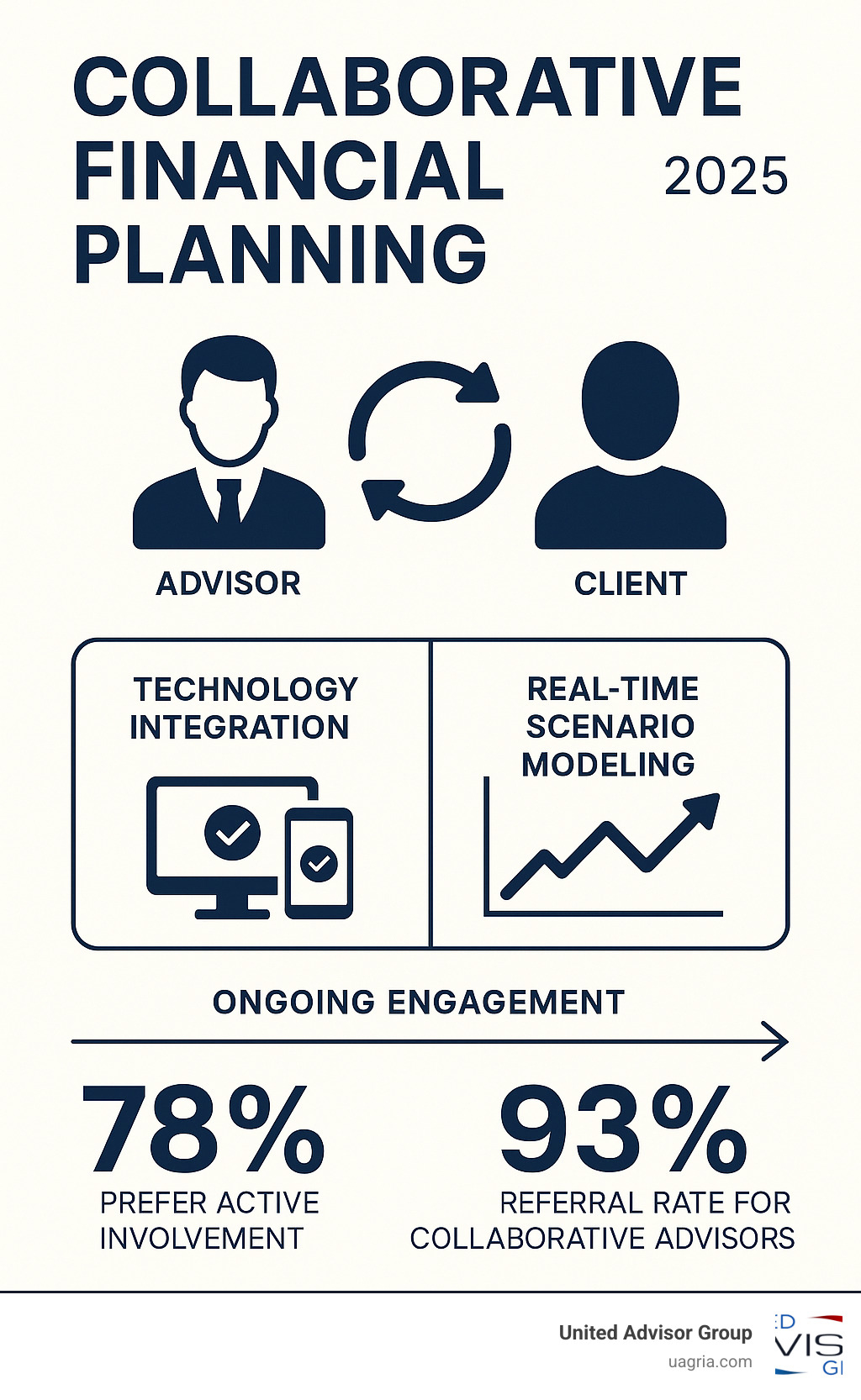
The financial planning industry is experiencing a fundamental shift. Research shows that 78% of consumers want to be actively involved in their financial planning process, yet many advisors still rely on outdated models that treat planning as a one-time event rather than an ongoing journey.
Traditional planning often results in lengthy reports that sit on shelves – what industry professionals call the “thud factor.” These static documents quickly become obsolete as life circumstances change and markets evolve. In contrast, collaborative planning creates living, breathing strategies that adapt in real-time.
For advisors trapped in restrictive broker-dealer environments, collaborative planning represents both an opportunity and a challenge. The approach requires flexibility, advanced technology, and the freedom to put client needs first – elements often missing in traditional firm structures.
The numbers tell a compelling story. Advisors who accept collaborative methods see dramatic improvements across key metrics: 93% receive referrals from existing clients compared to just 60% of less collaborative advisors. Client trust strengthens by 85% when clients feel actively involved in their planning process.
As Ray Gettins from United Advisor Group explains, “Our structure is designed to help already exceptional advisors become even better through the collaboration within the group.” My experience building advisor-focused platforms has shown me that collaborative financial planning thrives when advisors have the independence and tools to truly serve their clients’ best interests.
Why the Future of Financial Advice is Collaborative
The financial advisory landscape is changing fast, and clients are driving that change. Today’s investors don’t want to sit quietly while someone else makes decisions about their money. They want to roll up their sleeves and get involved. This shift toward collaborative financial planning isn’t just a trend – it’s the new reality.
The numbers tell the story clearly: 78 percent of consumers want to be actively involved in their financial planning process. That’s not a small group asking for something extra. That’s the vast majority of your potential clients saying they expect a seat at the table.
Traditional planning methods simply can’t keep up with this demand. Those thick binders full of charts and projections might look impressive, but they often end up gathering dust. Life doesn’t stand still, and neither should financial plans.
The real value comes from creating a dynamic, ongoing process that grows and changes with your clients. When people actively participate in building their financial future, something powerful happens – they actually understand what they’re doing and why. This understanding builds the foundation for lasting trust and genuine peace of mind.
The results speak for themselves: 61 percent of highly collaborative advisors report their clients have peace of mind, compared to just 41 percent of advisors using traditional methods. That’s not just a nice feeling – it’s a competitive advantage that translates into stronger client relationships and better business outcomes.
At United Advisor Group, we’ve built our entire approach around this collaborative spirit. We give advisors the freedom and tools they need to truly partner with their clients, without the restrictions that often come with traditional broker-dealer structures. You can learn more about how we support this approach through our comprehensive Services.
The Shift from Static Reports to Dynamic Conversations
Remember the “thud factor”? That satisfying sound of a massive financial plan hitting the client’s desk? While those thick reports might have impressed clients once upon a time, they often became expensive paperweights before the client even finished reading them.
Today’s approach is completely different. Instead of one-time events, we’re creating continuous journeys where financial planning becomes an ongoing conversation between advisor and client.
Picture this: your client asks, “What happens if I decide to retire three years early?” With modern collaborative financial planning tools, you don’t need to schedule another meeting next week to run the numbers. You can model that scenario right there, in real-time, showing exactly how that decision would impact their financial picture.
This interactive approach naturally leads to more frequent client touchpoints. Advisors using collaborative methods typically connect with existing clients 18 times per year – far beyond the traditional annual review. These regular interactions help you stay ahead of life changes and keep plans current.
This dynamic approach particularly resonates with Millennials and Gen Z, who grew up expecting interactive, transparent experiences. They don’t just want to be told what to do – they want to understand the “why” behind every recommendation and see how different choices play out in real-time.
The Psychology of Collaboration: Building Deeper Client Trust
At its core, collaborative financial planning is about empowerment. It transforms the traditional advisor-client relationship from “expert and student” to “partners working toward shared goals.”
When clients actively participate in shared decision-making, they develop genuine ownership of their financial plan. It’s no longer something that was done to them – it’s something they helped create. This ownership creates deeper commitment and follow-through.
Transparency becomes natural in this environment. Every assumption gets discussed, every projection gets explained, and every recommendation gets explored together. Clients understand not just what they should do, but why it makes sense for their unique situation.
The trust that builds from this process is remarkable. Research shows that clients’ trust in their advisor strengthens by 85 percent when they feel actively involved in their planning process. That level of trust becomes the foundation for long-term relationships and organic growth through referrals.
There’s another important benefit that often gets overlooked. Money decisions create stress in relationships – a recent AICPA survey found that 73 percent of couples experience tension around financial decisions, with 47 percent saying it negatively affects their relationship intimacy.
When you involve both partners in collaborative planning sessions, you’re helping them steer these sensitive conversations together. Instead of one person making decisions that affect both, you’re facilitating discussions that turn potential conflicts into shared goals. You’re not just improving their financial health – you’re strengthening their relationship.
The Business Case for Collaborative Financial Planning
Here’s where the rubber meets the road. While the human connection aspects of collaborative financial planning warm our hearts, let’s be honest – you also need to feed your family and grow your practice. The good news? This approach delivers on both fronts, creating a win-win that boosts your bottom line while genuinely serving your clients better.
The numbers don’t lie. Advisors who accept collaboration see remarkable improvements across every metric that matters: advisor revenue climbs, Assets Under Management (AUM) grow, client retention strengthens, and referral growth accelerates. Perhaps most importantly, your practice becomes more efficient, allowing you to serve more clients without burning out.

Boosting Your Bottom Line: Revenue, AUM, and Income
Let’s cut straight to what you’re probably wondering: does collaborative financial planning actually make you more money? The answer is a resounding yes. According to research from The Growth Of Collaborative Planning, advisors using collaborative approaches report a median revenue of $400,000 per advisor. Compare that to the $260,000 median for those still grinding out custom plans the old-fashioned way.
That revenue boost translates directly into your pocket. Collaborative advisors take home a median of $200,000 annually, compared to $189,000 for their custom-plan counterparts. While that might not seem like a massive difference, consider this: you’re earning more while working smarter.
Here’s the kicker – collaborative plans require only 15 hours per client in the first year, while custom plans demand 19 hours. You’re making more money in less time. That’s four extra hours per client that you can reinvest in growing your practice, serving additional clients, or – thought – actually taking a vacation.
For advisors feeling trapped in restrictive environments that limit their collaborative potential, these numbers represent more than just income. They represent freedom and the ability to build the practice you’ve always envisioned.
Creating a Referral Engine Through Deeper Engagement
When clients truly understand their financial journey and feel like active participants rather than passive recipients, something magical happens. They become your most enthusiastic advocates, creating a referral engine that runs on genuine satisfaction rather than awkward requests for introductions.
The statistics around collaborative planning and referrals are nothing short of remarkable. Highly collaborative advisors see a 33-point higher likelihood of receiving referrals compared to their traditional counterparts. But let’s break that down into real numbers that matter to your practice growth.
Ninety-three percent of highly collaborative advisors receive referrals from existing clients, while only 60% of less collaborative advisors can say the same. That’s not a small difference – that’s a completely different business model. When 68% of highly collaborative advisors report that clients have actively referred others to them (versus just 51% of others), you’re looking at organic growth that compounds year after year.
Think about what this means for your practice trajectory. Clients become 74% more likely to refer others when they feel genuinely involved in their planning process. This isn’t about pushing for referrals or running expensive marketing campaigns. It’s about delivering such an engaging, valuable experience that clients naturally want to share it with people they care about.
At United Advisor Group, we’ve built our entire model around empowering advisors to create these deep, collaborative relationships. When you have the independence and resources to truly put clients first, without proprietary product pressures or restrictive compliance burdens, collaboration becomes natural. Learn more about Why Advisors Choose United Advisor Group and how our platform supports the collaborative approach that drives both client satisfaction and practice growth.
How to Implement a Collaborative Framework in Your Practice
Making the shift to collaborative financial planning doesn’t have to feel overwhelming. Think of it as upgrading your practice from a one-way presentation to a two-way conversation. The key lies in choosing the right technology and building a team that supports this interactive approach.

Before diving into implementation, it’s worth understanding how different planning approaches stack up. The data tells a compelling story about why collaborative planning delivers superior results:
| Planning Approach | First-Year Time Spent (Median Hours) | Revenue Per Advisor (Median) | Take-Home Income (Median) | % Clients with Updated Plans (Median) | Annual Client Touchpoints (Median) |
|---|---|---|---|---|---|
| Collaborative | 15 | $400,000 | $200,000 | 42% | 18 |
| Custom | 19 | $260,000 | $189,000 | 32% | 16 |
| Comprehensive | 13.5 | $419,500 | $250,000 | 24% | 15 |
| Calculator | 17 | $400,000 | $200,000 | 21% | 21 |
(Data derived from Kitces Research on financial planning approaches)
Notice how collaborative planning delivers strong revenue and income while requiring fewer hours than custom planning. More importantly, 42% of collaborative clients receive plan updates throughout the year, compared to just 24% for comprehensive planning. This ongoing engagement is what transforms relationships and drives referrals.
Leveraging Technology for a Seamless Collaborative Experience
The magic of collaborative financial planning happens when technology becomes invisible to your clients but incredibly powerful for your practice. Think of your planning software as the bridge between complex financial concepts and clear client understanding.
Client portals serve as your always-open office. When clients can log in at 10 PM to review their progress or upload documents, they feel connected to their financial journey. The impact is measurable: clients’ trust in their advisors increases by 35 points when using a client portal. That’s not just a nice-to-have feature; it’s a trust-building powerhouse.
Interactive software features turn static meetings into dynamic workshops. Tools like real-time scenario modeling let you answer “What if?” questions instantly during meetings. When a client wonders about retiring three years early, you can show them exactly what that looks like without scheduling another appointment. These real-time adjustments keep conversations flowing and clients engaged.
Document vaults and secure communication channels round out the technology toolkit. No more lost emails or misplaced paperwork. Everything lives in one secure, organized space that both you and your clients can access anytime.
The beauty of modern planning technology is that it doesn’t complicate your process—it simplifies it. Your clients see clarity and engagement. You see efficiency and stronger relationships.
Top Collaborative Activities and the Role of Your Team
Successful collaboration isn’t about fancy software alone. It’s about knowing which activities create the most value for your clients. Our research reveals five collaborative activities that clients find most valuable.
Stress testing and comparing plan options tops the list. Clients want to know their plan can weather storms and understand their choices. Analyzing their current course of action helps them see where they’re headed if nothing changes. Demonstrating scenarios brings abstract concepts to life—suddenly, the difference between saving $500 versus $750 monthly becomes crystal clear.
Reviewing assumptions and estimates builds confidence. When clients understand why you’re using a 7% return assumption or planning for 25 years in retirement, they trust the process more. Finally, refining recommendations together ensures the plan truly fits their life, not just their numbers.
Here’s where your team becomes crucial. The most effective collaborative meetings often use what’s called the “Kirk-Sulu Method.” Picture this: you’re Captain Kirk, focused on the client conversation and strategic decisions. Your team member is Sulu, handling the technology and data entry. This division lets you maintain eye contact and connection with your clients while the behind-the-scenes work happens smoothly.
Staff support and paraplanners don’t just crunch numbers—they enable the human connection that makes collaborative planning work. When you’re not worried about clicking the right buttons or entering data, you can focus entirely on understanding your client’s needs and concerns.
At United Advisor Group, we understand that building effective teams requires freedom from restrictive compliance burdens. Our advisors have the autonomy to structure their practices in ways that truly serve their clients. Learn more about our approach to Trusted Financial Planner Services.
The goal isn’t just to implement collaborative planning—it’s to create an experience where clients feel heard, understood, and confident in their financial future. When you get the technology and team dynamics right, that’s exactly what happens.
Overcoming Problems and Measuring Your Success
Let’s be honest – transitioning to collaborative financial planning isn’t always smooth sailing. Even the most well-intentioned advisors face bumps along the way. But here’s the thing: these challenges aren’t roadblocks; they’re stepping stones to building a stronger, more successful practice.
The good news? Most obstacles are predictable and completely manageable with the right approach. Think of this as your roadmap for navigating the transition while building something truly exceptional for your clients and your business.

Addressing Common Challenges in Collaborative Financial Planning
The biggest hurdle many advisors face is dealing with client technology barriers. Not everyone is comfortable with new software, and some clients break out in a cold sweat at the mention of online portals. The secret? Start small and keep it simple.
I’ve found that offering brief, friendly training sessions works wonders. Sometimes a 15-minute phone call walking through the basics is all it takes. Choose platforms that feel intuitive, not intimidating. You’re trying to make their lives easier, not turn them into IT experts.
Maintaining consistent engagement is another challenge that keeps advisors up at night. That initial enthusiasm can fade faster than a New Year’s resolution. The solution lies in creating natural touchpoints throughout the year – not just when the markets are volatile or tax season arrives.
Think beyond the quarterly check-in. Share relevant articles, send quick market updates, or simply ask how their kids are doing in college. These small gestures keep the relationship warm and make the financial conversations feel more natural when they happen.
Time management concerns are completely valid, especially when you’re used to the “set it and forget it” approach of traditional planning. This is where building the right support structure becomes crucial. You don’t need to handle every technical detail personally – that’s what skilled team members are for.
The key is setting clear expectations from day one. Be upfront about what collaboration looks like in your practice. Explain how the process works, what you’ll need from them, and what they can expect from you. This transparency helps build initial trust and prevents misunderstandings down the road.
How to Assess and Improve Your Collaborative Practices
The beauty of collaborative planning is that it naturally creates opportunities for improvement. Your clients become your best coaches, helping you refine your approach through their feedback and engagement patterns.
Start by seeking client feedback regularly – not just during annual reviews, but throughout your interactions. A simple question like “How are you feeling about our planning process?” can reveal valuable insights you might miss otherwise.
Pay attention to your engagement metrics too. Are clients logging into their portals? Opening your emails? Responding to your communications? Low engagement often signals that something needs adjusting – maybe your communication style, frequency, or the technology itself.
Communication frequency is a delicate balance. Too little, and clients feel neglected. Too much, and you become background noise. The sweet spot varies by client, so don’t be afraid to ask what works best for each person.
Adapting to client needs is where the art of advising really shines. Some clients love diving deep into the numbers, while others prefer high-level summaries. Some accept technology, others prefer phone calls. Your ability to flex your approach shows true professionalism.
Create a continuous improvement loop in your practice. Regularly review what’s working, what isn’t, and what could be better. This isn’t just about client satisfaction – it’s about building a practice that grows stronger and more efficient over time.
The most successful advisors I know treat their practice like a living, breathing entity that evolves with their clients’ needs and market conditions. They’re never “done” improving, and that mindset is what sets them apart in an increasingly competitive industry.
Conclusion
The financial advisory world is changing right before our eyes, and collaborative financial planning sits at the heart of this change. What we’re witnessing isn’t just another industry trend – it’s a fundamental shift toward how financial advice should actually work.
When you accept this collaborative approach, something remarkable happens. Your clients become true partners in their financial journey, not just passive recipients of your expertise. They understand their plan deeply because they helped create it. They trust you more because they’ve seen exactly how you think through their challenges. And yes, they refer more people to you because they genuinely believe in what you’re doing together.
The numbers we’ve shared throughout this article aren’t just statistics – they represent real advisors building thriving practices. Median revenues of $400,000, referral rates jumping to 93%, and clients who actually have peace of mind about their financial future. These outcomes flow naturally from treating planning as the dynamic, ongoing conversation it should be.
But here’s what many advisors find: their current firm structure often stands in the way of true collaboration. When you’re pressured to sell proprietary products or steer endless compliance problems, it becomes nearly impossible to focus entirely on your client’s best interests. Advisor autonomy isn’t just a nice-to-have – it’s essential for delivering the kind of personalized, responsive service that collaborative planning requires.
This is where practice growth really accelerates. When you have the freedom to choose the best tools, recommend the most suitable solutions, and structure your practice around client needs rather than firm requirements, everything changes. Your energy goes toward building relationships instead of managing bureaucracy.
At United Advisor Group, we’ve built our entire platform around this principle. We believe exceptional advisors shouldn’t be held back by restrictive structures or conflicted incentives. Our model gives you the independence to practice collaborative financial planning the way it was meant to be practiced – with your clients’ interests as the only priority.
If your current firm’s structure limits your ability to adopt a truly collaborative model, it may be time to explore a platform built for advisor independence. The transition might seem daunting, but the freedom to truly serve your clients – and the financial benefits that follow – make it worthwhile.
Ready to see what this could mean for your practice? Calculate the financial benefits of transitioning your practice today and find how much more you could be earning while delivering the collaborative experience your clients deserve.