

Why Family Office Financial Planning Represents the Ultimate Advisor Opportunity
Family office financial planning is a comprehensive wealth management approach that serves ultra-high-net-worth families through integrated financial, tax, estate, and lifestyle services – typically requiring $100+ million in assets for single-family offices or $20+ million for multi-family arrangements.
Quick Reference: Family Office Financial Planning Essentials
- Primary Function: Holistic wealth stewardship across generations
- Key Services: Investment management, tax planning, estate planning, lifestyle management
- Client Threshold: $100M+ (single-family) or $20M+ (multi-family office)
- Structure Types: Single-family, multi-family, virtual/hybrid models
- Advisor Benefits: Higher fees, deeper relationships, comprehensive service delivery
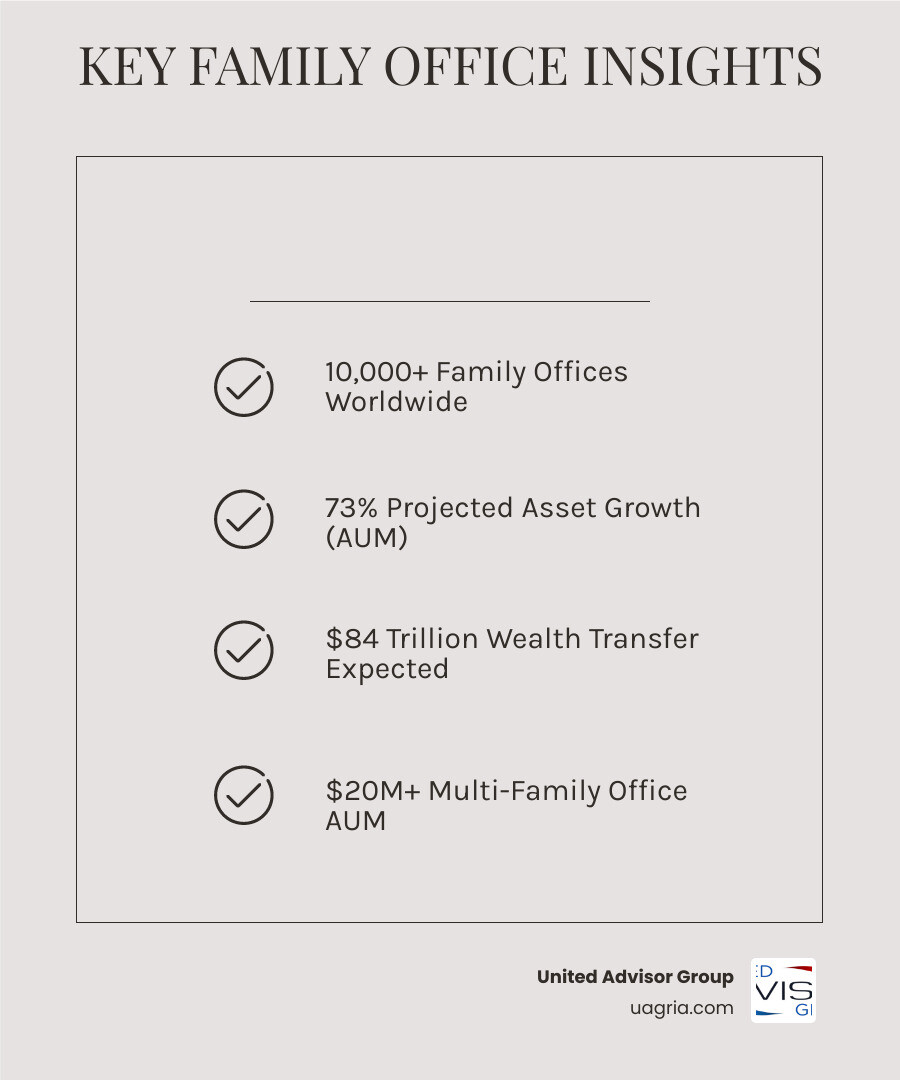
- Growth Opportunity: 10,000+ family offices globally with 73% projected asset growth
The numbers tell a compelling story. Over the past 20 years, global wealth growth has created an estimated 10,000-15,000 family offices worldwide. These sophisticated families – no longer just billionaires but those with $200 million or more in investable wealth – represent an extraordinary opportunity for independent advisors seeking to escape the constraints of traditional broker-dealer models.
Family offices manage far more than investments. They coordinate everything from philanthropic strategies and next-generation education to aircraft management and personal security. The average family office works with 27 different external advisors, creating significant opportunities for skilled professionals who can deliver integrated solutions without proprietary product pressures.
This expanding market offers something most advisors crave: the freedom to truly put client interests first. Unlike traditional wealth management focused primarily on asset allocation, family office financial planning encompasses business succession, intergenerational wealth transfer, family governance, and lifestyle coordination – all areas where independent advisors can demonstrate their highest value.
As Ray Gettins, Director at United Advisor Group, I’ve seen how exceptional advisors thrive when given the flexibility to serve ultra-high-net-worth families through comprehensive family office financial planning approaches. The collaborative structure we provide allows advisors to access the resources and expertise needed to compete in this sophisticated market while maintaining complete independence from proprietary product constraints.
The Family Office Blueprint: Core Models and Advisor Opportunities
Think of a family office as the ultimate command center for ultra-wealthy families. It’s where holistic wealth stewardship meets personalized service, creating an environment that prioritizes privacy, control, and complete customization over everything else.
Unlike traditional wealth management that focuses primarily on investment portfolios, family office financial planning encompasses the full spectrum of a family’s financial and personal needs. We’re talking about a comprehensive approach that weaves together investment strategy, tax optimization, estate planning, and even lifestyle coordination into one seamless experience.
The core functions of a modern family office read like a wish list for wealthy families. Investment management goes far beyond basic portfolio allocation to include sophisticated alternative investments and concentrated position management. Tax planning becomes a year-round strategic initiative rather than an annual scramble. Estate and wealth transfer planning ensures generational wealth preservation through complex trust structures and philanthropic vehicles.
But here’s where it gets interesting for advisors: family offices also handle risk management that extends to cybersecurity and personal protection, family governance that prepares the next generation for wealth stewardship, and lifestyle management that can include everything from yacht maintenance to coordinating international travel.
UHNW families gravitate toward these specialized advisory relationships because their wealth creates unique challenges that standard financial planning simply can’t address. They need advisors who understand that managing $200 million involves completely different considerations than managing $2 million. They want privacy, control, and deeply personalized service from professionals who truly understand their family’s values and long-term vision.

How Family Office Financial Planning Differs from Traditional Wealth Management
For independent advisors considering the family office space, understanding this distinction could transform your practice. The differences go far beyond just the size of client portfolios.
Traditional wealth management firms typically serve broader client bases with standardized offerings focused on investment management and basic financial planning. They excel at retirement planning and portfolio management, but their scope often ends there. Many face internal pressures to promote proprietary products, which can create conflicts between advisor recommendations and client needs.
Family office financial planning operates in an entirely different universe. The expanded scope of services means you’re not just managing money—you’re orchestrating a family’s entire financial ecosystem. This requires a proactive, anticipatory approach where you’re thinking three moves ahead, coordinating with legal and tax professionals, and often anticipating needs before the family even recognizes them.
The advisor relationship transforms from service provider to trusted family strategist. You’re serving a select number of clients with highly personalized solutions, operating under true fiduciary responsibility without proprietary product pressures. This means your recommendations are based purely on what’s best for the family, not what generates the highest commissions.
Perhaps most importantly, family office financial planning integrates non-financial needs seamlessly into the overall strategy. Tax planning influences investment decisions, which affect estate planning, which impacts philanthropic strategies—everything connects.
| Feature | Traditional Wealth Management Firms | Family Office Financial Planning |
|---|---|---|
| Primary Focus | Investment management, financial planning | Holistic wealth stewardship, multi-faceted |
| Scope of Services | Financial, investment, retirement | Financial, legal, tax, estate, lifestyle, governance, education |
| Client Relationships | Broader client base, standardized offerings | Select number of UHNW families, highly personalized |
| Advisor Role | Financial planner, investment manager | Integrated strategist, coordinator, trusted advisor |
| Non-Financial Needs | Limited or outsourced | Fully integrated, concierge services |
| Conflict of Interest | Can be present (proprietary products) | Minimized, true fiduciary standard |
| Asset Threshold | Varies, often lower | Typically $20M+ (MFO) to $100M+ (SFO) |
Exploring Family Office Structures: What Advisors Need to Know
The family office world isn’t one-size-fits-all, and understanding the different structures can help you identify the best opportunities for your practice. Each model offers unique advantages depending on the family’s wealth level, complexity, and desired level of control.
Single-Family Offices (SFOs) represent the gold standard of personalized wealth management. These dedicated entities serve exclusively one ultra-wealthy family, typically requiring $100 million or more in investable assets. According to research from the Family Office Exchange, some of the world’s largest entrepreneurial families have operated dedicated SFOs for decades, demonstrating the longevity and stability this model can provide.
For advisors, SFOs present fascinating opportunities. You might serve as an external specialist working alongside their internal team, bringing expertise in areas like alternative investments or international tax planning. Or you could help a family establish their SFO from scratch—a complex but highly rewarding engagement that can span years.
Multi-Family Offices (MFOs) offer the sweet spot for many independent advisors. These firms serve a limited number of affluent families, typically starting around $20 million in assets, by sharing professional resources and achieving economies of scale. Families get comprehensive family office financial planning services without the overhead of running their own dedicated operation.
This model represents tremendous growth potential for skilled advisors. You can either join an established MFO or, with the right expertise and client base, create your own. The key is maintaining that boutique, highly personalized feel while serving multiple families efficiently.
Virtual or Hybrid Family Offices leverage networks of independent professionals coordinated by a lead advisor or small internal team. This model offers incredible flexibility and cost-effectiveness, particularly for families with global assets or those who prefer keeping certain functions in-house while outsourcing others.
This is where United Advisor Group’s model truly shines for independent advisors. We empower you to act as the central coordinator, bringing together specialists in tax, legal, investment, and lifestyle management. You can provide comprehensive family office financial planning services without building a large in-house staff or dealing with broker-dealer compliance burdens.
The choice between these models often comes down to balancing complexity and cost-effectiveness. As an independent advisor, understanding these nuances positions you to guide UHNW clients toward solutions that perfectly fit their unique needs and long-term objectives.
Understanding Independent Fiduciary Virtual Family Office Roles
Architecting Comprehensive Family Office Financial Planning Services
Building a successful family office financial planning practice isn’t about throwing together a bunch of services and hoping they stick. It’s about creating a carefully designed ecosystem where every piece works together to serve your ultra-high-net-worth families’ complete lives – not just their investment portfolios.
Think of it like designing a luxury home. You wouldn’t just slap together the finest materials without a blueprint. The same principle applies here. Your service model needs to align perfectly with each family’s unique values, quirks, and long-term vision.
One of the most powerful tools I’ve seen advisors use is helping families create a family mission statement. Now, before you roll your eyes thinking this sounds like corporate fluff, hear me out. This process forces families to have conversations they’ve often never had. What does their wealth actually mean to them? How do they want their children to remember them? What legacy do they want to build?
These aren’t just feel-good discussions. They become the foundation for every major financial decision that follows. When a family knows their “why,” every investment choice, tax strategy, and estate planning decision becomes clearer.

Elevating Investment Strategy and Risk Management for UHNW Clients
Here’s where family office financial planning gets really interesting. We’re not talking about the typical 60/40 stock-bond portfolio your average investor might have. Ultra-high-net-worth families live in a completely different investment universe.
The foundation of everything starts with a solid Investment Policy Statement (IPS). This isn’t just paperwork – it’s your roadmap. It captures the family’s objectives, risk tolerance, time horizon, and liquidity needs. More importantly, it gives you clear guidelines when markets get choppy and emotions run high.
Strategic asset allocation for these families goes way beyond traditional investments. We’re talking about alternative investments like private equity, hedge funds, and venture capital. These can offer incredible returns, but they also come with serious complexity and liquidity constraints. Your job is knowing which ones make sense for each family’s specific situation.
Many of your UHNW clients will have concentrated holdings – maybe they built their wealth through a single company or own significant real estate. This creates unique challenges. How do you diversify without triggering massive tax bills? How do you manage the risk of having so much wealth tied up in one asset?
Risk oversight becomes much more sophisticated too. You’re not just worried about market volatility. You’re thinking about operational risk, manager risk, and even what I call “competency risk” – making sure your team’s skills match the complexity of what you’re trying to accomplish.
The families who work with independent advisors like those at United Advisor Group often tell us they appreciate having someone who can focus purely on their best interests, without pressure to sell proprietary products that might not be the right fit.
The Advisor’s Role in Tax and Estate Planning
If investment management is the engine of family office financial planning, then tax and estate planning is the transmission – it’s what makes everything else work efficiently across generations.
Proactive tax minimization is where you can really show your value. This goes far beyond filing annual returns. You’re staying ahead of changing tax laws, implementing tax-efficient investment strategies, and structuring assets using trusts and business entities to minimize liabilities. For families with global assets, the complexity multiplies exponentially.
Wealth transfer strategies are where the real magic happens. Tools like Grantor Retained Annuity Trusts (GRATs) and dynasty trusts can help families pass enormous amounts of wealth to future generations with minimal estate taxes. But these aren’t cookie-cutter solutions – each family’s situation requires careful customization.
Philanthropic planning deserves special attention because so many UHNW families are deeply committed to giving back. Setting up charitable foundations or donor-advised funds isn’t just about tax benefits – it’s about aligning their wealth with their values and creating a lasting legacy. You’re not just structuring these entities; you’re helping families think through their grant-making strategies and ensuring their philanthropic efforts actually make the impact they want.
Expanding Your Value: Lifestyle and Concierge Services
Here’s where family office financial planning really separates itself from traditional wealth management – and where independent advisors can create incredibly deep, lasting relationships with their clients.
When families have significant wealth, they often have significant demands on their time and attention. Lifestyle and concierge services aren’t just nice-to-haves; they’re essential for helping these families focus on what matters most to them. Common services where you can add tremendous value include:
- Bill Pay and Administration: Managing multiple properties, businesses, and investments means just keeping track of everything can become a full-time job.
- Property and Asset Management: This extends to vacation homes, yachts, private aircraft, and art collections, each requiring specialized knowledge and ongoing attention.
- Personal Security: Planning has become increasingly important, especially for families with high public profiles.
- Travel Coordination: This isn’t about booking flights on Expedia; it’s about managing complex international itineraries, often involving private aircraft and multiple family members with different schedules.
- Household Staff Management: Some families need help managing household staff, from nannies and chefs to personal assistants.
- Concierge Services: Fulfilling unique requests—securing tickets to exclusive events, managing specialized collections, or coordinating complex family gatherings.
- Healthcare Coordination: Ensuring families have access to top medical care and helping manage health-related logistics, especially for older family members.
By mastering these aspects of service delivery, you’re not just managing money – you’re enhancing family life. This is what transforms you from a service provider into an indispensable partner. And when you have the freedom to work without proprietary product pressures, like advisors do at United Advisor Group, you can truly focus on what each family needs most.
Building and Operating a Successful Family Office Practice as an Independent Advisor
Making the leap into family office financial planning as an independent advisor requires a fundamental shift in how you think about your practice. You’re no longer just managing portfolios—you’re building a sophisticated business that serves as the central hub for some of the world’s most complex financial situations.
The transition can feel overwhelming at first. You’ll need to define your unique value proposition, build relationships with specialized professionals, and create systems that can handle everything from investment oversight to coordinating a family’s private jet maintenance. But here’s the thing: these challenges are exactly what make this field so rewarding for advisors who are ready to think bigger.
The key is treating your practice like the business it truly is. This means setting clear goals, establishing accountability measures, and building a team (whether internal or through strategic partnerships) that can deliver the comprehensive services UHNW families expect.

Key Considerations for Your Practice: Costs and Client Criteria
Let’s address the elephant in the room: running a family office practice isn’t cheap. But understanding the economics upfront helps you make informed decisions about your business model and client criteria.
The cost structure varies dramatically depending on which model you choose. A single-family office managing around $200 million typically runs between $2 million and $4 million annually—roughly 1% to 2% of assets under management. That might sound steep, but remember, you’re providing far more than investment management.
These costs break down into three main buckets. Internal operating expenses include staff compensation (often the largest line item), office space, technology infrastructure, and cybersecurity measures. Investment advisory fees cover external management, custody, and specialized reporting systems. External professional services encompass legal, tax, accounting, and other specialized expertise that no single advisor can master alone.
Here’s where it gets interesting for independent advisors: complexity matters more than asset size when determining costs. A family with $100 million spread across multiple businesses, international properties, and complex trust structures will require more resources than one with $200 million in straightforward investments.
The traditional thresholds still hold true as starting points. Single-family offices typically require at least $100 million in investable assets, though many families wait until they reach $200 million or more. Multi-family office arrangements can work for families with $20 million or more, thanks to shared resources and economies of scale.
But don’t get too hung up on the numbers alone. The families who benefit most from family office financial planning are those dealing with complexity that goes beyond their asset size. Maybe they’re navigating a business succession, coordinating care for multiple generations, or managing assets across different countries. These situations create value opportunities that justify the comprehensive approach.
Best Practices in Governance for Family Office Financial Planning
One of the biggest mistakes I see advisors make is underestimating the importance of family governance. You can create the most sophisticated investment strategies in the world, but if the family can’t make decisions together, everything falls apart.
Establishing a governing board is often the first step toward sustainable success. Research shows that about 58% of successful family offices have formal boards, typically including four family members plus at least one outsider. That non-family member isn’t just there for show—they bring objectivity and expertise that can be invaluable when emotions run high or difficult decisions need to be made.
Think of yourself as both a financial strategist and a family facilitator. Regular family meetings become crucial for maintaining alignment on goals, educating younger generations, and addressing the inevitable conflicts that arise when significant wealth is involved. These aren’t casual dinners—they’re structured sessions with agendas, action items, and clear outcomes.
Preparing the next generation represents one of your highest-value services as an independent advisor. This goes far beyond teaching investment basics. You’re helping young family members understand the responsibilities that come with wealth, involving them in philanthropic decisions, and gradually introducing them to the complexities of family governance.
The families who do this well create systems that outlast any individual advisor or family member. They build cultures of stewardship that preserve not just wealth, but values and relationships across generations.
Leveraging Technology and a Collaborative Network
Running a modern family office financial planning practice without the right technology and professional network is like trying to perform surgery with a butter knife. It’s theoretically possible, but why would you handicap yourself?
Your technology stack needs to handle complexity that would overwhelm traditional wealth management systems. We’re talking about consolidated reporting across multiple entities, currencies, and asset classes. Document management systems that can organize everything from trust documents to yacht maintenance records. CRM solutions sophisticated enough to track not just financial goals, but family dynamics and personal preferences.
Cybersecurity isn’t optional—it’s existential. UHNW families are attractive targets for cybercriminals, and a single breach can destroy decades of relationship building. This means implementing multi-factor authentication, establishing clear security policies, training your team regularly, and maintaining confidentiality agreements with every external partner you work with.
Here’s where independent advisors have a real advantage: you can build a collaborative network without the conflicts of interest that plague traditional firms. The average family office works with 27 different external advisors—specialized attorneys, tax experts, investment managers, and even personal security consultants.
Your role becomes that of the central coordinator, ensuring seamless communication and unified strategy across all these relationships. It’s what we call the “triangulation of advice” model—separating advice from product sales and custody to eliminate conflicts and keep client interests first.
This collaborative approach allows you to compete with the largest family offices without building everything in-house. You can offer world-class expertise in specialized areas while maintaining the personal relationships and flexibility that UHNW families value most.
Collaborative Financial Planning
Conclusion: Achieve True Autonomy in Serving UHNW Families
The family office financial planning landscape represents more than just another market segment—it’s your gateway to the kind of advisory practice you’ve always envisioned. Here, you’re not just managing portfolios or selling products. You’re becoming a trusted partner in preserving family legacies, nurturing generational wealth, and simplifying the complex lives of ultra-high-net-worth families.
Think about it: when was the last time you felt truly excited about the depth of service you could provide? In the family office world, you’re coordinating investment strategies with estate planning, integrating tax minimization with philanthropic goals, and even managing lifestyle services that genuinely improve your clients’ daily lives. It’s comprehensive wealth stewardship at its finest.
The independence factor changes everything. Without proprietary product pressures breathing down your neck, you can focus entirely on what’s best for each family. No more awkward conversations about why you’re recommending a particular investment when you know there might be better options elsewhere. No more compliance headaches that distract from client service. Just pure, conflict-free advice that puts your clients’ interests first.
For advisors ready to make this transition, the numbers speak volumes. With over 10,000 family offices globally and 73% projected growth in assets under management, the opportunity has never been stronger. The upcoming $84 trillion wealth transfer means families are actively seeking advisors who can handle the complexity of multi-generational planning.
At United Advisor Group, we’ve built our entire model around empowering advisors like you to capture this opportunity. We provide the collaborative network, technology infrastructure, and operational support you need to deliver sophisticated family office services—all while maintaining complete autonomy over your client relationships and service delivery.
You don’t need to choose between independence and resources anymore. Our platform gives you access to specialized expertise in tax, legal, and investment management while keeping you at the center of your client relationships. It’s the best of both worlds: the resources of a large organization with the flexibility of true independence.
Your earning potential transforms when you serve UHNW families through comprehensive family office financial planning. These clients value expertise, pay for results, and build long-term relationships that span generations. They’re not shopping for the cheapest option—they’re investing in the best advisor for their family’s unique needs.
Ready to find exactly how much your practice could grow with true independence? Our calculator shows real numbers based on your current situation, helping you see the financial benefits of making the transition.
Find the financial benefits of true independence with our calculator