

Why the Financial Advisor Recruiting Market Has Shifted in Your Favor
Financial advisor recruiting has shifted from a buyer’s to a seller’s market, creating unprecedented opportunities for experienced advisors. Several key factors are driving this change: with 37% of advisors retiring in the next decade and jobs growing at 15%, a massive talent shortage is emerging. This demand, coupled with transition deals at all-time highs, gives seasoned advisors significant negotiating power.
This new environment means you have leverage. Firms are competing fiercely to attract advisors who can deliver immediate value. However, more options bring more complexity. The key is to look beyond the upfront deal and identify what truly supports your practice’s long-term success.
This guide will walk you through the modern recruiting process from an advisor’s perspective, helping you evaluate opportunities, steer negotiations, and make decisions that align with your vision for growth and client service.
As Ray Gettins, Director at United Advisor Group, I’ve seen that the best career moves happen when advisors prioritize long-term practice building over short-term incentives. Our model is designed by advisors, for advisors, to help you achieve greater independence and better client outcomes.
The Shifting Landscape: Why Top Advisors Are in High Demand
The financial advisory world is changing, putting experienced advisors in the driver’s seat. According to the U.S. Bureau of Labor Statistics, jobs for personal financial advisors are projected to grow by 15% through 2032—three times the average for all occupations. This isn’t just about new positions; it’s a fundamental reshaping of the industry.

This surge is driven by the “great advisor retirement wave,” with over 37% of current advisors planning to retire in the next decade. This creates a massive experience gap just as client expectations are evolving. Today’s investors demand comprehensive wealth management for complex needs like tax planning and multi-generational wealth transfers, fueling demand for sophisticated, holistic advice.
As a result, financial advisor recruiting has become fiercely competitive. Firms are offering unprecedented transition packages, creating incredible opportunities for advisors considering a move. You might find our insights on Secrets to Achieving Organic Business Growth Effectively helpful as you plan your next chapter.
Understanding Your Leverage in a “Seller’s Market”
In short, you hold the cards. The current market dynamics have shifted power to experienced advisors. Firms aren’t just filling desks; they’re seeking partners who can contribute to long-term growth. This scarcity means you have real negotiating power and can demand not just a competitive deal but also the autonomy and support to thrive. The smartest advisors use this leverage to find the right fit—a firm that supports their client service philosophy and career goals.
Key Drivers Pushing Advisors to Explore New Opportunities
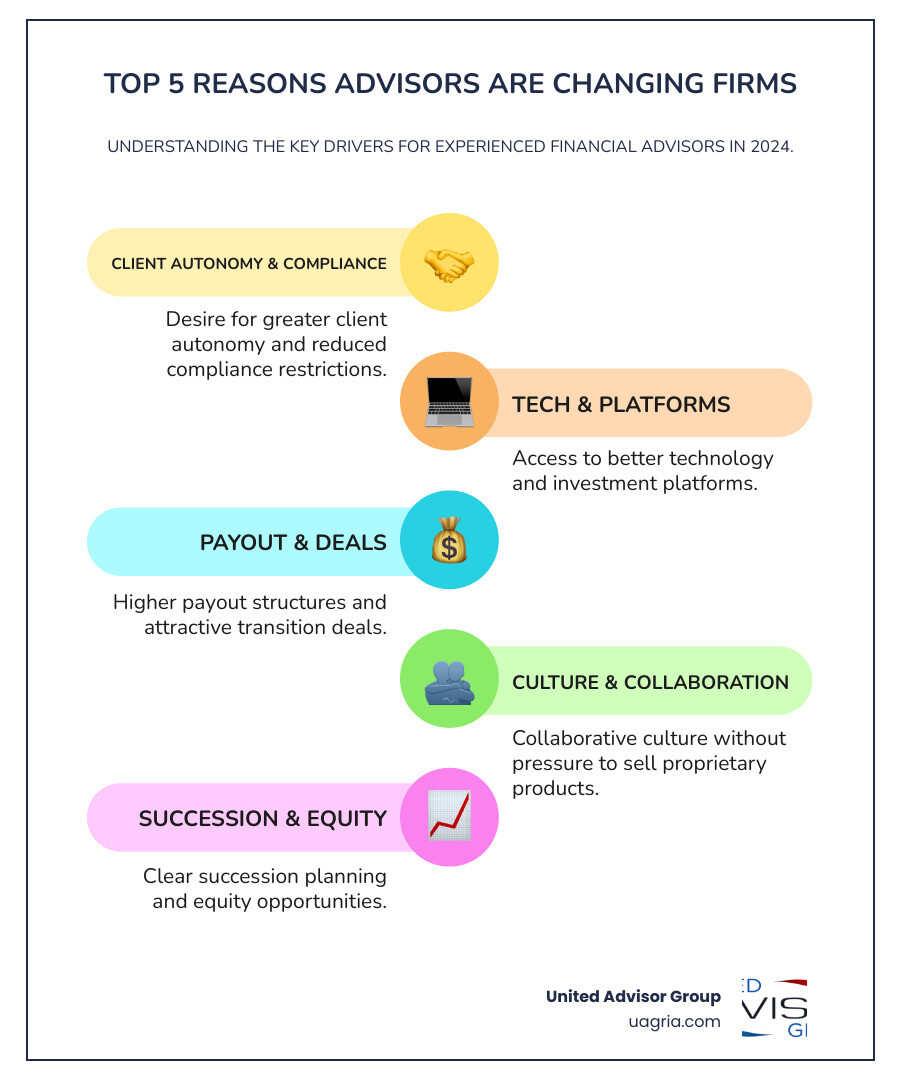
What motivates a successful advisor to move? It’s rarely just about money. The primary drivers are frustrations that hinder their ability to serve clients effectively:
- Desire for Independence: Many feel constrained by bureaucracy, restrictive compliance, and corporate politics. They want the freedom to build their practice on their own terms. Learn more about Advisor Autonomy Benefits.
- Proprietary Product Pressure: Advisors want to provide objective advice, not meet sales quotas for internal products.
- Outdated Technology: Antiquated systems create daily headaches and put advisors at a competitive disadvantage.
- Seeking Better Client Outcomes: Advisors look for environments that empower them to do their best work and prioritize client success.
What to Look For: Identifying Your Ideal Firm and Career Path
A successful transition requires looking beyond the immediate offer to find a long-term home for your practice. You’re choosing a partner that will influence how you serve clients, grow your business, and find professional fulfillment.
The core elements to evaluate include:
- Firm Culture: Does it match your values?
- Technology: Is it modern and empowering?
- Back-Office Support: Does it let you focus on clients?
- Compliance Philosophy: Is it reasonable and transparent, not restrictive?
- Career Development: Are there clear paths for growth and succession planning?
The firm must genuinely prioritize clients’ best interests. This focus is crucial for advisors aiming for significant growth, a topic we explore in What Growth-Minded Investment Advisors Aim to Achieve.
Comparing Firm Structures and Business Models
The advisory landscape offers several distinct models. Understanding their trade-offs is key to finding where your practice can flourish.
| Feature | Wirehouse | Independent Broker-Dealer (IBD) | Registered Investment Advisor (RIA) | Hybrid (IBD + RIA) |
|---|---|---|---|---|
| Payout | Typically lower (30-50%) | Higher (70-90%) | Often 100% minus platform fees | Varies by business line (BD or RIA) |
| Autonomy | Limited; firm dictates products/process | Moderate; some product choice, firm oversight | High; full control over products, services, brand | High for advisory business, moderate for brokerage |
| Compliance | Highly centralized, often restrictive | Centralized, but less restrictive than wirehouse | Advisor responsible, but can outsource or get support | Dual compliance (BD and RIA) |
| Technology | Often proprietary, can be outdated | Varies; may offer choice or proprietary platform | Advisor chooses; can integrate best-of-breed | Mix of BD and chosen RIA tech |
| Proprietary Products | Common; pressure to sell | Less common; broader product shelf | None; full open architecture | None for advisory, limited for brokerage |
| Client Ownership | Often firm-centric | Shared or advisor-centric | Advisor-centric; full client ownership | Mixed, depending on registration |
Hybrid models offer flexibility, blending commission-based and fee-based services. The goal is to find a model that grants the independence and flexibility you need without bureaucratic burdens. True Understanding Advisor Independence is about knowing how these structures impact your daily work. Our Wealth Manager vs Financial Advisor Comparison can also clarify roles within these models.
Aligning Your Values with a Firm’s Culture
Culture is the firm’s DNA. With 90% of advisors citing its importance, getting it right is critical. Look for a culture defined by transparency, collaboration over internal competition, and genuine support for work-life balance. Does the firm’s mission align with your values, and do its leaders’ actions match their words?
To gauge culture, go beyond mission statements. Speak with current advisors, observe interactions during visits, and ask tough questions. A firm that lives its values creates an environment where you feel engaged and respected. Consider if a new firm Can a New Firm Match Your Culture Expectations? before making a move.
Navigating the Financial Advisor Recruiting Process: A Step-by-Step Guide
Transitioning to a new firm can seem daunting, but a strategic, step-by-step approach makes it manageable. Most financial advisor recruiting processes follow a predictable pattern: initial engagement, due diligence, interviews, offer evaluation, and finally, resignation and client transition.

Understanding this flow helps you stay in control. Approaching each stage with intention is key to a successful move. Proper planning makes all the difference, as highlighted in these RIA Transition Success Stories.
Stage 1: The Initial Approach and Vetting Opportunities
This first stage is about opening doors and screening opportunities, whether through a headhunter or your own proactive search. While recruiters offer market knowledge, remember they are paid by the firm. Use your professional network to uncover opportunities as well. Treat initial conversations as mutual interviews—you are screening them as much as they are screening you. Be prepared to sign non-disclosure agreements (NDAs) as talks progress.
Stage 2: The Due Diligence and Interview Gauntlet
Once you’ve identified promising firms, it’s time to separate marketing fluff from substance. You’ll likely provide a business profile (or “T-12”) showcasing your trailing 12-month production. Be accurate to build trust. This is your chance to ask tough questions about their tech stack, back-office support, and compliance philosophy. Insist on speaking with other advisors who have made similar transitions to get a real sense of the firm’s culture and support. For those considering the RIA space, a collaborative compliance environment is crucial for enhancing client relationships, as we discuss in our guide on the Registered Investment Advisor: Enhancing Client Relationships.
Stage 3: Finalizing the Move and Ensuring a Smooth Transition
Executing the move professionally is critical. Carefully review the Letter of Understanding, ideally with legal counsel, to ensure it matches all verbal agreements. Follow industry protocols for advisor transitions to protect your reputation. A quality firm will provide comprehensive support for this process. Keep your resignation professional and concise. Your new firm should help you develop a clear, compliant client communication strategy. A strong onboarding experience, followed by ongoing support for your long-term success, is the hallmark of a true partner firm.
Decoding the Deal: Understanding Compensation in Financial Advisor Recruiting
While it’s natural to focus on the numbers, the “deal” in today’s financial advisor recruiting market is about more than the payout grid. Smart advisors look at the complete picture, which includes:
- Transition Assistance: Upfront bonuses, back-end bonuses tied to performance, and forgivable loans provide financial stability during the move.
- Equity Opportunities: A real ownership stake can be more valuable than cash incentives, allowing you to build wealth as the firm grows.
- Benefits Packages: Comprehensive health insurance, retirement plans, and other perks add significant value to your total compensation.
Understanding these components is key to an informed decision. To learn more about the financial side of independence, see our Insights on Costs Involved in Becoming an RIA.
Beyond the Payout: What a Competitive Offer Includes
A competitive offer invests in your success. Look for technology stipends, marketing support budgets, and business development resources like coaching or prospecting tools. A comprehensive benefits package that supports work-life balance and a robust transition package with administrative and legal support are also hallmarks of a top-tier firm. This is what true Independent Financial Advice enables: compensation structures that reward hard work without artificial limits.
The Long-Term View: Evaluating Equity and Growth Potential
Immediate compensation pays the bills, but equity and growth potential build generational wealth. Look for firms with clear partnership tracks and succession planning support. Less than a third of advisors have a succession plan, so firms that facilitate internal acquisitions create immense opportunities for growth.
The ability to build enterprise value—something you can eventually sell—is the difference between a high-paying job and true business ownership. Your growth potential is tied to the firm’s trajectory, so ensure its strategy aligns with your ambitions. The right structure can open doors to advanced opportunities, which we explore in our guide to Understanding Independent Fiduciary Virtual Family Office Roles. The best deals position you for long-term financial and professional success.
Frequently Asked Questions about the Financial Advisor Recruiting Journey
It’s natural to have questions during the financial advisor recruiting journey. Here are answers to some of the most common concerns we hear.
How long does the financial advisor recruiting process typically take?
The timeline varies based on your needs and the complexity of your practice. A typical transition takes anywhere from six weeks to six months. Factors like your documentation readiness, your book’s complexity, and the firm’s internal processes all influence the speed. The most important thing is not to rush. A thorough evaluation protects your interests and your clients’. A quality firm will respect your need for careful consideration.
Should I use a third-party recruiter or search on my own?
Both approaches have merit. Recruiters offer market knowledge, access to unadvertised opportunities, and negotiation leverage. However, since they are paid by the firm, their allegiance may not be solely to you. A self-directed search gives you complete control but can be time-consuming and may limit your exposure to opportunities. Many advisors find a hybrid approach most effective, using a trusted recruiter while also conducting their own research and networking.
What are the biggest red flags to watch for when evaluating a new firm?
Trust your instincts. If something feels off, it probably is. Key red flags include:
- High-pressure sales tactics: Quality firms respect that this is a major decision and give you space to evaluate.
- Lack of transparency: Vague answers about compensation, support, or firm challenges are a bad sign.
- High advisor turnover: This often points to poor management, a toxic culture, or unrealistic expectations.
- Inflexible compliance: Look for a compliance department that acts as a partner, not a police force.
- Outdated technology: Firms that don’t invest in modern systems often lag in other critical areas.
Take Control of Your Future and Build Your Ideal Practice
The financial advisor recruiting market has shifted in your favor. With high demand and a shortage of experienced talent, you have the leverage to find more than just a better deal—you can find a true partnership to build the practice you’ve always envisioned.
The right move is transformative. Finding a firm that values your autonomy, provides genuine support, and shares your client-first philosophy allows you to stop fighting the system and start thriving. You can build lasting enterprise value and serve clients without compromise.
At United Advisor Group, our model is built to help advisors achieve true independence. We empower you to focus on what matters most: delivering exceptional client outcomes. Your ideal practice is within reach.
Ready to see what breaking away could mean for your practice and bottom line? Use our financial benefit calculator to see the impact of moving your practice to United Advisor Group and learn how to avoid the key problems when moving to an RIA from a broker-dealer. Are you ready to claim your future?