

Laying the Foundation: Understanding Financial Goals for Retirement
What are financial goals for retirement? They are the specific financial targets you set to ensure you have enough money and security to live comfortably when you stop working.
Key financial goals for retirement typically include:
- Income Replacement: Aiming to replace 70% to 90% of your pre-retirement income to maintain your lifestyle.
- Savings Milestones: Reaching specific savings amounts at different ages (e.g., 1x salary by age 30, 10x by retirement).
- Diverse Income Streams: Planning for income from Social Security, pensions, and personal investments.
- Investment Growth: Strategically investing your savings to grow your nest egg while managing risk.
- Budgeting: Creating a realistic budget for spending during retirement years.
- Contingency Planning: Accounting for unexpected expenses like healthcare costs.
Retirement is a dream for many, a long-awaited period of freedom and enjoyment. But achieving that dream without financial stress takes careful planning. Many people find the idea of figuring out how much they need daunting, often wondering: “How much is enough?”
For financial advisors, guiding clients through this can be challenging. Your clients look to you for clear answers and a solid roadmap. This guide is designed for financial advisors like you, offering clear insights and practical steps to empower your clients in achieving their retirement dreams.
I’m Ray Gettins, Director of United Advisor Group. My passion is helping advisors empower their clients to achieve their financial goals for retirement, providing the flexibility and collaboration they need to truly excel.
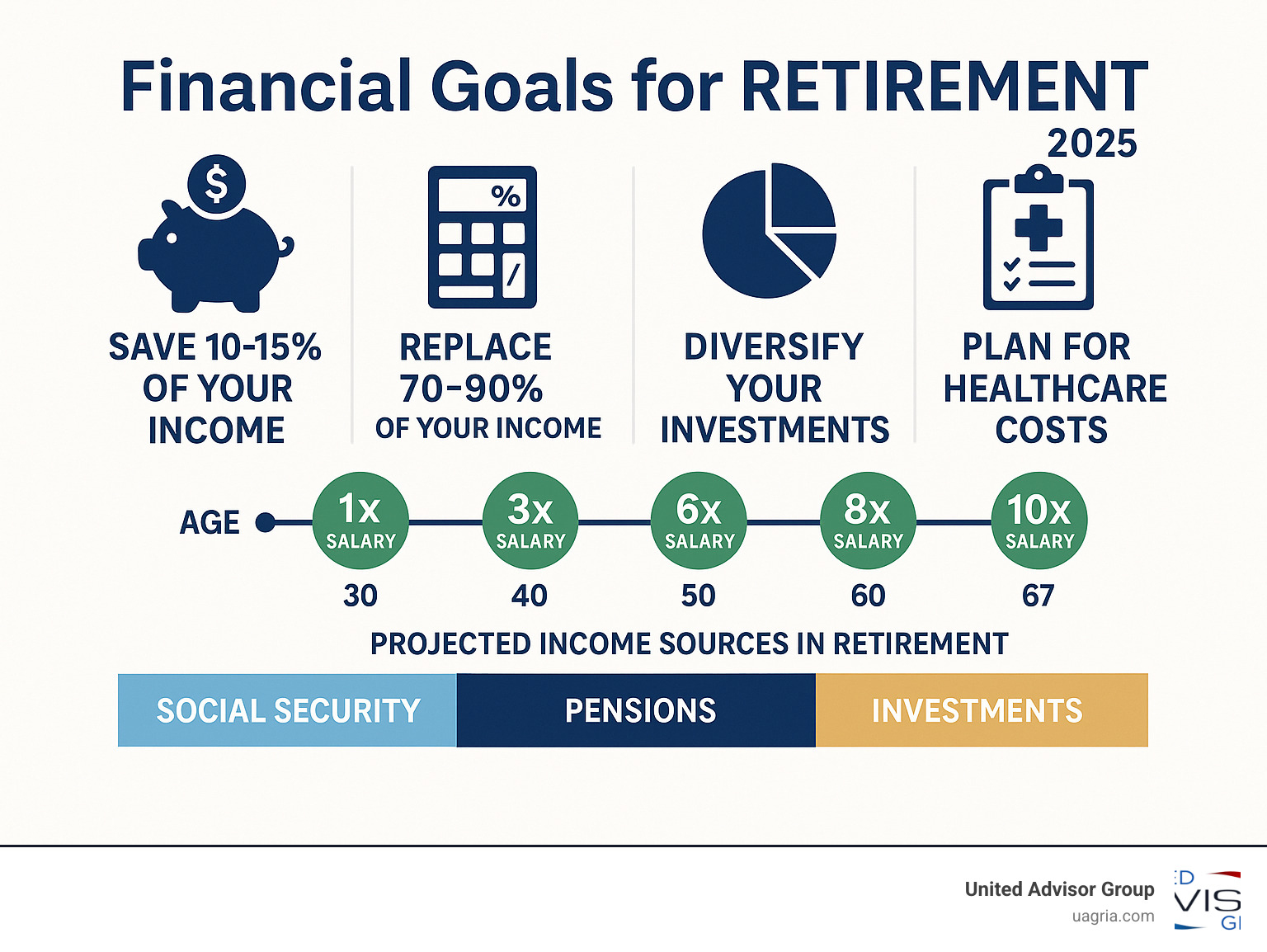
Key financial goals for retirement vocabulary:
The Advisor’s Playbook for Defining Client Retirement Needs

Here’s the truth: only about half of Americans have actually calculated how much they need for retirement. That leaves a massive gap where your expertise becomes invaluable. As an advisor, you’re not just crunching numbers—you’re helping people transform their retirement dreams into concrete, achievable financial goals for retirement.
Every client who walks through your door brings unique circumstances, fears, and aspirations. Your job is to cut through the complexity and give them clarity. When someone asks, “How much do I need to retire?” they’re really asking, “Will I be okay?” Your role is to help them answer that question with confidence.
How to Help Clients Calculate Their “Magic Number”
The magic number conversation starts with understanding what retirement actually looks like for each client. Some dream of world travel and expensive hobbies. Others want to downsize and live simply. This matters because it determines whether they need 70% to 90% of their pre-retirement income to maintain their desired lifestyle.
Here’s where the 4% withdrawal rule becomes your teaching tool. If a client needs $80,000 annually in retirement, they’ll need about $2 million saved. That’s because $2 million × 4% = $80,000 per year. While this rule isn’t perfect (market conditions vary, after all), it gives clients a concrete starting point.
But there’s more to consider. Longevity estimates are crucial—many of your clients will live well into their 90s. Planning for a 30-year retirement instead of 20 can make a huge difference in their required savings.
Inflation impact is the silent wealth killer that many clients don’t fully grasp. A dollar today won’t buy the same groceries in 20 years. Factor in 2-3% annual inflation to keep their purchasing power intact throughout retirement.
Then there’s the elephant in the room: healthcare costs. A healthy 65-year-old couple might need $318,000 just for medical expenses, excluding long-term care. When you include potential long-term care needs, that number can jump to over $400,000. These figures often shock clients, but it’s better they know now than find it later.
Online retirement calculators can help clients visualize their future, but they’re just the starting point. Your personalized guidance is what turns generic projections into actionable strategies. For comprehensive approaches that integrate tax considerations, explore our Retirement and Tax Planning resources.
Setting Realistic Financial Goals for Retirement by Age
Age-based benchmarks help break down overwhelming retirement savings goals into manageable milestones. The 10x salary rule suggests clients should have ten times their final working salary saved by retirement, but getting there requires hitting smaller targets along the way.
Industry benchmarks provide helpful guideposts: 1x salary by age 30, 3x by age 40, 6x by age 50, 8x by age 60, and 10x by age 67. These targets give clients concrete goals to work toward and help you track their progress.
Reality check: most Americans fall short of these benchmarks. The average 401(k) balance for 25-34 year-olds is under $25,000, while 35-44 year-olds average only about $69,000. Student loan debt makes things even tougher—college graduates with loans have roughly half the assets of their debt-free peers by age 30.
Managing client expectations means being honest about these challenges while emphasizing hope. The power of starting early cannot be overstated. Even small contributions benefit enormously from compound interest over decades. As you probably tell clients, “The best time to start saving was 20 years ago. The second best time is today.”
A good rule of thumb is saving 15% of annual income (including employer matches). This might seem daunting for younger clients, but you can help them start smaller and increase their savings rate by 1% annually until they reach this target.
These age-based targets aren’t meant to discourage clients who are behind. Instead, they provide clear direction and help you celebrate progress along the way. Every milestone reached is a victory worth acknowledging, and every adjustment made puts them closer to their retirement dreams.
Architecting a Client’s Retirement Income Strategy
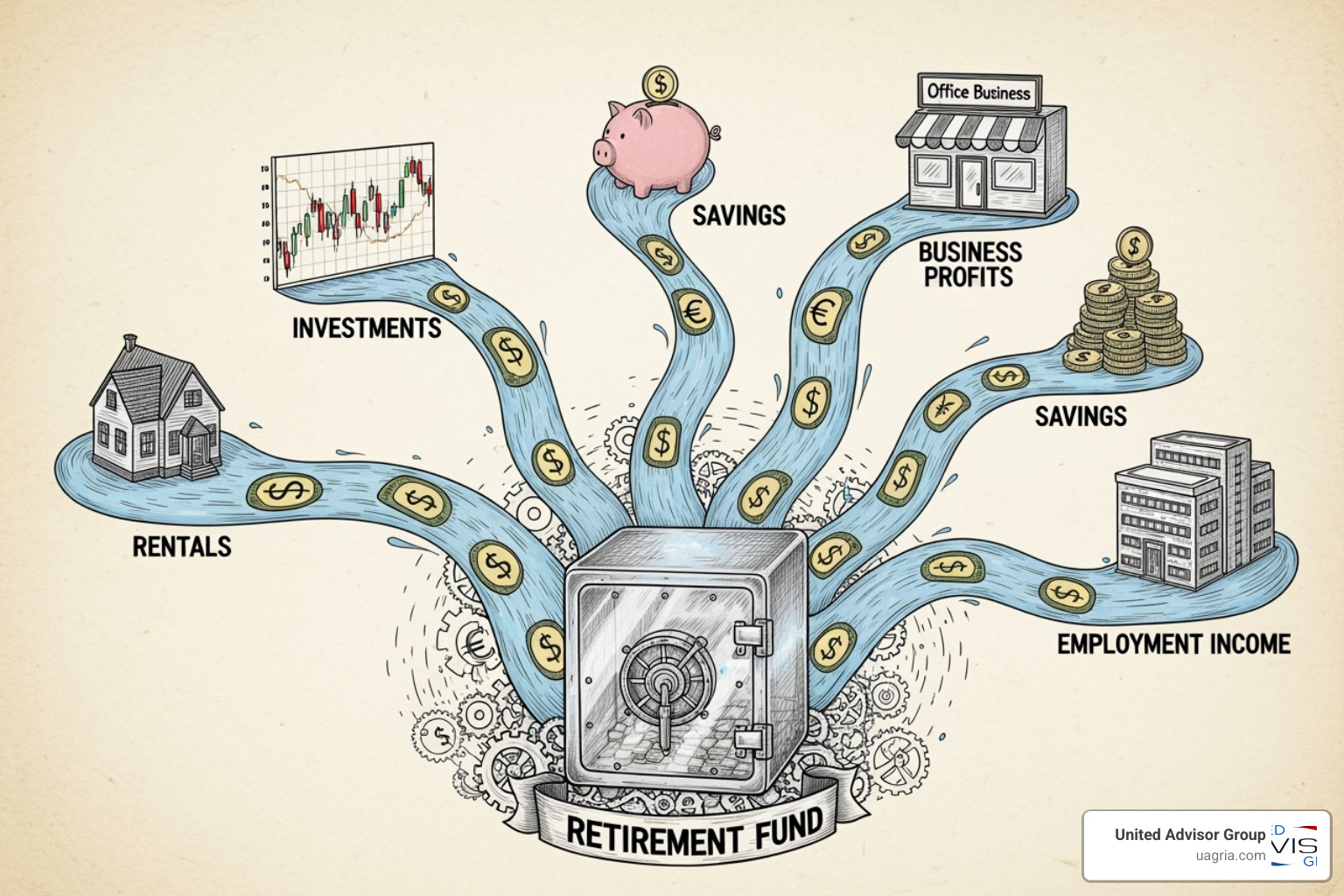
As financial advisors, we know that simply saving money isn’t enough. A truly solid retirement plan needs a smart income strategy. Think of it like building a sturdy table for your client’s retirement. It needs strong, reliable legs to stand firm. Our job is to help them build those legs.
Deconstructing the Three-Legged Stool of Retirement Income
For a long time, we’ve talked about retirement income as a “three-legged stool.” These legs are Social Security, pension plans, and personal savings. We guide clients to see how each part helps create their financial security.
Social Security is a big piece for most Americans. On average, it replaces about 40% of a person’s pre-retirement income. It’s a key foundation, but it’s usually not enough on its own to keep up a comfortable lifestyle. We also need to talk about the future. The Social Security Administration expects that by 2033, they might only be able to pay about 79% of promised benefits. This means we can’t rely just on Social Security. We help clients understand their expected benefits and how choosing different ages to claim can change their monthly income.
Pension plans used to be very common, but they’re less so now. Only about a third of Americans have a pension plan. If your client is lucky enough to have one, we help them understand its value. We show them how it fits with their other income sources. We also teach them about things like vesting schedules and how pensions might transfer if they change jobs.
The third leg, personal savings, is now more important than ever. This includes money saved in 401(k)s, IRAs, and other investment accounts. This is the leg where clients have the most control. So, it often needs to be the strongest. We work closely with clients to make sure their personal savings plans match their overall financial goals for retirement. To see more about how we work together, check out our insights on More info about Collaborative Financial Planning.
Building a Resilient Portfolio to Generate a Fourth Leg
We think it’s smart to add a “fourth leg” to that retirement income stool. This could be a well-diversified investment portfolio that’s set up to create income. It might also involve smart part-time work or even real estate investments. For advisors, this is where you show your ability to think ahead and build truly robust plans.
When it comes to investing, our main goal is to build strong portfolios. These portfolios need to handle market ups and downs but still grow. This means smart asset allocation, which is about balancing different investments like stocks (equities) and bonds (fixed income). We do this based on how long a client has until retirement, how comfortable they are with risk (risk tolerance), and their specific financial goals for retirement. As clients get closer to retirement, we usually suggest moving towards more conservative investments. This helps protect their money. But it’s still key to keep some growth-focused investments to fight off inflation.
Here’s a surprising fact that shows how important our role is: “Nearly one-third of investors — 31% — say they don’t know how their retirement money is invested.” This is a big chance for us as advisors! We need to teach our clients not just how much to save, but how their money is truly working for them. While equities were the most popular retirement investment at 31%, it’s concerning that cash came in second, at 23%. Cash might feel safe, but it often loses buying power over time because of inflation. We help clients understand why it’s vital to have their money invested wisely for their goals, using the power of diversified portfolios.
We also talk about different ways to invest. This includes target-date funds, which automatically change investments over time. We also cover individual ETFs and mutual funds that offer broad market exposure. Our main aim is to create custom investment solutions that truly fit each client’s unique needs. Learn more about how we do this with More info about Custom Investment Solutions.
Addressing Common Client Problems and Providing Advanced Guidance

Let’s be honest—as financial advisors, we rarely encounter clients whose retirement journey has gone exactly according to plan. Life happens. Careers change. Markets fluctuate. Kids need college funding. The reality is that 68% of workers say they could work until retirement and still not have enough saved.
This is where our expertise truly shines. Beyond the spreadsheets and projections, we become problem-solvers, coaches, and sometimes even cheerleaders for clients who feel overwhelmed by their financial goals for retirement. The good news? There’s almost always a path forward, no matter how far behind someone feels.
Actionable Catch-Up Strategies for Clients Who Are Behind
When a client walks into our office feeling defeated about their retirement savings, our first job is to shift their mindset from “I’m doomed” to “Let’s see what we can do.” The statistics might seem daunting, but they also reveal opportunity—if most people are behind, then even modest improvements can put our clients ahead of the curve.
Catch-up contributions are often our first recommendation for clients aged 50 and older. The IRS allows these additional contributions specifically because lawmakers recognized that many people need extra time to build their nest eggs. It’s like getting a second chance, and we make sure our clients take full advantage.
We also champion the “1% solution”—encouraging clients to increase their savings rate by just 1% annually. This approach feels manageable rather than overwhelming. A client earning $75,000 who increases from 8% to 9% is only talking about an extra $62 per month. Most people spend more than that on coffee and lunch. The beauty is that this small change compounds over time, both through habit formation and actual investment growth.
Working longer isn’t always what clients want to hear, but even delaying retirement by two or three years can dramatically improve their financial picture. Their existing savings get more time to grow, they need fewer years of retirement income, and they can potentially increase their Social Security benefits by delaying when they start claiming.
Sometimes the most powerful strategy is simply helping clients reduce expenses and redirect that money toward retirement. We work with them to identify budget areas where they can trim without feeling deprived. Maybe it’s refinancing their mortgage, cutting one subscription service, or choosing to eat out one less time per week. Every dollar saved today becomes multiple dollars in retirement through compound growth.
This proactive, solution-focused approach is exactly what growth-minded advisors aim to achieve with their clients. You can learn more about what growth-minded investment advisors aim to achieve in building successful practices.
Protecting the Nest Egg from Unexpected Events and Early Withdrawals
Building wealth is challenging enough—protecting it can be even trickier. We’ve seen too many clients derail their financial goals for retirement because they weren’t prepared for life’s curveballs or because they made emotional financial decisions during stressful times.
The foundation of protection is a robust emergency fund. We stress this constantly because the statistics are sobering: around 17% of savers have borrowed from their retirement plan. When someone taps their 401(k) for an emergency, they’re not just losing that money—they’re losing all the future growth it would have generated. A $10,000 withdrawal at age 45 could cost them $40,000 or more by retirement age.
Market volatility is another major threat, especially for clients nearing retirement. We spend considerable time educating clients about market cycles and the critical importance of staying invested during downturns. The concept of sequence of returns risk is particularly important—experiencing poor returns early in retirement can devastate a portfolio because withdrawals amplify the impact of losses.
We also stress-test portfolios against various scenarios. What happens if the market drops 30% the year they retire? What if inflation runs higher than expected? These exercises help clients understand their risk exposure and make adjustments before problems arise.
Insurance strategies round out our protection approach. Beyond basic health coverage, we explore disability insurance for working clients and long-term care insurance for retirees. These aren’t fun topics, but they’re essential for protecting decades of careful saving.
This comprehensive approach to wealth protection is central to effective wealth management. For more insights on our holistic approach, explore our wealth management services designed for Cincinnati locals.
Beyond the Balance Sheet: Discussing Non-Financial Goals for Retirement
Here’s something that might surprise newer advisors: some of our most valuable conversations with clients have nothing to do with asset allocation or withdrawal rates. They’re about what retirement actually looks like day-to-day.
We’ve learned that clients who only focus on the financial numbers often struggle with the transition to retirement. There’s fascinating scientific evidence that we think of our future selves as other people entirely, which explains why retirement planning can feel so abstract and why people struggle with the psychological shift when it actually arrives.
Lifestyle planning becomes crucial. We ask clients to paint a picture of their ideal retirement day. Do they want to travel extensively? Pursue hobbies they never had time for? Start a small business? Learn new skills? These conversations aren’t just feel-good exercises—they directly impact financial planning. The couple who wants to spend six months a year traveling needs a very different financial strategy than the couple who plans to stay home and tend their garden.
Social connections often get overlooked but are critical for retirement satisfaction. Work provides built-in social interaction and sense of purpose. When that disappears, some retirees struggle with isolation and boredom. We encourage clients to think about volunteering opportunities, joining clubs, or finding other ways to stay connected and engaged.
Health and wellness planning goes beyond just budgeting for medical expenses. We discuss how clients can stay active, maintain routines, and keep their minds sharp. Physical and mental health directly impact both retirement enjoyment and financial needs.
By integrating these non-financial elements into our planning conversations, we help clients create retirement visions that are both financially sustainable and personally fulfilling. This holistic approach is what transforms good advisors into indispensable trusted partners for their clients.
Frequently Asked Questions for Financial Advisors
As advisors, we’re always refining our approach to best serve our clients. It’s truly rewarding to guide them toward their financial goals for retirement. Here are some common questions we encounter, along with how we approach them, helping us to be the best possible partners for our clients.
How do I motivate a client who feels too far behind to start saving?
It’s completely understandable for a client to feel overwhelmed, even defeated, when they realize they’re not where they want to be with their retirement savings. This feeling of being “behind” is quite common. Our first step is always to validate those emotions and acknowledge that it can feel like a huge mountain to climb.
But here’s the good news: it’s never too late to start, and even small steps can make a big difference. We gently shift the focus from the daunting “total needed” to manageable, achievable actions. We emphasize the incredible power of starting now, no matter how small the initial contribution might seem. Imagine saying to a client, “It’s true, you’re not exactly where you hoped to be, but every journey starts with that first step. What if we just aimed for an extra $50 a month? Let’s look at how much that could grow over time with the magic of compounding.” We love using visuals, like projected growth charts, to show how those modest, consistent contributions can truly compound into significant sums over the years. Our goal is to frame it as progress, not perfection, building momentum and establishing positive habits that will serve them well for their financial goals for retirement.
What’s the best way to explain risk tolerance to a new client?
Explaining risk tolerance effectively is absolutely crucial. It’s the foundation for building trust and making sure a client’s portfolio truly aligns with their comfort level and their overall financial goals for retirement. We always try to avoid confusing jargon and instead use relatable analogies. Think about it this way: some people love the thrill and steep drops of a roller coaster ride, while others prefer a much gentler, more predictable experience. We might use this kind of comparison to help them understand different investment styles.
While questionnaires can be a good starting point, we always follow up with deeper, more personal conversations. We really want to understand their “sleep-at-night factor.” We’ll ask probing questions, like, “How would you honestly feel if your portfolio dropped by 10% in a single month? What about 20%?” Their emotional reaction to these scenarios gives us invaluable insight into their true comfort level. It’s also important to remember that risk tolerance isn’t set in stone; it can change over time due to life events or shifting market conditions. Our ultimate goal is to craft a portfolio that perfectly aligns with their stated comfort level, their time horizon, and their unique financial goals for retirement.
How can I add value beyond just managing investments?
As independent financial advisors, we have a fantastic opportunity to add value that goes far beyond simply managing investments. This holistic approach is what truly differentiates us and allows us to become invaluable partners to our clients.
We accept comprehensive financial planning, which includes a wide range of services. We dig into tax planning strategies, helping clients understand the tax implications of their investments and withdrawals, and guiding them on smart moves like Roth conversions or tax-loss harvesting. We also provide estate planning coordination, working closely with their legal professionals to ensure their wishes are honored and their legacy is protected for generations to come. During market volatility, we act as a calm, rational voice, offering crucial behavioral coaching that prevents emotional decisions from derailing long-term plans. We can even help with debt management, creating strategies to pay down high-interest debt so clients can free up more capital for saving. And let’s not forget insurance needs analysis, making sure they have adequate protection for life, disability, and long-term care.
By offering this comprehensive suite of services, we position ourselves as a trusted, go-to resource for all their financial needs, coordinating with other professionals as required. This is the essence of truly independent financial advice, and it’s how we empower our clients to achieve their financial goals for retirement with confidence. You can read more about it here: More info about Independent Financial Advice.
Empowering Advisors to Help Clients Achieve Their Retirement Dreams
As a financial advisor, there’s nothing quite like that moment when a client’s face lights up as they realize their financial goals for retirement are within reach. It’s what drives us every day—knowing that our guidance can transform someone’s golden years from a source of anxiety into a period of true freedom and joy.
Your role as an advisor goes far beyond managing portfolios or crunching numbers. You’re a dream enabler, a voice of reason during market turbulence, and often the difference between a client who retires confidently and one who lies awake at night worrying about money. You help translate their hopes into actionable plans, turning abstract concepts like “comfortable retirement” into concrete strategies they can follow.
But here’s the thing—you can’t do your best work when you’re bogged down by unnecessary burdens. When you’re spending time on compliance paperwork instead of client conversations, or when you’re pressured to sell proprietary products that might not be the best fit, your ability to serve clients suffers.
The importance of a supportive framework cannot be overstated. You need an environment where you can focus entirely on what you do best: understanding your clients’ unique situations, crafting personalized strategies, and being there when they need guidance most. Whether it’s helping a 35-year-old realize that starting now can still put them on track for retirement, or showing a 55-year-old that catch-up strategies can make a real difference, your expertise shines when you have the freedom to truly serve.
At United Advisor Group, we believe that guiding clients to financial freedom requires advisor freedom first. We provide the independence and resources advisors need to focus on what matters most—their clients’ success. When you’re not constrained by proprietary product pressures or weighed down by excessive compliance requirements, something magical happens: you can deliver the kind of personalized, client-focused service that builds lasting relationships and transforms lives.
We’ve seen advisors flourish when they have the autonomy to choose the best solutions for each client, regardless of which company offers them. We’ve watched practices grow when advisors can spend their time building relationships instead of filling out forms. Most importantly, we’ve witnessed the profound satisfaction that comes from knowing your recommendations are driven purely by what’s best for your clients’ financial goals for retirement.
Your clients deserve an advisor who can focus entirely on their success. You deserve a partner who supports that mission without getting in the way. That’s exactly what we provide—a platform where your expertise can shine and your clients can thrive.
For more information on how we support advisors in delivering exceptional service, explore our More info about Trusted Financial Planner Services.